


Mirror Hanging Hooks Heavy Duty: How to Choose Safely
You've got the mirror leaning against the hallway wall, still in its wrapper, and a pack of hooks on the floor beside you with HEAVY DUTY printed across the front in letters big enough to read from the stairs. The drill is charged. All that's missing is a decision.
The packaging won't tell you this: the hook is the least interesting part of the job. What holds a mirror on a wall is a load path, a chain of connections running from the glass and its frame, through the mirror's own fittings, into a hook or rail, into a screw, into an anchor, and finally into whatever is behind the paint. That chain performs only as well as its weakest link, and on most interior walls the weakest link is the gypsum board, not the hook.
So this walks the chain in order: the mirror's weight, the wall behind it, the rating on the packet, the capacity you really get, and the secondary restraint that stops a bad outcome turning into a bad story. By the end you'll know what to buy for your mirror and, just as usefully, when to hand the job to someone else.
Weighing the Mirror and Reading Your Wall
The load path starts before a hook ever enters the picture. Two facts decide everything that follows: how much the mirror weighs and what your wall is made of. Guess at either, and the best hardware in the shop won't rescue the installation. Work through these six checks before you spend anything.
Weigh the complete assembly. Stand on a bathroom scale holding the mirror and subtract your own weight, or hang a luggage scale from the wire. Include the frame, wire, cleat and any plates. The wall carries all of it, not just the glass.
Round up to the next 5 lb. A mirror that reads 43 lb is a 45 lb job. Bathroom scales drift, frames vary more than catalogues admit, and hardware choice should never rest on a best-case number.
Tap the wall and listen. A light, drummy sound over a wide area means hollow drywall. A dull, solid thud means plaster or masonry. That difference decides which anchor families are even legal on your wall.
Find the studs and mark both edges. Sweep an electronic stud finder across the wall, then confirm each hit with a thin nail or a magnet. Mark the centre of every stud, because a fixing that lands on a stud edge holds a fraction of what one at the centre does.
Check the board thickness. Look inside an outlet or switch box on the same wall. 1/2-inch drywall is common in homes, while commercial walls often carry thicker board, and toggle ratings are tied to that thickness.
Judge the centre of gravity. A deep frame, an off-centre cleat or a heavy top rail pulls the top of the mirror outward, turning a downward load into a pull-out load. Pull-out is the direction most anchors handle worst.
Each step protects a different link in the chain. Weighing sets the load the whole path must carry. The tap test and stud search tell you which material the last link, the wall itself, is. The centre-of-gravity check tells you which direction the load will pull once the mirror relaxes against the wall.
Three slips cause most failures. People weigh only the glass. People assume every wall is drywall when plenty of older homes are plaster on lath. And people trust a stud finder without confirming the hit with a second method.
If the mirror is still being chosen rather than hung, settle the frame against your wall first: browsing mirrors that brighten Yorkshire homes makes the point plainly, because frame depth, overall size and frame style all change a mirror's weight and therefore the fixing points the wall must carry.
Write the results on one index card: weight, wall type, stud positions, today's date. That card goes with you to the hardware aisle, then back in a drawer as the installation record.
Matching Hook Hardware to Your Mirror's Weight
Start with the band your mirror falls into. Guidance on hanging a heavy mirror safely sorts mirrors into three groups and pairs each with a hardware family, and it recommends fixings rated for at least twice the mirror's complete weight rather than running at the printed limit.
Mirror weight | Hardware family | Fix into | Rating to look for |
|---|---|---|---|
Under 20 lb (under 9 kg) | Picture hook or two | Stud or sound drywall anchor | At least 2x the complete weight |
20 to 50 lb (9 to 23 kg) | Rated toggle bolts or metal cavity anchors | Stud where possible | At least 2x the complete weight |
Over 50 lb (23 kg) | French cleat, Z-bar or mirror plates | Studs or solid masonry | At least 2x the complete weight, spread across multiple fixing points |
Below 20 lb, a picture hook or two is often adequate, provided the hook sits in a stud or a sound anchor. Light mirrors fail for dull reasons: the hook was rated per pair and you used one, or the plaster crumbled behind it the moment the screw bit.
The 20 to 50 lb band is where the label does the most damage. Rated toggle bolts, metal cavity anchors or a screw into a stud will all carry a 30 lb mirror comfortably. An ordinary plastic plug will not, no matter how confident its packaging looks.
Above 50 lb, the mirror belongs on studs or solid masonry, ideally with a French cleat, Z-bar or mirror plates distributing the load across several fixing points. At that weight the piece also needs restraint beyond the fixings themselves.
Run the arithmetic rather than eyeballing it. Say a framed mirror weighs 45 lb and its wire, D-rings and cleat add 3 lb. That's 48 lb of complete weight, so the fixings should be rated to at least 96 lb. If nothing on the shelf carries that figure in writing, you've learned something about the product.
The doubling isn't superstition. Drywall thickness, anchor orientation, pull-out force, vibration, installation error and an off-centre mirror all eat into a printed rating, so reserve capacity is what keeps you out of the margin.
Three questions settle the purchase: what is the complete weight, what sits behind the wall, and does the rating on the packet match that substrate. The phrase Mirror Hanging Hooks Heavy Duty describes a product category. It doesn't answer any of the three.
Reading Hook and Anchor Ratings
A rating on a packet is a claim about a test, and the test conditions are the part most shoppers never read. The main families promise different things.
Picture hooks: rated per hook and designed to take a wire, D-ring or strap hanger. Fine for light mirrors, and you should confirm whether the figure covers one hook or a pair.
J-hooks and wire hangers: aimed at light frames. Wire stretches and shifts under sustained load, and a J-hook gives you a single contact point that can slide.
Rated toggle bolts and metal cavity anchors: the mid-weight workhorses. Their capacity is tied to wall thickness, hole size and the direction of pull, so a figure quoted for downward shear doesn't transfer to a mirror leaning away from the wall.
Cleats, Z-bars and mirror plates: the heavy-piece option. The rating belongs to the rail plus its anchors, spread over several points, not to a hook at all.
Ask before you buy: which wall thickness was this tested on, was this a working load or a breaking load, and is the figure for one fixing or two?
Three questions that expose a weak label
A label reading heavy duty with no test conditions gives you no basis for hanging a 50 lb mirror. Working load is the figure you can build on; breaking load is the point at which the thing failed in a laboratory, sometimes once. Per-hook and per-pair figures differ by a factor of two, and confusing them halves your margin.
Remember that a hook's rating stops at the hook. The screw, the anchor and the wall each carry their own limit, and the lowest of those sets what the assembly can hold. Ask the seller for the anchor's own data sheet, then compare its stated conditions with the wall in front of you before the drill comes out.
Drywall, plaster and masonry each need a different anchor family. Our anchor selection guide breaks down which family suits which wall, because the wall reading from earlier decides whether the product in your hand is valid at all.
Why the Wall Limits Your Hook's Real Capacity
An assembly holds only as well as its weakest part, and on interior walls that part is almost never the hook. The numbers make the gap plain.
On standard 1/2-inch drywall, an ordinary fastener may support only about 5 to 10 lb per anchor, while specialized hollow-wall toggles carry manufacturer ratings ranging roughly from 50 to 265 lb, according to this guidance on mirror hanging accessories.
Fixing | Typical capacity | Key condition |
|---|---|---|
Ordinary fastener in 1/2-inch drywall | About 5 to 10 lb per anchor | Too weak for a mirror over 20 lb |
Specialized hollow-wall toggle | Roughly 50 to 265 lb manufacturer rating | Depends on product, wall thickness and load direction |
Screw into a wood stud | Set by the screw diameter and the stud, well above the drywall figures | Force transfers into framing; stud must be located accurately |
Masonry anchor | Per manufacturer data sheet | Correct embedment depth and grip range |
Those figures are not interchangeable. The range on a hollow-wall toggle exists because the same product behaves differently in 3/8-inch board than in 5/8-inch, in a vertical pull than in a sideways one, and in a tight hole than in a wallowed one.
Why two 50 lb hooks aren't a 100 lb fixing
A 60 lb mirror doesn't become safe because two hooks each claim 50 lb. It becomes safe when the rating is valid for that specific drywall thickness and that specific loading direction. Otherwise you've added two assumptions, not two hundred pounds of capacity.
Stud-mounted screws and French cleats spanning two studs remain the most dependable path because the force transfers into framing instead of relying on the tensile and shear strength of gypsum board. Masonry works the same way in principle, though the fixings are a different discipline entirely. If you're dealing with brick or block, this explainer on mechanical and chemical anchors explained from Yasu Trading Co. LLC covers how expanding and resin anchors transfer load into a solid substrate.
Pull-out force deserves its own warning. A mirror hung on a wire pulls down and slightly out, and an over-tight screw or an oversized hole turns that into a slow extraction. Damaged drywall, crumbling plaster and anchors used outside their stated grip range all cut capacity sharply, which is why what drywall can and can't hold matters more than the number on the hook.
Before the drill comes out: read the anchor's own data sheet and match three things to your wall, the board thickness, the load direction and the grip range.
Choosing and Installing Two-Point or Cleat Systems
One hook, two hooks or a cleat. The difference isn't brand or price, it's how many points share the load and how much freedom the mirror has to move afterwards.
A single heavy-duty hook concentrates the full weight at one point and lets the mirror tilt and drift sideways. Two fixings share the load and make levelling far easier. A French cleat spreads weight along a long horizontal rail, so stress at any one point drops when the rail is fixed into several studs or sound masonry. Museum-oriented safety guidance relayed through the National Park Service notes FEMA recommendations that large pictures and mirrors are more stable hung from two hooks rather than one, as summarised in this note on hanging pictures on mirrored walls.
The infographic below lays the three approaches side by side.
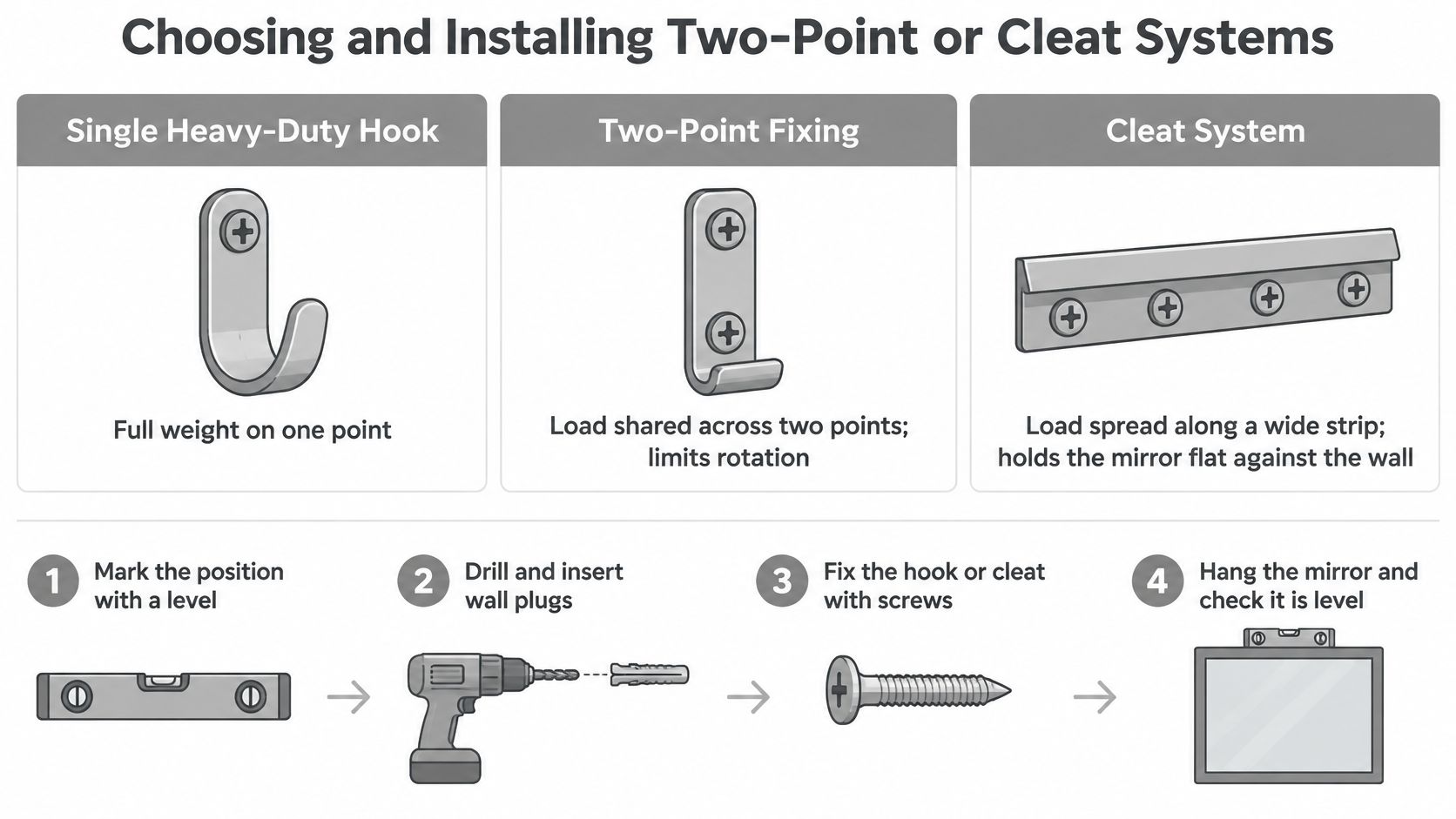
Now the conservative field guideline, which is worth more than any single product rating. Split the mirror's weight across two fixings, then use no more than half of each fixing's published maximum. The Hello Services guide to hanging mirrors and artwork puts it in worked terms: a 16 kg mirror nominally loads each of two fixings at 8 kg, yet the hardware should be rated to at least 16 kg per fixing before you apply that reduction. The point is tolerance for uneven weight, imperfect levelling, installation slop and the odd knock.
A cleat earns its keep when the wall is inspected first. Pull-out forces differ materially from simple downward shear, and damaged drywall, weak plaster, oversized holes or an anchor sitting outside its specified grip range will undo good hardware in a season.
Here's the sequence in practice, with a two-minute tug test at the end.
Mark positions and a level line. Set stud or anchor centres and draw the level line before any drilling, so a mistake costs pencil, not plaster.
Pre-drill pilot holes sized to the anchor. Never larger. An oversized hole is the quietest way to lose half an anchor's grip.
Set each anchor to its specified embedment. Stop at the depth the maker states, because overdriving crushes the very material the anchor is biting into.
Fix the hook or rail with every anchor inside its grip range. One anchor sitting in a hollow pocket drags the whole rail's capacity down.
Lift the mirror on and check level and clearance. Doors, furniture and drawer fronts all move, so leave room for them to.
Press gently outward on the top edge. Movement, ticking or a soft creak means something is loose, and it won't tighten itself.
Record the date, weight, wall type and fixing details. Two minutes now saves an afternoon of guesswork later.
Don't drill into damaged drywall, and never reuse an anchor that has already carried a load, since its grip is spent. The Wickes guide to hanging a mirror makes the same point about record-keeping: wall type, hardware, measured weight, fixing points and inspection date belong in a note attached to the building, not in your memory. Our own picture hanging cleat guide goes deeper on rail sizing if you're hanging something wide.
Restraint, Glass Safety and Calling a Professional
A hook rated for 100 lb makes one link in a chain strong. The load path still runs through the wall, the anchor, the fixings on the frame and whatever stops the mirror moving once it is up, and any of those links can fail someone without the hook ever reaching its limit.
Leaning mirrors are the clearest example. A mirror that stands on the floor and rests against the wall needs a safety strap anchoring its top to a stud, because a door slam, a vacuum cable or a child leaning on it converts a decorative object into a falling slab. Wire deserves similar suspicion: it stretches and shifts under sustained load, so it should never be the only support for a heavy piece. D-rings on two hooks, or a cleat, keep the geometry fixed.
Frameless mirrors need different hardware again. There is no frame to carry fixings, so the load has to reach clips that bear on the glass edge, a concealed rail, or an edge channel made for glass. A shatter-resistant safety film applied to the back reduces the chance of dangerous fragments if the glass does break.
Where failure costs more than a mirror
Some locations raise the stakes far beyond the price of the glass.
A lobby in a busy corridor: foot traffic and trolleys mean impact is a matter of when, so concealed restraints or a strap are standard practice.
A mirror beside a swinging door: check the door's full arc before drilling, then add a strap so a strike moves the mirror rather than dropping it.
A gallery wall: visitors brush past and lean in, so fixings stay rated and the mirror stays tethered.
A home with young children: anti-tip restraint stops a pull becoming a fall, and glass film limits what breaks.
The habit that catches problems early: once a year, put a hand on the top edge of every heavy mirror in the house and press gently outward.
The install-or-call decision
Do it yourself for a standard home mirror when you have confirmed the complete weight, identified the wall, chosen fixings with reserve capacity and applied restraint. Call a professional for anything over 50 lb, for plaster or unidentified walls, for public or commercial spaces, and for high placements where a ladder and a second pair of hands are not enough.
Colorado Art Services has spent over 15 years hanging pictures and handling art across the greater Denver metro, and the company offers a free estimate for its art hanging, display and installation services. That gives you a professional view of what your wall and mirror need before you commit to drilling.
A mirror that heavy deserves more than a packet with a confident label on it. Colorado Art Services handles mirror hanging, heavy piece hanging and high placement across Denver and the Front Range. Visit Colorado Art Services to arrange a free estimate.
Comments