


Sculpture and Installation: A Practical Placement Guide
The crate is open on the lobby floor, the delivery crew has folded its blankets, and a stone torso is leaning against the wall exactly where they set it down. Someone asks the obvious question. Where does it go?
That sounds like a design decision. It's a weight and stability decision first, and the answer changes what hardware you buy, who you call, and how many people it takes to move the piece one more time without damage.
What follows is the order a careful installer works in. Understand what the object physically is, check the conditions where it will sit, choose a mounting method that fits the type, then settle materials, movement and access, and only then decide whether this is a job for you and a helper or for a crew. Each step constrains the next one, which is why jumping straight to the drill is how most damage happens.
What Sculpture Installation Covers and Why It Matters
Sculpture installation is the planning, mounting, leveling and securing of three-dimensional work so it stays stable, stays safe and reads the way the artist intended. A framed painting hangs from a wire and pushes down through two hooks. A sculpture carries its own weight down through a base, occupies floor area, and depends entirely on whatever sits underneath it. Bring a wall-hanging mindset to a three-dimensional piece and you'll spend the afternoon solving problems you created before you opened the toolbox.
Every installation comes down to four decisions, whether the piece is a six-inch ceramic figure or a two-ton outdoor work. Where does it sit? What does it rest on or hang from? How is it secured? Who moves it?
The four decisions: placement, support, restraint and handling. Fixings are just the last item on that list, which is why they come last.
This isn't a niche activity. In the Art Basel and UBS Survey of Global Collecting 2025, 56% of surveyed collectors who had bought fine art reported buying sculpture during 2024 or the first half of 2025, and sculpture carried a 14% share of total expenditure. Pieces that occupy floors and plinths need spatial planning in a way that wall art doesn't.
Homeowners, office facilities teams, galleries and developers all run into the same questions, so treat this as routine planning rather than a specialist trade you can't approach. If you're still deciding what should go where, these sculpture display ideas help you narrow the options before anyone lifts anything. Public-facing sites do this constantly. A winery placing a work along the path to its caves, the way visitors book tasting reservations in Calistoga before a tour, is designing a route as much as a display.
Start with the placement checks, because they decide everything that follows.
Plan Placement, Weight and Stability Before You Mount
A tall bronze figure on a narrow plinth in a lobby is the classic failure case. The artwork is sound. The plinth is sound. Together they put the center of gravity high enough that a shoulder brushing the piece, a delivery cart rolling past, or a visitor leaning in for a closer look can start a rocking motion the base cannot absorb.
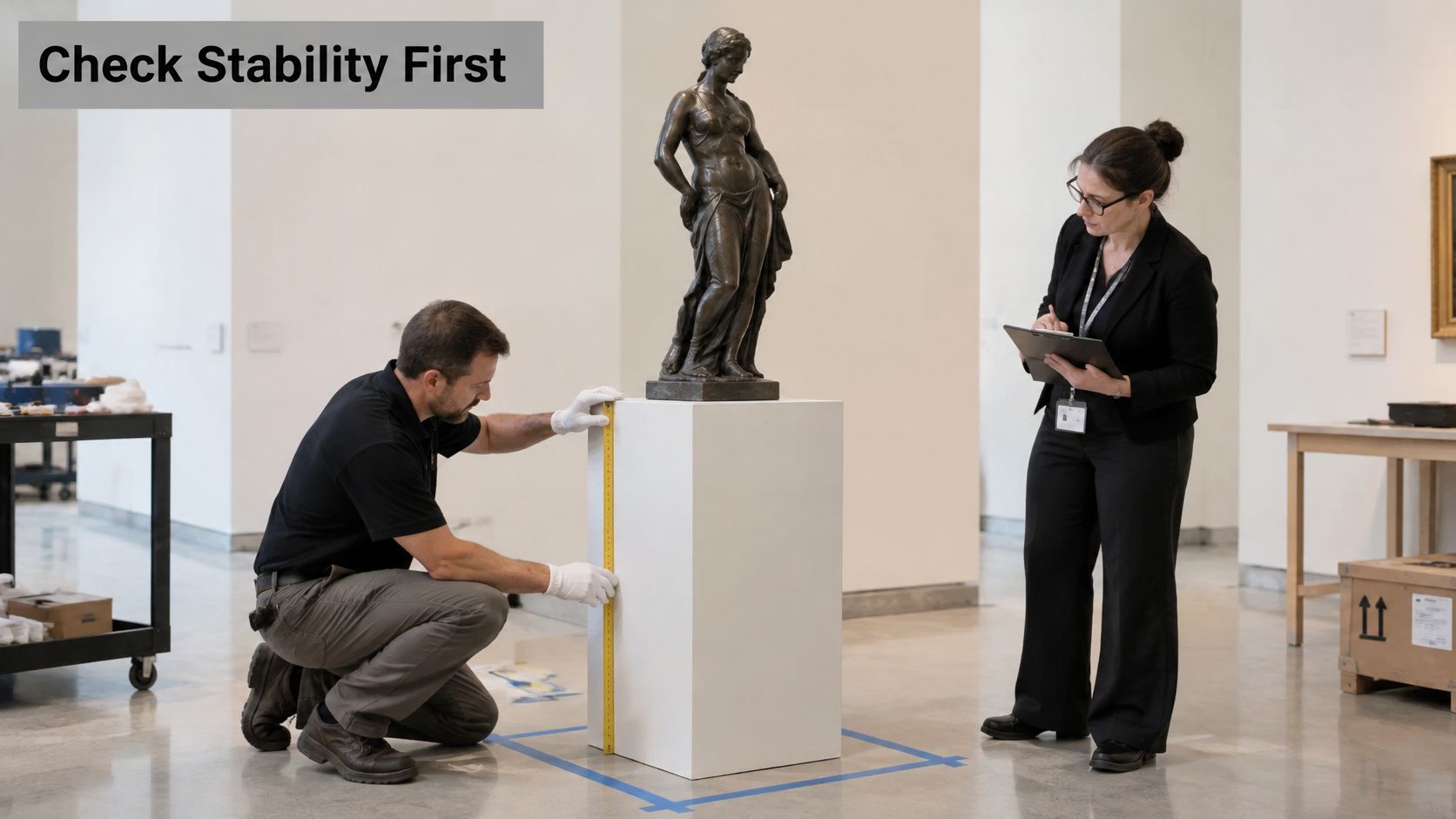
Stability comes from the combined mass of the sculpture and its pedestal, never the sculpture alone. A plinth works like a stance: feet close together feel fine until something pushes from the side, while a wider base gives the mass somewhere to resist. Work out where that combined center of gravity sits before you fix anything, and you will know whether the piece is safe on the base you have or needs a different one.
The three levers that keep a piece upright
Seismic mitigation guidance for museum collections describes three practical levers. First, lower the center of gravity by adding mass to the lower portion of the display assembly. Second, increase the effective base-to-height ratio by widening the footprint. Third, secure the object firmly to the floor, pedestal, shelf, wall or purpose-built mount.
On the lobby bronze, that translates to a wider plinth with weight concealed in its interior. Rocking, sliding, uplift and overturning all drop sharply once the base is wider than the piece is top-heavy. That is the whole stability problem: give the mass a broader, lower path back to the floor.
Material strength is the other half of the calculation. The same seismic mitigation guidance for museum collections calls a safety factor of three good practice, meaning a mount's rated capacity should generally exceed the expected design load by at least three times. A bracket rated for 50 pounds carries a 15-pound piece comfortably; it does not carry a 40-pound one.
Careful installers differ from confident ones in one place: where the restraint force lands. Any strap, clamp or brace must be engineered so it does not push load into a weak or brittle part of the artwork. A strap that holds a marble torso steady by squeezing a thin carved arm has moved the failure, not prevented it.
Placement deserves the same rigor as the mount. Verify floor and wall capacity, then check sightlines from the door, the desk and the seating area. Confirm lighting does not throw the piece into silhouette, keep traffic clearance around anything people might brush, and move the work away from heating vents and direct sun. Outdoors, ground preparation is ordinary site work with a heavier consequence: compact the soil, give water a path away, and only then set the footing. The same homeowner logic behind learning to prep a side yard for rock applies here, with the difference that a sculpture load concentrates on a much smaller footprint.
Before anyone drills, have these four answers written down:
Combined center of gravity: calculated for sculpture plus pedestal, not guessed.
Likely failure modes: rocking, sliding, pull-out, tip-over, or crushing at a contact point.
Floor and wall capacity: confirmed for the actual load, including the pedestal.
Reversibility: restraints chosen so the piece can be removed later without repair work.
Match the Mounting Method to Each Sculpture Type
Use this as your quick reference. The rows run from lowest risk to highest, and the last column tells you where a DIY job stops.
Sculpture type | Typical mounting method | Main risk | Who should install |
|---|---|---|---|
Tabletop or small bronze | Felt-padded base or reversible fixing to shelf or plinth | Tipping and knocks | Owner with a helper |
Freestanding floor piece on plinth | Anchored pedestal with counterweighted base | Overturning and rocking | Professional installer |
Wall-mounted relief or panel | French cleat or engineered bracket into rated wall anchors | Pull-out from wall and uneven load | Professional installer for heavy pieces |
Suspended or hanging work | Overhead rigging with rated hardware | Structural overload and swing | Engineer with installer |
Large outdoor monumental piece | Footings, anchor bolts and crane lift | Wind, ground movement and theft | Specialist rigging crew |
Interactive or powered piece | Mount planned with power and network routing | Electrical and data failure | Installer working with an electrician |
Small bronzes and tabletop pieces are the forgiving end. A felt pad protects the base, a reversible fixing keeps the piece from sliding off a shelf, and one careful person can usually set it. The risk isn't structural, it's a sleeve catching an edge.
A freestanding floor piece on a plinth is a different animal because the plinth has to be anchored and its interior counterweighted. Owners who anchor the sculpture but not the pedestal have secured the wrong half of the assembly.
Wall-mounted reliefs and panels live or die on the wall behind them. A French cleat spreads load beautifully when it's fixed into anchors rated for that load, and disastrously when it isn't. Anything heavy belongs with an installer who will open the wall and look.
Suspended work moves the question overhead. Rated hardware, a known attachment point, and an engineer's sign-off whenever the structure is in doubt. Swing is a real force, not a decorative effect.
Outdoor monumental pieces need footings, anchor bolts and a rigging crew with a crane. Wind load, ground movement and theft all belong in the plan.
Interactive and powered pieces should be mounted as part of the same conversation as power and network routing, not before it.
Three rules apply to every row. Weigh the piece before you lift it, since a guess that's off by half is how backs and artworks both get hurt. Choose the reversible option whenever the owner may move the work later. Photograph the hardware before the piece covers it, because the next person to touch this will need to know what's underneath.
Pick Materials and Finishes That Handle Installation
The same mount can serve two completely different objects, and the material decides how the piece has to be touched.
Material | Main handling risk | Handling note |
|---|---|---|
Stone such as marble or granite | Heavy and chips at edges | Two-person lift with padded straps |
Ceramic | Brittle, hairline cracks under point loads | Isolate from vibration and avoid point contact |
Thin metal | Dents and fatigue at joints | Support the full panel, not the edges |
Bronze | Heavy and patina scratches easily | Soft slings and non-abrasive pads |
Wood | Moisture change causes warping | Keep steady indoor humidity during and after install |
Mixed media | Dissimilar materials expand at different rates and joints fail | Document each joint before any move |
Stone rewards patience. Marble and granite take a two-person lift with padded straps under the mass, never a hand under an overhanging edge where a chip becomes a gouge.
Ceramic punishes concentration. Point loads and vibration are what crack it, so the piece needs full support along its base and isolation from the floor it sits on.
Thin metal fails at joints, not in the middle of a panel. Dents and fatigue start where the sheet meets a weld or a fold, which is why you support the full panel instead of grabbing an edge.
Bronze is heavy and its patina is a surface, not a coating. Soft slings, non-abrasive pads, and no wiping with anything you haven't checked against the finish.
Wood moves with the room. A piece installed in a dry winter showroom and then moved to a humid space can warp or split at a glued joint, so hold indoor humidity steady through and after installation.
Mixed media is the hardest category because dissimilar materials expand at different rates. Adhesive joints that held in the studio can fail when temperature swings.
Finishes carry the same risk. Conservation guidance recommends contact materials that are stable, non-abrasive, non-corrosive and non-staining, fitted over broad contact areas so pressure spreads rather than concentrates in one spot. Lacquer, wax and patina all mark when something rubs them, and foam or tape that off-gasses can leave a stain you can't reverse.
Ask the artist or owner three things before you touch a piece:
What detaches? Loose elements, removable bases, and accessories that ship separately.
What must not be touched? The surface, the finish, or a repaired area with a known history.
Which finish is on it? Patina, lacquer, wax, raw metal, or sealed stone.
A material's weakest point, not its overall weight, decides how it gets lifted.
How to Move and Set a Sculpture Step by Step
Most transit damage never announces itself. A sculpture arrives looking intact, and the crack that opened somewhere on the road only shows up at the condition check. The Georgia O'Keeffe Museum's account of moving its collection describes how vehicle vibration reaches artworks across a broad frequency range, and repeated low-amplitude vibration loosens joints and widens existing cracks even when no single bump looks serious. It is like fatigue in a paperclip: one bend does nothing, a hundred small bends snap it.
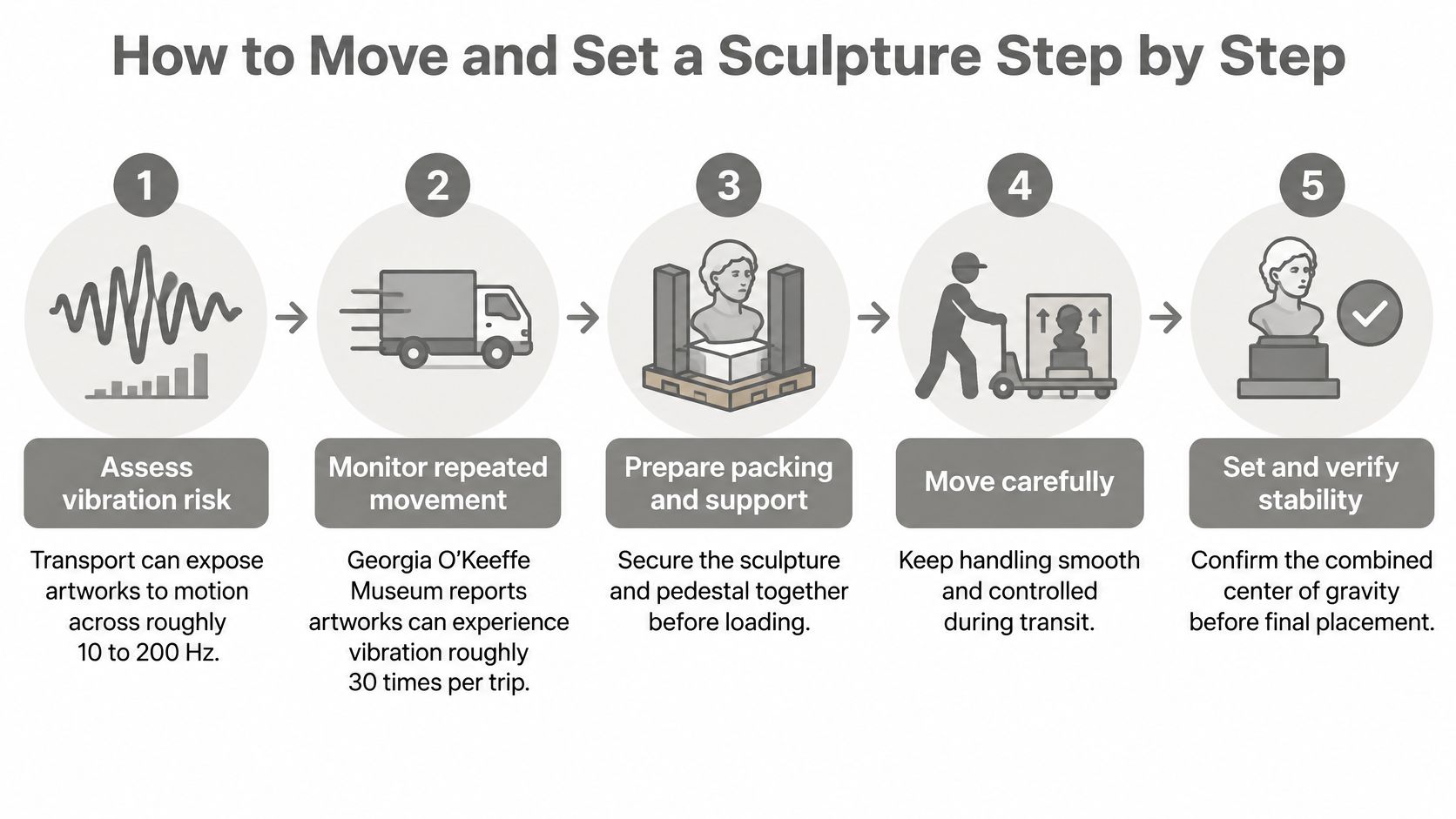
Photograph and record the condition before the piece moves. Every face, every joint, every existing chip with a scale reference. The common slip is skipping the record for a move you expect to take ten minutes, which leaves you with no way to prove where a new crack came from.
Immobilize detachable parts. Pad and tape loose elements so they can't shift inside the assembly. Anything that can swing will swing, and it will find the most fragile surface in the crate.
Cushion the piece inside the crate, or use suspension transport for fragile work. A hard crate transmits every bump straight into the object. Compatible foam, padding or a suspended platform interrupts that path.
Lift only at the designed points with rated slings. Lifting by an arm, an edge or a protruding element is the single most common cause of breakage during handling. If you can't identify the load path, stop and ask.
Set the piece on a prepared base, then check level and restraints. The base is leveled before the sculpture arrives. Confirm the piece sits flat, the restraints engage as designed, and nothing rocks when you press a corner gently.
Inspect joints and fracture lines on arrival. Compare against the photographs from step one. Monitoring should focus on the object, since its mass distribution, resonance and pedestal connection determine how much of the vehicle's vibration reaches it.
Steps three through five share one logic: the sculpture's own weight decides how it travels, where it can be held, and what it lands on. Get the load path wrong at any stage and the damage is done before the piece reaches its plinth.
A homeowner with a helper can handle steps one, two and six on a small, stable piece, and can usually manage step three with proper packing materials. Steps four and five on anything the two of you can't comfortably lift belong to a professional crew, and for large or top-heavy work the setting step belongs to someone who does it weekly. Colorado Art Services offers local art moving and pickup and delivery for exactly that gap between a careful pair of hands and a rigging team, and what art in hand really involves is worth reading before you decide which side of that line you're on.
Plan Access, Lighting and Interactive Parts Early
Access is a placement decision, not a retrofit. The Henry Moore Institute's 2025 Beyond the Visual exhibition put blind and partially sighted practitioners at the center of curatorial decisions and designed sculpture for touch, sound, movement and spatial awareness. The research around it found that access is too often treated as an add-on, and that multisensory engagement improves appreciation for everyone, a concept the exhibition describes as "blindness gain."
That reframes questions most installation plans never ask. How do plinth height, clearance, lighting, tactile boundaries, seating and circulation work together? When is touch appropriate, and when should a fragile piece offer a tactile surrogate beside it instead?
Test before you fix. Walk the sightlines and reach ranges with disabled users while the piece is still movable, not after the anchors are set.
Lighting deserves the same scrutiny. A raking spotlight that flatters a textured bronze can blind someone approaching it, and a piece lit from below reads as a silhouette from a wheelchair. Place seating where people can rest and still see the work.
When the sculpture has a power cable
Interactive and environmental works add operational questions that hardware checklists miss. Who owns sensor calibration and software maintenance once the piece is installed? How do power, networking, heat, humidity and visitor interaction affect where it can sit? What happens when a light, a projection or a live data feed fails on a Saturday?
Answer those before you drill. Build in a fallback mode so the piece still reads as complete when the data stops. Keep the mount reversible, because connected works need recalibration, component replacement and sometimes seasonal relocation. Leave maintenance access that doesn't require moving the artwork.
Access checks: plinth height, tactile boundary, sightline from seated height, reach range, seating, circulation width.
Interactive checks: power route, network route, heat clearance, maintenance access, fallback mode, owner of software upkeep.
The safest installation isn't always the most permanent one.
Decide Whether to Hire a Professional Installer
The decision rests on weight, stability, the surface you're fixing into and the tools the job needs. It doesn't rest on how confident you feel.
Situation | Why It Matters | Recommendation |
|---|---|---|
Heavy or top-heavy piece | Overturn risk and floor load | Hire a professional installer |
Work needs ladders, scaffolding or a lift | Fall risk | Hire a professional installer |
Drilling into concrete or masonry | Anchor failure under load | Hire a professional installer |
Small, light piece on existing hardware | Low risk if earlier checks pass | Owner can install with a helper |
Institutional loan or insured work | Documented handling and condition reports | Hire a professional handler |
A heavy or top-heavy piece carries overturn risk and needs a floor-load check, which is a two-person question at minimum. Ladders, scaffolding and lifts bring fall risk into a job where you're also holding something irreplaceable. Concrete and masonry drilling demands anchors rated for the load you calculated, and a hole in the wrong place is permanent.
Small, light pieces on hardware that's already proven itself are a reasonable DIY job, provided the placement checks pass. Institutional loans and insured works usually require documented handling and condition reports, which is a paperwork obligation as much as a physical one.
Before you call anyone, have four answers ready. Count how many pieces need installing, note whether ladders or scaffolding are required, say whether the install needs drilling into hard surfaces, and measure the largest piece. Those are exactly the questions Colorado Art Services asks on its contact form, and having them ready turns a vague enquiry into a real estimate. The company offers a free estimate for art hanging, display and installation work from its Lakewood base, serving the Denver Metro area and Front Range, and you can call for a quote or to talk through your project. When a job is complicated, what art installation experts actually do helps you judge what you're paying for. Piano movers work the same way with awkward, heavy objects that can't be tipped, and specialist piano removal in London shows how much planning goes into a single object that resists being carried.
Keep the photographs and condition record from the move. They're the first thing anyone will ask for if something looks different later.
Colorado Art Services handles sculpture placement, heavy-piece mounting and full installation across the Denver Metro area and Front Range, from a single bronze on a plinth to a building-wide gallery layout. If you're weighing combined center of gravity, floor capacity, rigging or lighting before a piece goes in, the team can plan the placement and set it safely. Visit Colorado Art Services for a free estimate and to talk through your project.
Comments