


8 Mirror Hanging Ideas for Every Room and Wall
Wall mirrors are not a minor accessory. DataIntelo put the global mirrors market at $13.63 billion in 2025, and wall mirrors alone accounted for 38.5% of global market value that year. Nearly all of that glass ends up held to a wall by two or three small holes somebody drilled.
That's where placement decides everything. The same 36-inch round mirror can make a narrow hallway feel twice its width or make a low ceiling feel like it's pressing down, and the difference is height, reflection, and whether the hardware is right.
Hanging a mirror is a design decision and an installation job at the same time. You can pick a perfect spot and ruin it with a plastic anchor that pulls out of half-inch drywall. You can also hang it beautifully and put it where it reflects a tangle of cords and a bare bulb.
Settle the lighting early, because sconce placement beside the mirror controls whether the glass bounces useful light into the room or throws glare back at the person standing in front of it.
The eight approaches below cover both halves of the job. Each one comes with the sizing rule, the hardware that holds, and the mistake that ruins the placement.
1. Symmetrical Mirror Pairs Flanking a Sofa or Bed
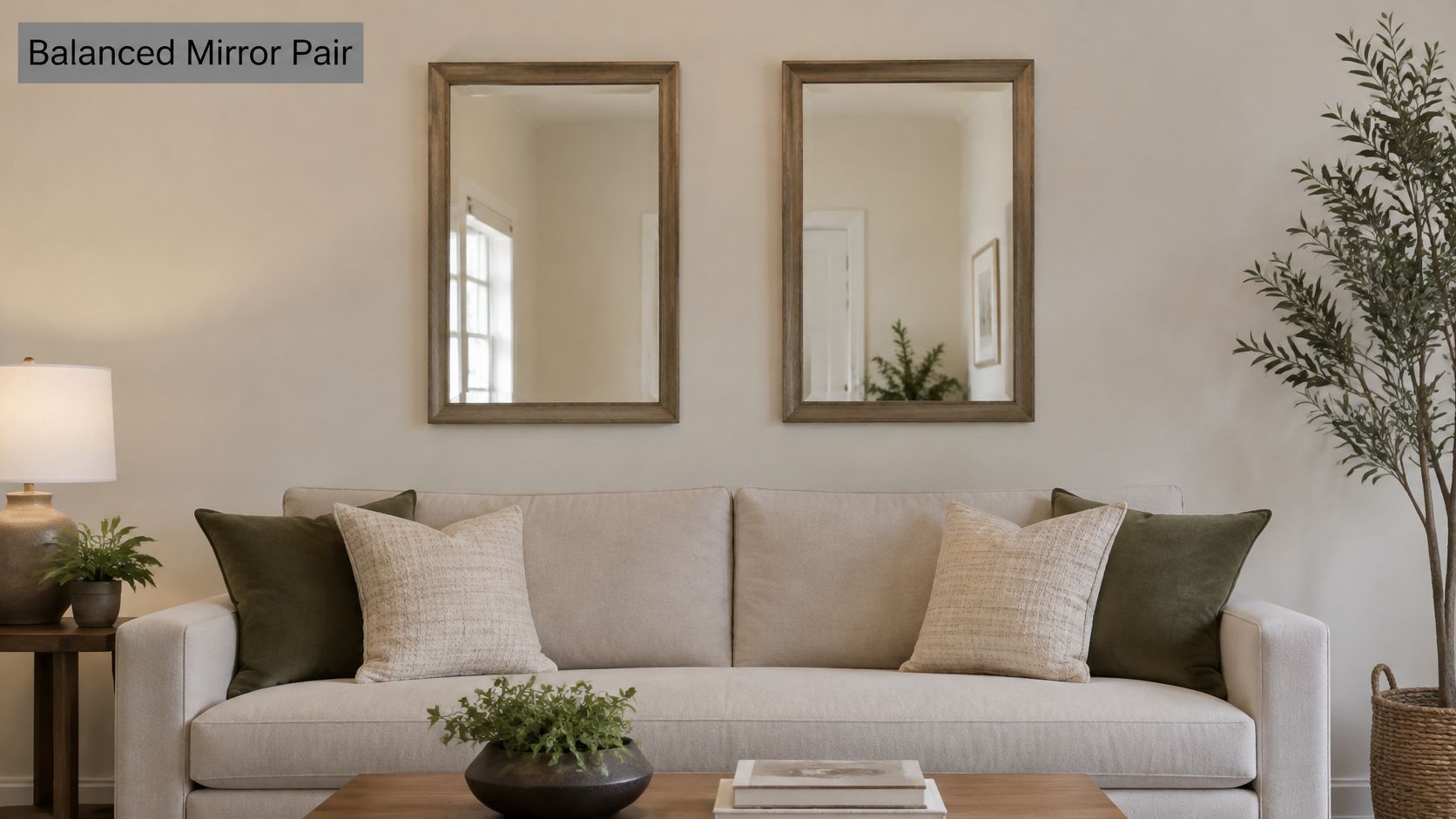
Two matching mirrors hung at equal distances either side of a sofa, bed, or console outperform one bigger mirror in most rooms. The pair frames the furniture, adds formal balance, and gives a long wall visual weight without a single dominant object. Boutique hotel rooms use the layout constantly because it reads as deliberate from every seat.
Measure From the Furniture Centerline
Find the centerline of the sofa or headboard first, not the wall. Mark it in pencil, check it with a level, then measure outward in both directions by the same number. When a sofa sits off-center under a window or a beam, the mirrors follow the sofa.
Set the bottom edge of each frame 6 to 10 inches above the top of the furniture. Closer crowds the sofa back. Higher and the mirrors float away from the grouping.
Two hooks per mirror. One hook lets a frame rotate out of level within weeks, especially near a door. Space two hooks about a third of the frame width apart on the same horizontal line.
Match frame widths exactly. A half-inch difference between mirrors that sit six feet apart is visible from across the room.
Size hardware to weight. A fastener capacity guide from Albany County Fasteners puts plastic expansion anchors at roughly 10 to 25 lb and toggle bolts at 50 to 100+ lb, and notes that a 40 to 75 lb mirror on standard half-inch drywall generally needs two heavy-duty toggles, two stud connections, or a load-spreading cleat.
Say two 24 by 36 inch mirrors go over an 84 inch sofa. The centerline lands at 42 inches, each mirror starts 12 inches out from it, and each hangs from two toggles set in the same stud bay.
Practical rule: If a mirror costs more than the drill bit you're using, give it two fasteners.
Height, reflection, and furniture layout interact more than many expect. This guide to mirror placement in a living room covers the rest of the logic.
2. Oversized Statement Mirror Over a Console or Fireplace
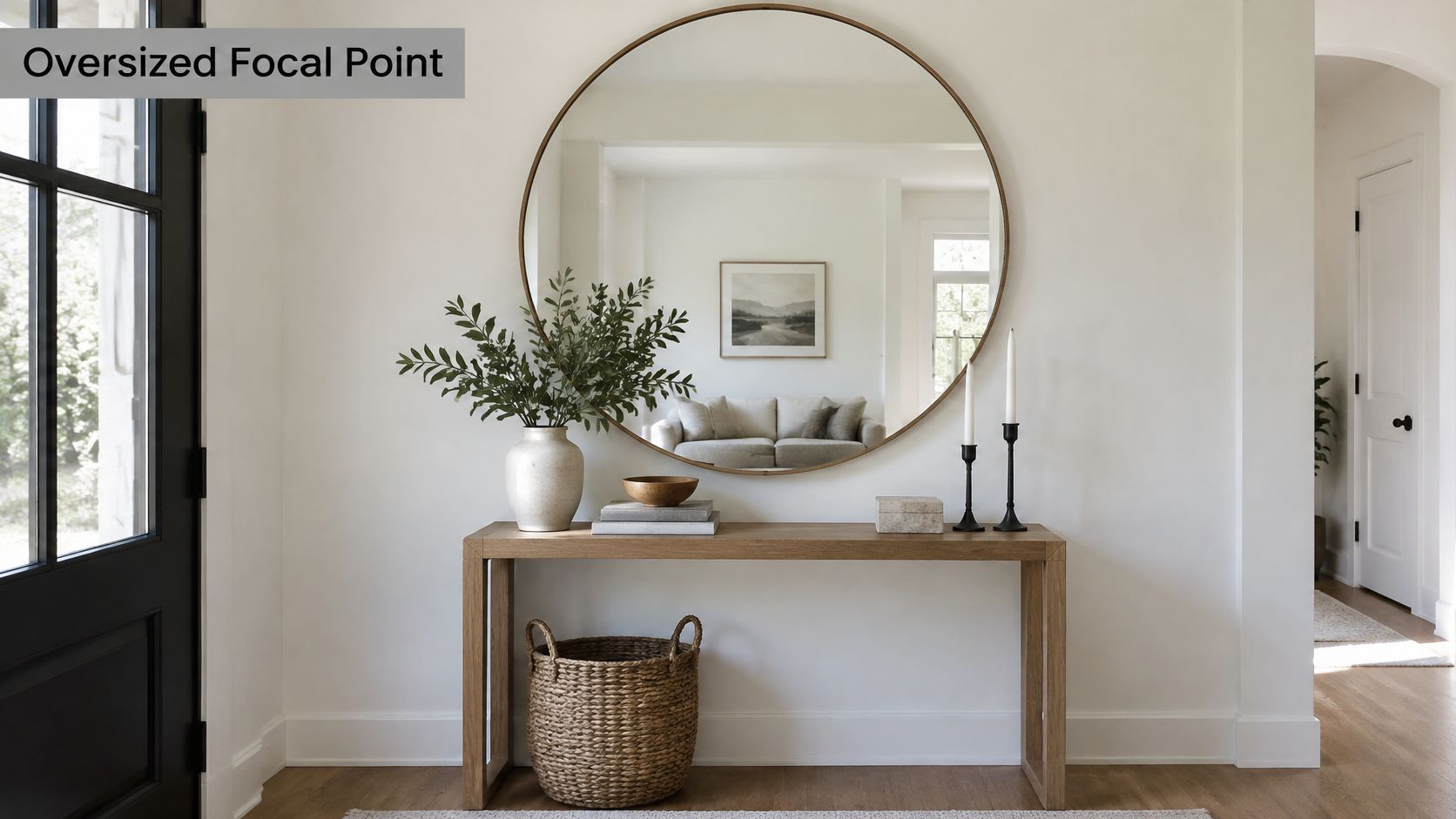
A long wall with a four-foot console under it wants one big mirror, not three small ones. A single oversized piece above a console, sideboard, or mantel anchors the wall and doubles the surface beneath it, which is why entryways, dining rooms, and hotel lounges keep coming back to it.
Where the Top Edge Goes
Center the mirror on the console or mantel, then set the top edge 8 to 10 inches above the furniture. On a fireplace, measure from the mantel shelf, not the firebox, and check that the bottom of the frame clears the mantel's projection so nothing tips forward when someone leans on it.
Hanging a mirror above a mantel is an old habit. The recorded history of mirrors traces large flat glass to Renaissance Venetian makers, and by the 16th century mirrors had become architectural features placed above mantels and built into furniture. The physics haven't changed. The glass is heavier now.
Mirror-rated D-rings or a French cleat for anything over about 15 lb. A picture wire on a heavy frame will bow and eventually slip off the hook.
Safety backing film on large panels, especially in homes with children, pets, or a bench under the mirror.
Studs where you can get them. Drywall toggles are the fallback, not the plan.
A 42 by 72 inch arched mirror is a two-person lift, and its hanging weight puts it in cleat territory rather than hook territory.
A statement mirror is a structural decision wearing a decorative frame.
This guide to heavy-duty mirror hooks covers anchor selection for pieces at this scale.
3. Salon-Style Mirror Cluster or Gallery Arrangement
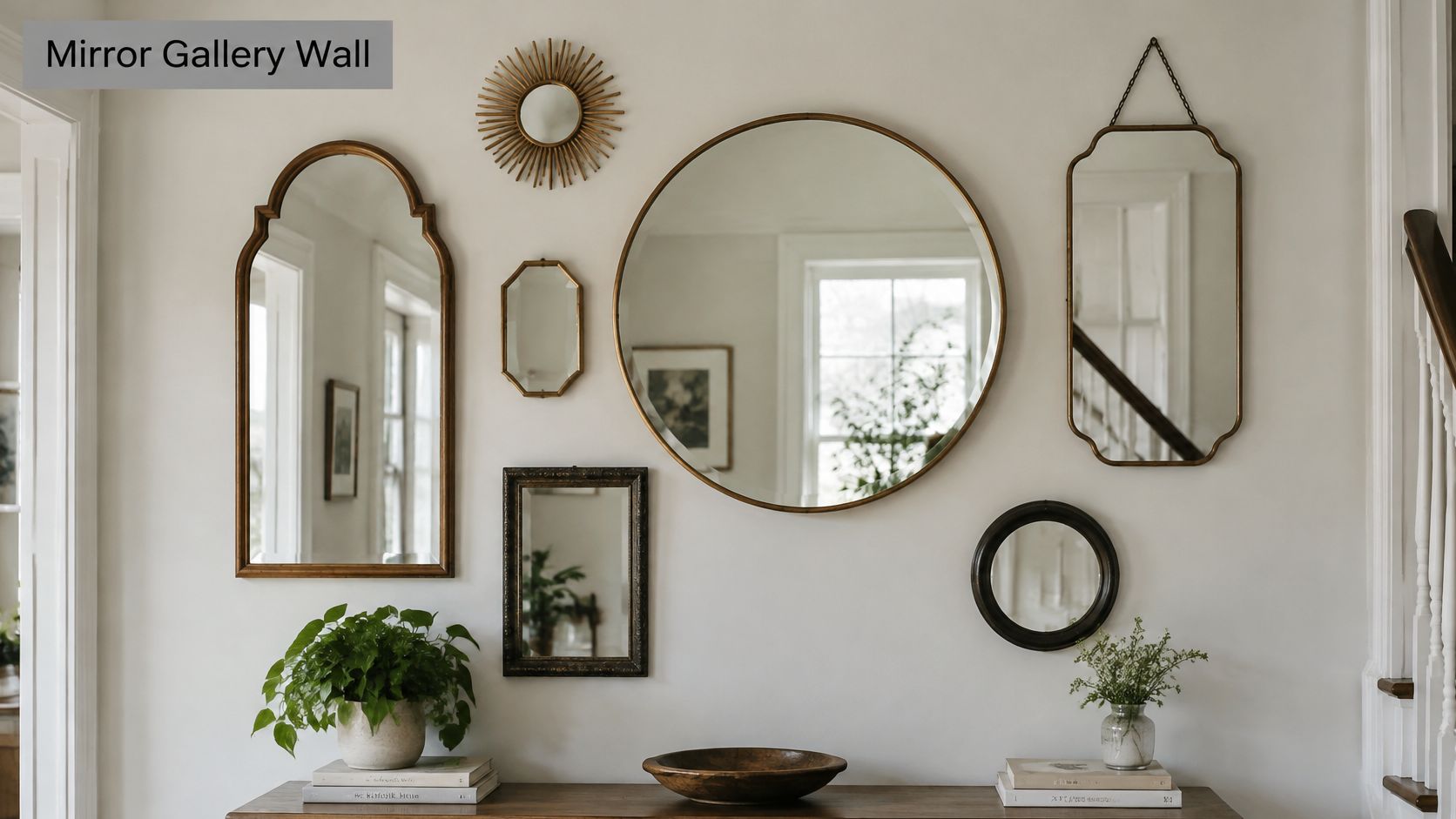
A mirror cluster can fill a long hallway, a stair wall, or the space above a low sofa. Varied shapes and frames create a collected look, while each pane reflects a different part of the room. The trade-off is more measuring and more attachment points than a single mirror requires.
Template First, Drill Second
Arrange the mirrors on the floor, or cut paper templates and tape them to the wall. Step back to check the overall shape, then mark each hanging point before drilling.
Start with the largest mirror, slightly off-center, and build the arrangement around it.
Limit the frames to two or three finishes. Brass, black, and raw wood can sit together without making the wall feel scattered.
Leave 2 to 3 inches between frames. That spacing keeps each mirror distinct and leaves room to clean around them.
Keep the smallest pieces near eye level and build outward, checking that the cluster reads as one arrangement.
Use hardware suited to each mirror's weight and hanging method. A wall full of separate hooks can drift out of level if you measure each piece from the floor; use the templates to align the gaps and confirm each mirror is level as you install it. For a tall wall with smaller mirrors, the Farmhouse World decor sizing guide offers another reference for judging scale.
4. Leaning Floor Mirror with Wall Anchoring
A leaning mirror is the fastest way to fill an empty corner, and the easiest tall object in a house to knock over. Every leaning mirror needs a strap or bracket at the top, including the heavy ones. The angle that makes them look casual is the same angle that lets them fall forward.
Anchor It, Then Style It
Lean the mirror at 5 to 10 degrees and fix the top of the frame to the wall with a furniture anchor strap or a wall bracket screwed into a stud. Leave a little slack so the mirror still rests on its own base, and put a rubber pad or anti-slip strip under the bottom edge so it doesn't creep across a wood floor. Keep the piece out of walkways, door swings, and the overnight path between a bed and a bathroom.
Height matters more than many assume for a full-length mirror. A design guide from Homestyler recommends a center point around 58 to 62 inches, with 8 to 12 inches of floor clearance for full-body visibility and 18 to 24 inches of clear space in front of a dressing mirror.
Those numbers can conflict in a shared bedroom or hotel room where a child and an adult use the same glass. When they do, favor the shorter viewer's line of sight and move the piece along the wall rather than raising the mirror.
A leaning mirror without a strap is a shelf of glass waiting for a vacuum cord.
5. Mirror Placed Opposite a Window for Natural Light Reflection
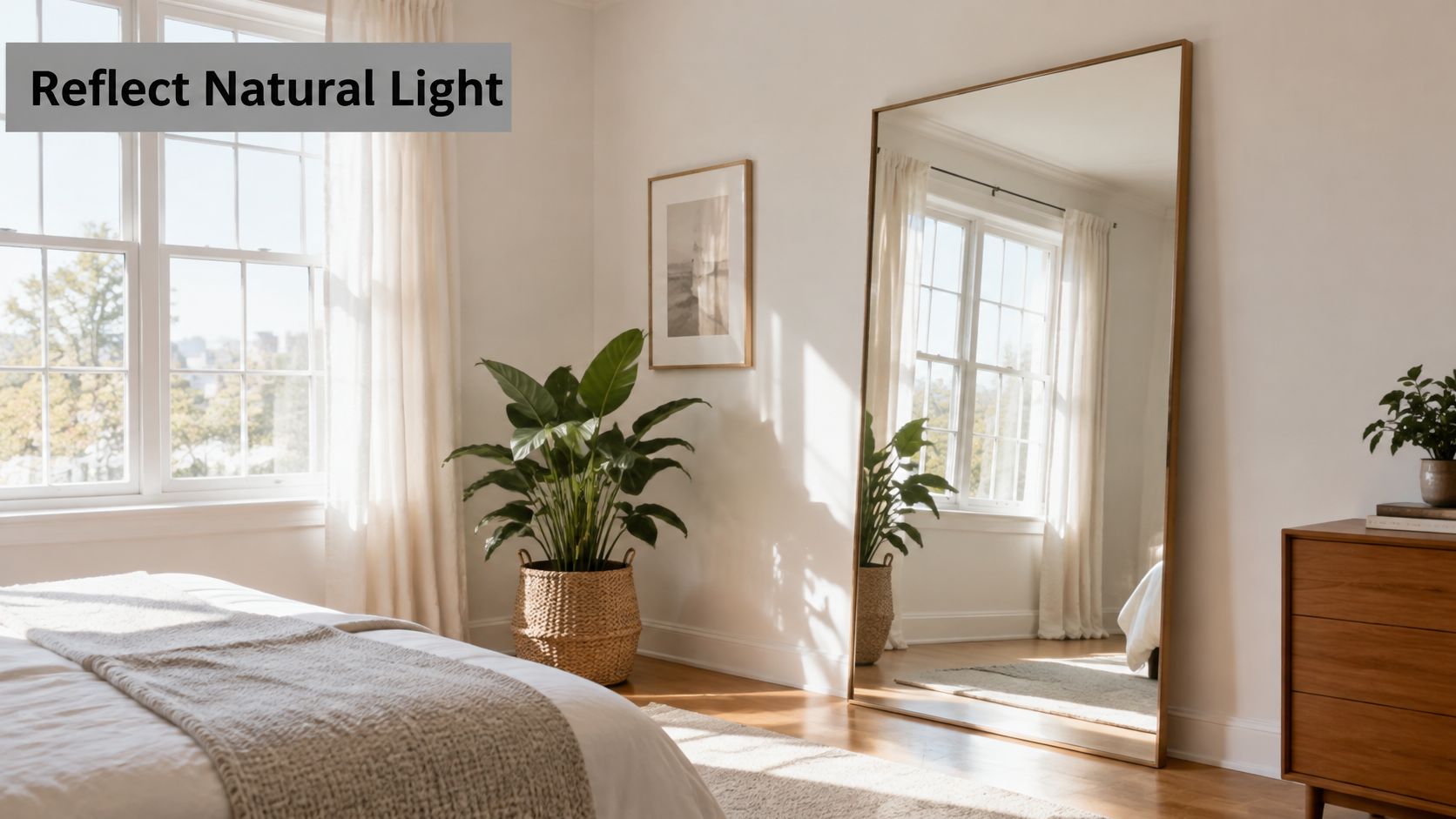
Opposite a window, a mirror reads as a second window. In a north-facing living room or a narrow hallway, that's the cheapest way to push daylight deeper into the plan, and it costs nothing to run afterward.
Test the Reflection at Three Times of Day
Stand where people sit at 8 a.m., noon, and late afternoon. The reflection changes completely across those hours, and a mirror that's beautiful at nine can be unusable at two.
Direct midday sun on the glass produces glare strong enough to wash out the wall opposite, and it puts heat on whatever hangs nearby, including artwork.
Slight downward tilt throws light onto the floor and away from eyes.
Slight upward tilt bounces light off the ceiling, which lifts a dark room but can look theatrical in a small one.
Clear the surface opposite. A mirror across from a window also reflects the console beneath it, the stack of mail on that console, and the cords behind the lamp. Editing that view is half the job.
The mirror doesn't brighten a room by itself. It brightens the room by repeating something worth looking at.
The same rule holds in offices and lobbies facing glazed walls, though there the calculation also includes sightlines and privacy, which changes where the glass can legally go.
6. Arched or Sunburst Mirror Hanging
An arched or sunburst mirror is decorative first and functional second, and it should be hung that way. The curved silhouette softens a room full of right angles, fills the space above a doorway that a rectangle can't, and gives a mantel something other than another framed print.
Leveling a Shape With No Straight Edges
You can't line up a curve with a level held against the frame. Work from the bounding box instead: mark the center of the rectangle the mirror's outer edges would form, and hang from that center point. Then confirm the piece against something straight and architectural, such as a door casing, mantel edge, or ceiling line, using a laser level across the wall.
Two D-rings and a wire only if the frame is rated for them. A wide sunburst on a thin frame concentrates load at two screw holes.
A French cleat on a heavy arch spreads the load and holds the piece flat against the wall.
Warm sconces on each side pick up the texture in a distressed or gilded finish.
Lighting has become part of the mirror purchase itself. Houzz reported in 2024 that LED lighting was the most common upgraded mirror feature, chosen by 21% of renovating homeowners, followed by anti-fog systems at 20%. If your arched mirror carries no integrated light, a pair of sconces does similar work.
7. Full-Wall Mirror Panels Installed with Z-Clips
Full-wall mirror work turns up in gyms, dance studios, retail floors, and the occasional modern living room. It's the one item here where the wall matters more than the frame. Z-clips and mirror mounting clips hold the glass slightly off the wall, which lets air move behind it and keeps the silvering away from trapped moisture.
Confirm the Load Path Before You Buy Clips
The U.S. National Park Service guidance on using objects in exhibits makes the point that applies directly here. The fastener has to support the framed object, and the wall, ceiling, or floor has to be able to accommodate and transfer the added load. Mirror panels concentrate a lot of weight on a few clips.
Map the substrate first: drywall over framing, plywood sheathing, masonry, or metal studs. Then plan clips at the top and bottom edges, a continuous bottom channel, edge protection, and safety backing film across every panel. A consistent ventilation gap protects the backing from condensation.
Here's how a commercial panel run comes together on site.
8. Picture Rail or Cable Mirror Hanging System
In a house with original picture molding, a cable system solves a problem hooks can't. You can move the mirror without adding another hole, and the weight lands on the rail instead of on two screw holes in a hundred-year-old plaster wall.
What the Rail Has to Be Fastened To
A picture rail screwed into drywall alone is decoration. The rail needs blocking or studs behind it, and every hook and cable needs a rated load that exceeds the mirror's weight rather than matching it.
Level along the rail, not along the mirror. If the rail is out of level, hooks set at matching heights will still hang the glass crooked.
Neutral cable in steel or clear disappears against most paint colors. Bright brass hooks pull the eye to the hardware instead of the frame.
Two cables per mirror so the piece can't swing or rotate.
Galleries use rail and cable systems because a show can be rehung in a day. The same logic applies in a corporate lobby where art rotates every quarter and the mirror stays where it is.
Flexibility is worth paying for once, when the alternative is patching plaster every season.
This overview of cable hanging systems covers rated hardware and rail installation details.
8 Mirror Hanging Ideas at a Glance
Best Room | Installation Difficulty | Key Hardware | Best For |
|---|---|---|---|
Living room or bedroom; symmetrical mirror pair | Moderate; careful measuring and leveling | Two picture hooks per mirror or a level-based hanging system | Creating balance around a sofa, bed, or console |
Entryway, dining room, or living room; oversized statement mirror | Difficult; heavy mirror needs secure anchoring | Mirror-rated D-rings or French cleat; stud or masonry anchors | A dramatic focal point that reflects light |
Large wall, hallway, or stairway; mirror gallery arrangement | Moderate to difficult; multiple hanging points need precise planning | Picture hooks and paper templates | Filling a wall with a flexible, collected look |
Bedroom or dressing area; leaning floor mirror | Easy, with a required safety anchor | Furniture anchor strap or wall bracket | A relaxed full-length mirror that can be repositioned |
Dim room, narrow hallway, or office; mirror opposite a window | Moderate; placement depends on light and sightlines | Wall-mounting hardware suited to the mirror | Reflecting daylight to make a room feel brighter and larger |
Entryway, mantel, or above a doorway; arched or sunburst mirror | Moderate; irregular shapes need careful leveling | Suitable wall hooks and a laser level | Adding a decorative focal point and softening straight lines |
Gym, dance studio, or retail space; full-wall mirror panels | Difficult; precise installation and strong wall support required | Z-clips or mirror mounting clips; safety backing film | Covering a large wall with secure, replaceable mirror panels |
Historic home, gallery, or rental; picture rail or cable system | Moderate to difficult; rail installation may need professional help | Picture rail or ceiling track, rated cables, and adjustable hooks | Repositioning mirrors without repeatedly drilling into walls |
Hang It Once, Hang It Right
Every idea above fails the same way: a hole in the wrong place, a fastener that isn't rated for the load, or a frame that isn't restrained at the top. The design half is reversible. The install half usually isn't, at least not without patching, sanding, and repainting a section of wall you'll never match exactly.
Three checks catch most problems before the drill comes out. Weigh the mirror with the frame and any backing board, identify what's behind the drywall, and decide whether the piece needs one fastener or a system that spreads load across the wall. Then buy hardware for that combination, not for the mirror's size on a shelf tag.
Take the shared-room problem seriously too. A mirror that serves a standing adult and a seated child, or a wheelchair user approaching at an angle, needs its center point set for the shorter, closer viewer and enough clear floor space that nobody has to lean in. Visual alignment with nearby art or architecture comes after that, not before.
Heavy mirrors, full-wall panels, and rail-and-cable layouts reward professional installation. Colorado Art Services has handled picture hanging and art handling across the greater Denver area for more than 15 years, and mirror hanging, heavy-piece mounting, and high-placement work are part of the regular service list. Wall conditions and weight ratings get checked before anything goes up.
Leveling is a separate skill from lifting, and both matter on a framed piece. These tips for leveling picture frames apply to mirrors with frames worth protecting.
A free estimate takes the guesswork further. We confirm what the wall can hold, where the mirror should sit for the people who use the room, and which hardware gets it there, then install it level and restrained so it stays that way.
Mirror hanging, heavy-piece mounting, and high-placement installs are core work for Colorado Art Services, along with placement and layout planning for residential and commercial walls across the Denver Metro area and Front Range. Before you drill, send over the mirror's dimensions and your wall type for a free estimate, and we'll confirm the hardware, height, and anchoring plan that fits the room.
Comments