


Art Storage Chest Guide: Materials and Climate Basics
An art storage chest keeps mixed, chemically stable works near 50% relative humidity and 15°C to 25°C, with swings held to about ±5% RH and ±2°C. Push past that band for long and paint, wood, paper, and photographs can warp, split, or separate even while the lid stays shut.
An art storage chest is a closed, protective piece of furniture for holding artworks, prints, and textiles away from light, dust, handling, and changing conditions, and it is only safe when its materials and climate are right. Would a tight lock and a solid wooden lid be enough on their own? That is the gap most buying guides leave open. A lock limits who can open the chest. It says nothing about the air trapped inside, or about acids coming off the wood the art is leaning against.
What an Art Storage Chest Is
Picture a closed library stack and an open shelf in a living room. The stack keeps books out of sun, dust, and passing hands, and it groups them so you can pull one item without dragging the rest. The open shelf leaves every volume in the room's light, dry winter air, and everyday traffic. An art storage chest is that closed stack in furniture form. It is an enclosed, lockable piece built to hold paintings, prints, works on paper, and textiles away from light, dust, handling, and room-level swings.
The outcome still depends on the materials, the air inside, and how steady the room is. A key only answers the handling problem.
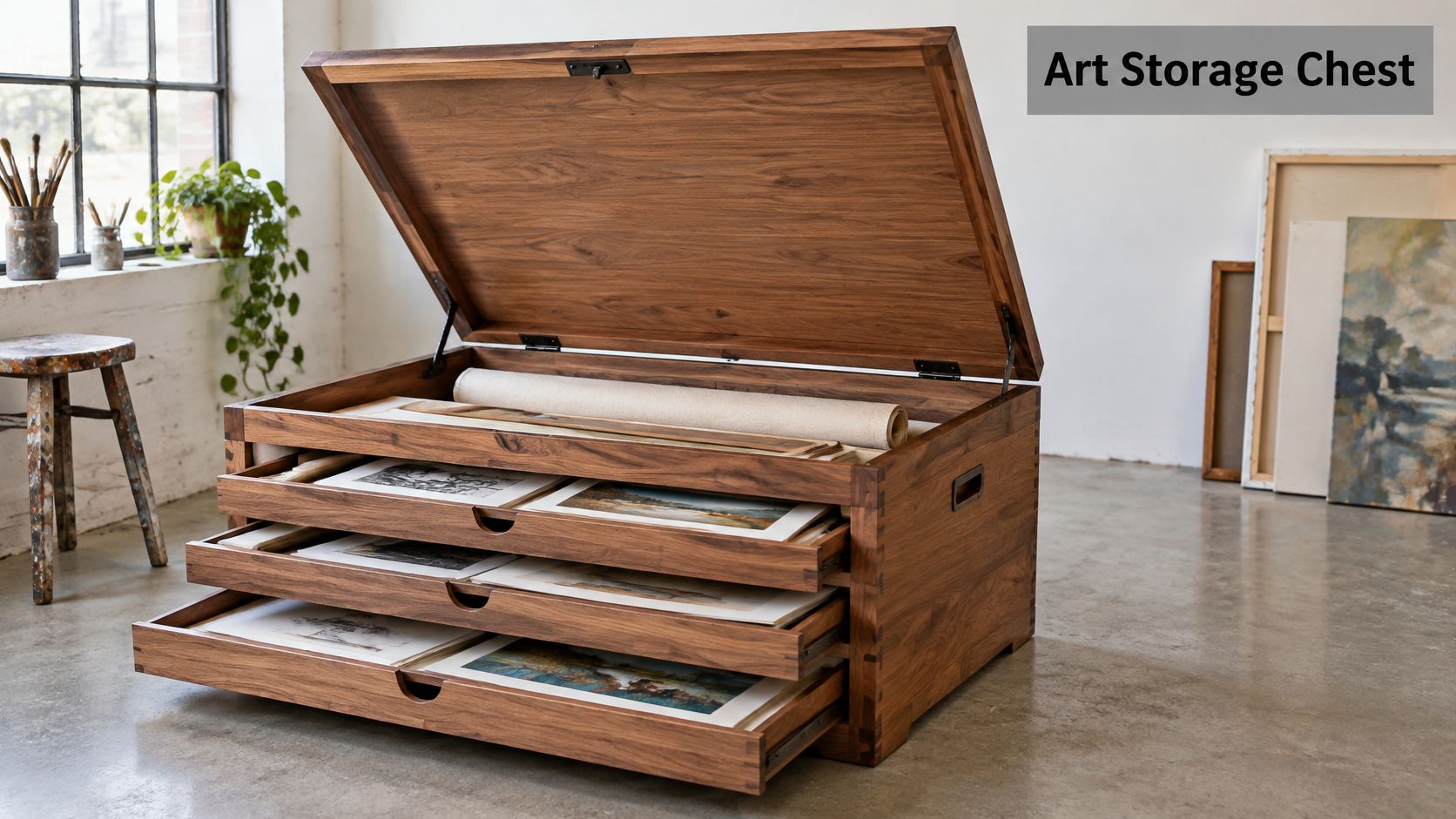
Hospitals don't toss instruments into a random crate. They rely on purpose-built medical bins and containers so each item stays separated and protected. A chest for art needs that same fit. The risks are light, abrasion, acids, and humidity rather than contamination, but a mismatched container still fails the contents.
Storage furniture has carried that job for a long time. A Philadelphia Museum of Art educational record documents a Pennsylvania German chest dated 1803, made for Margaret Bladt. Brides used chests like it for tablecloths, clothing, and blankets. This example has two bottom drawers and a small till for valuables, and its interior could hold pasted birth and marriage certificates. Families passed these chests on, so the furniture was an archive as well as a box.
Match the chest to each object's size, medium, and sensitivity. A pretty exterior is not a conservation plan.
What to Consider When Choosing a Chest
Check the chest against the artwork, not against a catalog photo. Work through these six points before you pay.
Fit the object. Measure height, width, and depth, then add room for padded supports and a hand's width so you can lift the piece out. Frames, glazing, and small projections should never press the walls. A chest that is "almost big enough" becomes a damage machine the first time someone shuts the lid in a hurry.
Closure and lock. A tight lid or door with a lock cuts dust and light. That same seal can hold damp air. Buy the lock, and plan to watch the interior, or the seal works against you.
Internal layout. Drawers and a small till suit jewelry-scale objects and small works on paper. Shallow compartments let you reach one piece without stacking three more on top of it. Deep bins invite piles, and piles hide the bottom piece until something tears.
Interior finish and liner. Open the lid and look at the wood, paint, and metal before you commit. If you can't add an acid-free liner or an inert barrier, walk away. The art should never rest on a raw or freshly finished surface.
Weight and portability. A loaded chest is a two-person object. Decide now whether it stays in one room or moves between a house and an office. Moving changes how you crate it and how fast the wood inside has to adjust to a new room.
Ventilation. A metal cabinet needs vents or a logger inside, because steel doesn't breathe. A wooden chest needs space around it so air can move under and beside the box. No vents and no logger means you are guessing.
If any point fails for the most fragile piece in the group, that chest is the wrong chest, even at a good price.
Materials That Keep Stored Art Safe
A wooden, metal, or antique chest can hold paintings, works on paper, or textiles only when the interior is isolated from the art and the climate inside is checked. The chest has to be a chemically stable enclosure. Untreated wood, particleboard, and cheap hardware can release acids or corrode, and those problems transfer to whatever touches them.
Material or feature | Suitable for art? | Why it matters |
|---|---|---|
Untreated wood | Avoid | Can release volatile compounds that affect paint, paper, and textiles |
Acidic composites or particleboard | Avoid | Off-gassing and acidity can damage works on paper and textiles |
Closed steel cabinet | Use with caution | Traps humidity, so it needs ventilation or regular monitoring |
Acid-free boxes and tissue | Recommended | Reduce light, abrasion, soiling, and pest exposure |
Inert barriers and archival liners | Recommended | Keep contents away from interior surfaces and finishes |
Padded, non-abrasive supports | Recommended | Spread load away from frames, corners, and glazing |
Untreated or corrosive hardware | Avoid | Corrosion can transfer to contents that touch the fittings |
What the numbers say about the air
A University of Illinois conservation guide recommends conditions no higher than 70°F and about 30–50% relative humidity for works on paper, and it warns that closed steel cabinets should be ventilated or closely monitored because trapped humidity creates risk. The same guide cites Smithsonian textile storage around 45% RH ±8% and 70°F ±4°F, and it notes that acid-free boxes and tissue cut light, abrasion, soiling, pests, and climate swings. It also recommends keeping art at least four inches above the floor so floodwater, dirt, and pests have farther to travel.
That elevation rule is easy to skip when a chest already has a bottom. A chest sitting on a garage slab still puts the art in the flood and pest zone. Raise the chest, and line the interior.
Why a tight seal can backfire
A sealed chest blocks dust and light. It can also trap humidity and make the microclimate worse if nobody ventilates it or reads a meter. Buyers ask whether any wooden, metal, or antique chest is "archival" because it closes. The honest answer is no. Antique painted chests are often historically important and chemically unpredictable. Use them for display of the furniture itself, not as the only barrier around a watercolor.
Line the interior so nothing touches a finish, a nail head, or bare plywood. Nest prints in acid-free boxes the way collectors handle long-term storage for film posters, then set those boxes on padded supports inside the chest. Our notes on archival storage materials cover tissue, boards, and barriers in more detail if you are building the kit before you buy the furniture.
A locked lid is not a conservation treatment. The liner, the hardware, and the air inside decide whether the art is safer than it was on the wall.
Climate Targets for Art Inside a Chest
Temperature and relative humidity (RH) are the two readings that drive most physical damage in storage. The average matters, and so does how far the reading wanders from one day to the next. A chest should be a climate-buffered enclosure, not only a lockable container.
Artwork or priority | RH target | Temperature | Note |
|---|---|---|---|
General chemically stable collection | About 50% RH (±5%) | 15°C to 25°C | Practical starting target for mixed framed works |
Works on paper | 30–50% RH | No higher than about 70°F (21°C) | Sensitive to humidity and light |
Textiles | About 45% RH (±8%) | 70°F (±4°F) | Smithsonian storage reference |
Mold prevention priority | Below 60% RH | Stable with air circulation | Dehumidify if RH stays elevated |
Wood components moved between rooms | Difference no greater than 7 points | Matched to the destination | Acclimatize wrapped in foam and blankets for several days |
Why the average is not enough
Canadian Conservation Institute guidance sets a practical target for general chemically stable collections at about 50% RH and 15°C to 25°C, and it asks precision control to limit variation to about ±5% RH and ±2°C. Fluctuations drive dimensional change, deformation, delamination, and cracking in paintings, wood, paper, and photographic materials. Paper and textiles sit in tighter bands than a mixed group of framed works, which is why one chest stuffed with every medium is a compromise, not a universal setting.
A closed cabinet does cut collisions, pests, pollutants, water from above, and some of the room's bad air. Enclosure alone doesn't guarantee safety. Prolonged high RH can build a humid microclimate that supports mold, even when the room looks dry and the chest looks shut.
How to read the chest
Put a calibrated temperature and RH data logger inside the chest, or immediately beside it if the interior is too tight. Read it on a schedule, and look at the objects when you do, not only at the screen. Keep the chest in a conditioned interior room. Basements, attics, exterior walls, and leak-prone corners swing too hard for the logger to "average out."
If readings stay high, dehumidify the room and give the air a path to move. Don't wait for a musty smell. A simple habit of humidity monitoring stops the logger from becoming a gadget you bought and forgot.
A steady 55% RH is usually kinder to a panel painting than a room that hits 50% on Tuesday and 70% by Friday.
When Professional Art Storage Is the Safer Choice
The useful question isn't "What humidity should every chest have?" It is "How stable must the room be for this artwork, and can this chest live inside that stability?" A single fixed target such as 70°F and 50% RH isn't required for every collection. The American Alliance of Museums describes that traditional approach as energy-intensive and sometimes a poor fit for diverse collections, while projects test broader settings to cut cost, energy, and carbon emissions without giving up safety. The Metropolitan Museum is running building simulations and pilot studies across 116 air-handling units and five central plants to measure what revised settings save.
For a house, an office, or a gallery along the Front Range, dry winters and altitude make a fixed number even less helpful. A slightly imperfect average that barely moves can beat a perfect target the heating system can't hold. Sensitive works on paper, wood panels, textiles, photographs, and bare metal don't share one comfort zone. If the room can't stay steady for the most sensitive piece, the chest is the wrong tool.
Situation | Home chest may suffice | Professional storage is safer |
|---|---|---|
A few framed prints in a stable interior room | Yes, with a data logger | Not needed unless the room is unstable |
Large oil paintings with no climate control | Only if room RH and temperature can be held steady | Yes, if the home cannot keep conditions stable |
Works on paper or textiles in a basement or garage | No | Yes |
Many pieces moving between homes or sites | Possible with padded crates and careful handling | Yes, for packing, transport, and secure storage |
Monumental sculpture or ceramics in an unconditioned space | Often no | Yes, for controlled conditions and handling |
When the room loses the argument
Say you have six framed prints in a bedroom that stays even through winter. A lined chest and a logger can carry that group. Say the same prints live in a garage that freezes in January and bakes in July. The chest will track that garage. Professional storage is the safer room, not a luxury upgrade.
Our warehouse is built for that second case. It holds controlled temperature for nearly any object we take in, from monumental sculpture and large canvases to delicate ceramics, with cameras and alarms on the space. If the need is temporary, short-term storage options are often cleaner than parking a chest in an unconditioned bay between houses.
How to Set Up a Chest Safely at Home
Placement does as much work as the furniture. A good chest on a damp slab, tight against an outside wall, still fails.
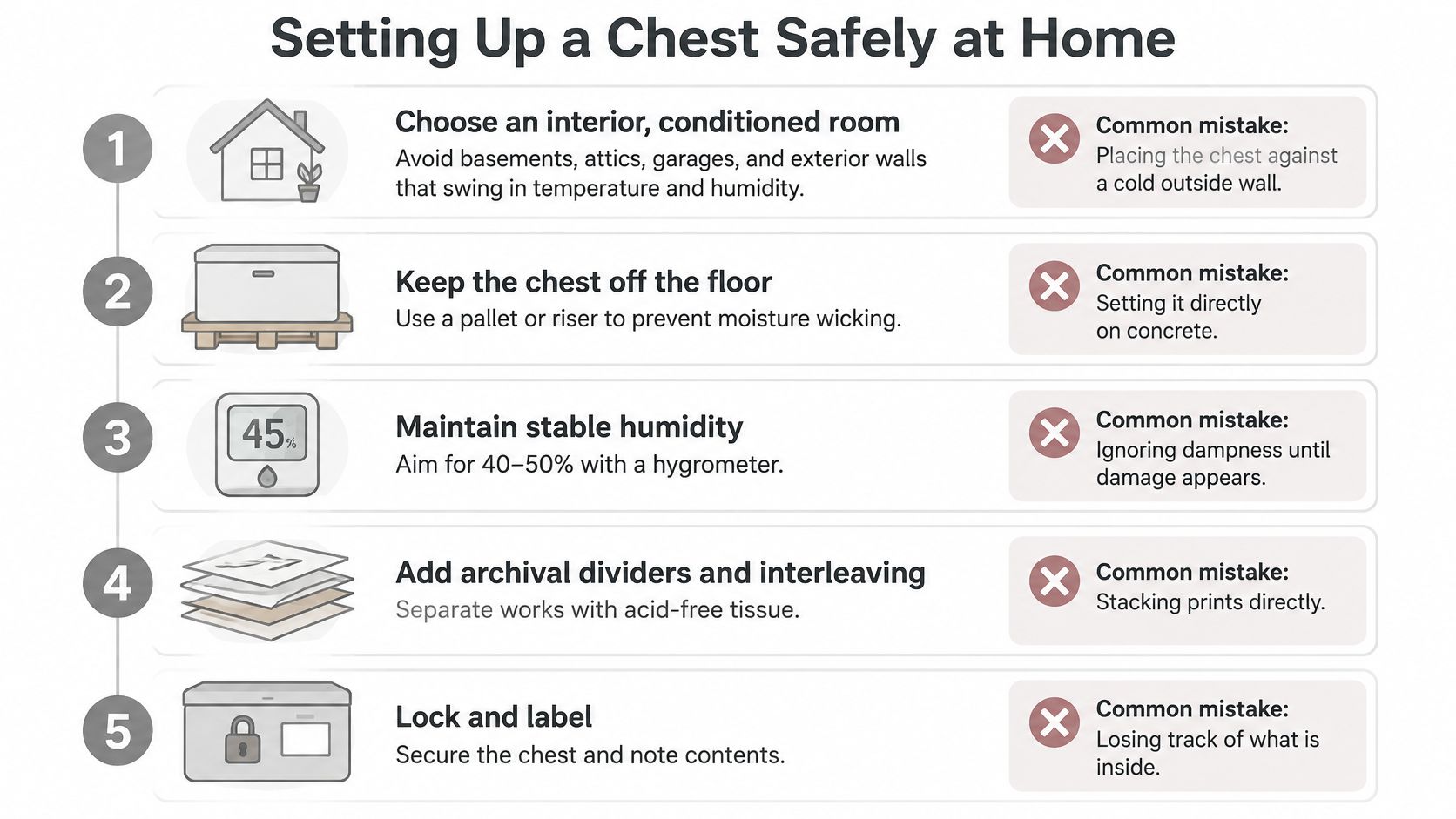
The drawing above is a quick map. The routine below is the one to follow, including the mistake people make at each step.
Choose an interior, conditioned room. Basements, attics, garages, and exterior walls swing in temperature and RH, and the chest will follow them. The usual mistake is shoving the chest against a cold outside wall, where condensation shows up on the back panel long before anyone opens the lid.
Raise it on padded blocks. Air has to move underneath, and nothing in the collection should sit on a damp floor. Setting a wooden chest straight on a concrete slab wicks moisture into the base and then into the microclimate.
Leave an air gap. Canadian Conservation Institute notes on storage areas recommend at least a 10 cm gap between collections and cold floors, hot ceilings, or exterior walls, because temperature gradients create localized RH errors and condensation. Shelves, if you use them inside or beside the chest, should be shallow enough that you can retrieve a work without dragging it across its neighbor.
Log the interior. Seat the calibrated logger where it reads the air the art sits in, then check it on a schedule you will keep. A logger in a desk drawer two rooms away tells you about the desk, not the chest.
Load on padded, non-abrasive supports, and stop before the chest is full. Supports should spread weight off frames, corners, glazing, and fragile projections. Overpacking abrades surfaces and blocks both inspection and air movement. If you have to force the lid, you have already gone too far.
Acclimatize wooden parts when you move. Compare RH at the source and at the destination. For wooden components, a difference greater than 7 percentage points calls for full wrapping in foam and blankets for several days, then a gradual unwrap. Passive buffering helps in a seasonal climate, and it doesn't replace a stable room. Where mold is the priority, keep RH below 60%, keep air moving, and dehumidify if the reading stays up.
Act on the log. A chest can look dry and still sit above the mold line for weeks. Ignoring the numbers because the exterior feels fine is the last, and most common, mistake.
A short walkthrough of safe handling and placement helps if you would rather see the sequence than only read it.
Confirm Your Storage Plan Before You Buy
Don't buy the chest, or book a warehouse, on a guess. Run this sequence first so the choice matches the art you own.
List every work by medium, size, and fragility, and mark the piece that is most sensitive. That piece sets the standard. The oil sketch doesn't get to outvote the watercolor.
Log the target room for two to four weeks. Note the high and low for temperature and RH, not just a single afternoon reading. One sunny Saturday will flatter a bad room.
Pick a chest that passes the six checks and whose interior materials are safe for that most sensitive piece. If the liner can't be added, it isn't a candidate.
Decide whether the room can hold the target for that piece. If the log shows wide swings, a home chest won't correct them.
If the room can't hold the line, call us for a quote. We are fully insured and work with collectors across Denver, Littleton, Englewood, Evergreen, Boulder, Highlands Ranch, Parker, Castle Rock, Castle Pines, Aurora, Greenwood Village, Lafayette, Louisville, Loveland, Ft Collins, Glenwood Springs, Vail, and Aspen. Send the artwork list and the logger readings so the quote covers packing and the right kind of space, not a generic bin.
A measured room check and a written list are the next steps. They turn a furniture purchase, or a storage quote, into a plan for specific objects.
Colorado Art Services stores art in a specialized warehouse with controlled temperature, and we pack, crate, and move pieces locally when a home chest isn't the right room for them. If your logger shows a room that can't stay steady, or you need pickup for paintings, works on paper, or sculpture, we can price the job from your list. Visit Colorado Art Services and call us for a quote or to talk through the project.
Comments