


Hire Art Installation Experts with Confidence
A large framed piece is finally on the wall. It's level enough, the hardware feels firm, and nobody can immediately explain why the room still looks unfinished. Then you notice the slight tilt, the center point sitting a little too high, glare washing across the glazing, or a hanging wire pressing a shallow dimple into the frame. The installation works mechanically, but it doesn't look resolved.
That difference matters. Art installation experts close the gap between “it's up” and “it's right.” They account for wall construction, load distribution, viewing height, lighting, access, object condition, and the visual relationship between multiple pieces. Their work starts where the average weekend project ends.
The Moment a Piece Looks Almost Right
The frame is mounted, the hardware holds, and the room still feels wrong. A slight tilt can fight the architecture. A piece centered on the wall can sit too high once the furniture is considered. A securely mounted mirror can reflect a ceiling fixture straight into the viewer's eyes.
These faults reveal why installation is both an engineering and conservation discipline. Before drilling, the installer assesses the wall, the object, and how people use the room. The proposed position must work with wall proportions, doors, furniture, sightlines, and circulation. The frame's existing hardware also needs inspection. It may be suitable, or it may need a more stable support system that protects the object over time.
What the finished wall reveals
A resolved installation depends on several physical decisions working together:
Alignment: The frame should relate to the wall, neighboring objects, furniture, and architectural lines, rather than only to a bubble level.
Load distribution: Hardware should transfer weight into suitable wall structure instead of concentrating stress at one weak point.
Frame protection: Wire, D-rings, cleats, and brackets must support the object without crushing edges, stressing joints, or distorting the frame.
Lighting control: Glazing, surface texture, beam angle, and viewing position determine where reflections appear.
Access planning: The crew must move the object through doorways, stairwells, elevators, and tight corners without striking walls or trim.
The installer must also know when to stop adjusting hardware. If the composition fails, moving a nail slightly will not fix it. Change the spacing, revise the centerline, adjust the lighting, or choose different hardware. That decision reflects judgment, not merely installation speed.
Practical rule: A secure installation is only the starting point. The object must sit comfortably in the room, hold its position over time, and look intentional from the seating and circulation points where people view it.
The traditional museum eye-level convention is 57 to 60 inches, or roughly 145 to 155 centimeters, with 58 inches often used as a U.S. museum benchmark, according to industry guidance on professional art installation practices. Use that convention as a starting point, then adjust it for sculpture, oversized work, seating, staircases, and specialized displays. The correct height serves the object, the room, and the people using it.
What Art Installation Experts Do
A professional installation starts before the first hole is drilled. A two-person crew may arrive with a laser level, stud finder, measuring tools, rated hardware, protective blankets, and a lifting plan. The team inspects the piece, confirms the proposed location, identifies the wall construction, and chooses a way to lift and position the work without dragging its lower edge against the wall.
The sequence matters. A competent installer reads the wall first, the object second, and the location third. Drywall over studs, plaster and lath, brick, concrete, tile, and wood paneling all call for different fasteners. They also create different limits for drilling, patching, and load capacity. The installation is an engineering decision shaped by the object's condition and the building's structure.
The work behind the visible result
The finished image may look simple, but the service combines art handling, light carpentry, layout, and practical engineering. Depending on the project, the crew may provide:
A site survey or photo assessment
Condition notes before handling
Measurements and placement diagrams
Hardware selection and load planning
Safe lifting and transport within the property
Installation, leveling, and final adjustment
Lighting alignment or coordination with an electrician
Removal, packing, and post-install documentation
Museum and gallery work adds formal coordination. The installer may work with a registrar, curator, conservator, exhibit designer, security manager, or facilities department. The project may also require conservation framing, vibration controls, seismic planning, UV-filtering glazing, or documented de-installation procedures. Verify each capability for the specific job. A general picture-hanging service should not be assumed to have them.
The Metropolitan Museum of Art's guide The Care and Handling of Art Objects was first published in the 1940s and has been updated continuously. Its history reflects the shift from informal picture placement toward conservation-based installation, as described in this historical overview of professional installation standards. Installation is part of object care. Handling protocols, wall conditions, hardware, placement, and preservation all affect the result.
Digital artwork, projection surfaces, and video walls require a separate technical plan. Facilities teams can review Access Electrical and Lighting for an overview of the electrical, structural, and display coordination these systems involve.
Competence scales with the object
Room size does not set the difficulty. A fragile pastel may need more careful handling than a large, sturdy print. A heavy mirror mounted on tile can demand more planning than a lightweight painting installed on a stud-backed wall. Delicate glazing, unstable hardware, or an uncertain frame should trigger an inspection before the crew selects a mounting method.
Ask what the installer will document, what happens if existing hardware proves unsafe, and whether the assigned team has handled comparable objects. Hire for documented capability, not the lowest price. The right provider treats each work as a distinct object with structural and conservation requirements.
Services That Cover Real-World Install Day
A useful service menu should describe the problems a crew can solve, rather than promise that it can “hang anything.” Residential work, commercial work, exhibitions, sculpture, mirrors, and storage each introduce different handling and access requirements.

Residential rooms
A homeowner may need one painting installed above a mantel, a group of works arranged as a gallery wall, a large mirror secured over tile, or art placed above a headboard and shelving. These jobs look familiar, but the finish depends on details such as sightlines from a sofa, uneven floors, trim height, outlet locations, and whether the wall can accept the intended hardware.
Gallery walls require more than repeating the same gap between frames. The installer has to establish the overall field, account for different frame sizes, and decide whether the composition should align by top edge, centerline, baseline, or a deliberate visual grid. Temporary placement on the floor can help, but it doesn't replace checking the composition at the actual wall and viewing distance.
Commercial environments
Offices, restaurants, retail spaces, hotels, and property developments often involve a larger number of pieces and stricter access conditions. A lobby statement may need lift equipment or a coordinated installation window. Conference room art may need to be installed without disrupting meetings. Retail and workplace projects can add security clearances, loading-dock restrictions, elevator reservations, protection of finished floors, and after-hours work.
Commercial installation also benefits from repeatable documentation. A facilities manager may need a location schedule, hardware record, photographs, or a plan for future art rotations. Without that information, the next move becomes a fresh investigation instead of a controlled change.
Galleries and exhibition spaces
Gallery-adjacent work can include plinth setup, lighting alignment, wall preparation, label placement, exhibition installation, and de-installation. The team must follow the exhibition plan while adapting to the actual room, including walls that aren't square, floors that aren't level, and sightlines that differ from the drawings.
Lighting deserves technical attention. A widely used museum and gallery rule places wallwash luminaires at about one-third of the room height from the display wall, with fixture spacing roughly matching that wall distance. The museum and gallery lighting guidance from licht.de explains why beam angle, glare, shadowing, reflective surfaces, and viewing distance matter. Sensitive paper-based works may require illumination around 50 lux, while more durable materials can tolerate different levels, so lighting should be coordinated with the work's conservation needs.
The following video offers useful context for the broader coordination involved in professional display installation.
Sculpture, mirrors, and logistics
Three-dimensional work changes the job completely. A sculpture may need a fabricated base, floor anchoring, concealed fasteners, or rigging for an overhead element. The installer must consider tipping, contact points, center of gravity, public circulation, and whether the object can be safely rotated or repositioned after it enters the room.
Mirrors bring their own risks. Tile can crack, grout joints can complicate drilling, and a large sheet can flex or shatter if lifted from one edge. Heavy-piece mounting calls for wall reinforcement or a load-spreading system rather than a stronger-looking hook.
For projects that include transport, white-glove art installation service guidance is relevant because blanket wrapping, crate construction, pickup, delivery, and secure storage form one connected chain of custody. Reputable providers may combine those services into a single-day or multi-day visit, depending on the number of pieces, access route, preparation, and installation sequence.
The global service segment reflects that wider role. One industry database listed 2,386 art installation services worldwide as of September 2026, including 750 in the United States, 196 in the United Kingdom, and 98 in France, as reported by the art installation services industry directory. Those figures point to a professional service category supporting homes, institutions, galleries, and commercial environments, not merely occasional moving labor.
When DIY Stops Being the Smart Move
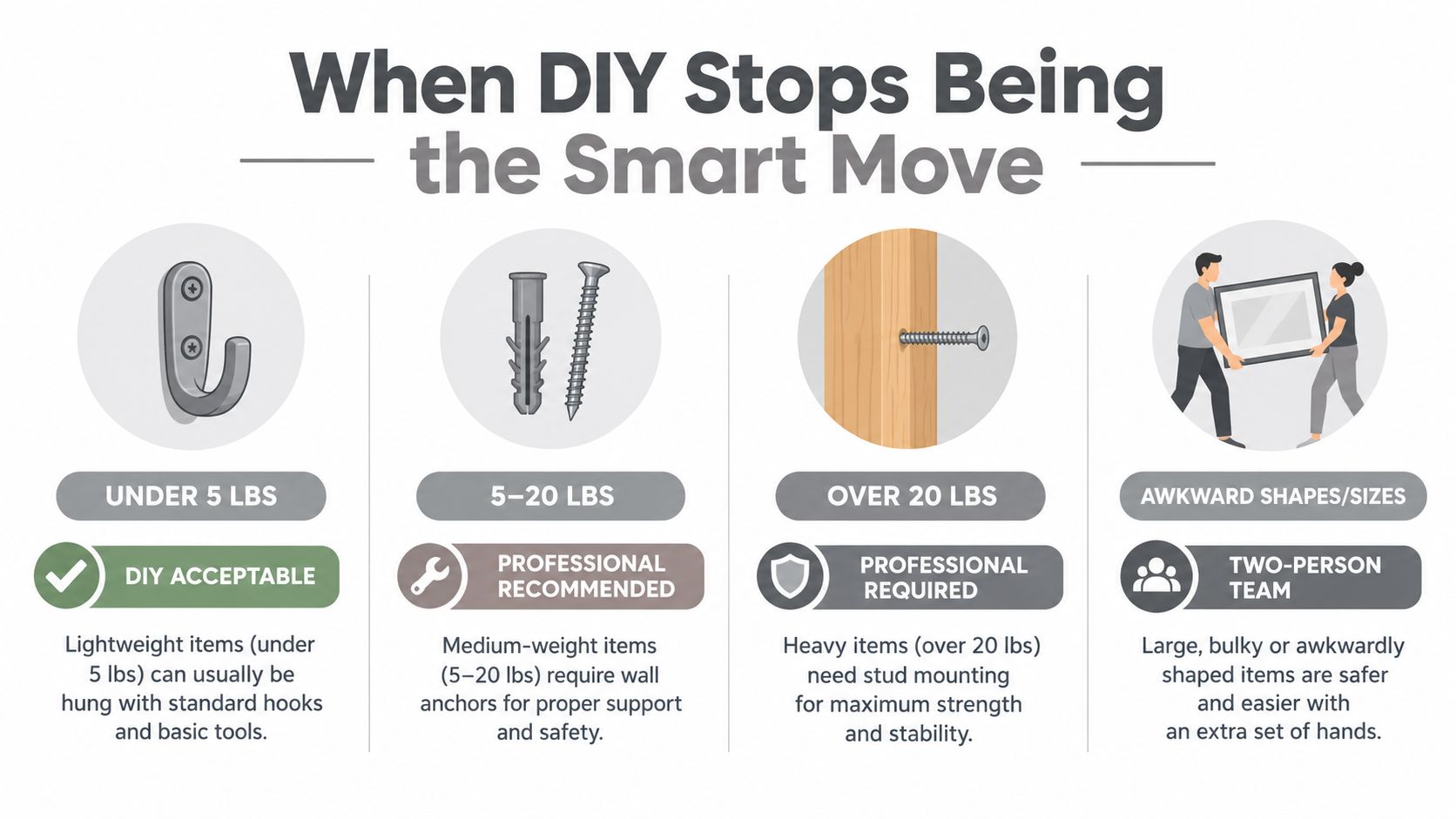
DIY stops making sense when the consequence of a mistake exceeds the value of saving a service call. That line depends on weight, size, height, fragility, wall construction, and the number of people needed to control the object.
A light, conventional frame on a sound wall may be a reasonable homeowner project. A large glazed work, a heavy mirror, or an object with uncertain hardware is different. One person can often position a small frame, but awkward shapes and large surfaces create mechanical advantage that makes the object difficult to control even when its listed weight seems manageable.
Identify the failure mode
Standard hooks and light-duty anchors fail in predictable ways:
Anchor pull-out: The fastener loses its grip because the wall material or anchor type can't carry the working load.
Wall tearing: Drywall or plaster breaks around the fastener, often leaving a larger repair than the original hole.
Frame distortion: Uneven support pulls on the hanging hardware or twists the frame.
Impact damage: The object shifts during lifting and strikes a wall, stair rail, floor, or nearby furniture.
Personal injury: A lift from a ladder or an awkward position strains the back, shoulders, or hands.
For heavy pieces, industry guidance recommends sizing hardware with a safety margin of 25% to 50% above the artwork's maximum weight. Some technical guidance also suggests dividing a published anchor shear rating by 4 to estimate a conservative working load. For example, an anchor rated at 100 pounds may be treated as supporting only about 25 pounds in real conditions, especially where vibration, mechanical advantage, or repeated movement is possible, according to this guidance on selecting picture-hanging hardware.
Know when the wall and object require a crew
When studs aren't available, multiple anchors can distribute the load, but spacing and wall composition still matter. Toggle or expansion anchors may be more appropriate than nails or light-duty plugs in drywall or masonry, but the installer must match the hardware to the actual substrate.
Height adds another variable. Ceiling-tall work, stairwell placement, and installations above furniture may require two-person control, specialized ladders, or lift equipment. A ladder doesn't just increase fall risk. It reduces the installer's ability to hold, rotate, and protect a large object while fastening it.
Fragility is the clearest threshold. Glass, mixed media, unstable surfaces, irreplaceable originals, and works with delicate frames deserve controlled lifts, clean gloves where appropriate, protective padding, and a handling plan. Independent museum guidance recommends professional handling once works exceed about 3 feet by 3 feet, or when ladders, heavy objects, fragile surfaces, or uncertain wall structures are involved, as outlined in the Broad's art-handling toolbox.
Don't ask only, “Can I hang this?” Ask, “What happens if I'm wrong?” If the answer includes a cracked wall, a back injury, broken glazing, or professional conservation, the job has crossed into professional territory.
How Professional Art Installation Is Priced
A quote should describe the work required to produce a safe, finished result. The lowest number often reflects the shortest task description, not the lowest total cost after hardware, access, wall repair, transport, and protection are included.
Most providers build pricing around the object and the site. A small residential visit may use an hourly model, while commercial, gallery, and multi-piece work is more often quoted as a project. Neither approach is automatically better. The question is whether the quote makes the assumptions visible.
Common Pricing Factors in Art Installation Quotes
Cost Driver | Why It Matters |
|---|---|
Piece size and weight | Larger or heavier objects may require more crew members, stronger hardware, protective equipment, or specialized lifting |
Wall material | Plaster, lath, brick, concrete, tile, and drywall require different fasteners and preparation |
Ceiling height | High placement can require ladders, lifts, additional labor, and more floor protection |
Number of pieces | Multiple works increase measuring, layout, leveling, handling, and documentation time |
Access route | Stairs, narrow corridors, elevators, loading docks, and occupied spaces affect the installation sequence |
Framing or glazing | New hardware, conservation framing, glazing adjustments, or frame repairs add scope |
Sculpture base work | Three-dimensional objects may require fabrication, anchoring, leveling, or rigging |
Schedule | After-hours work, event deadlines, secure-access procedures, and restricted delivery windows affect labor planning |
Travel and transport | Pickup, delivery, blanket wrapping, crating, and storage create responsibilities beyond wall placement |
Insurance and documentation | Coverage, condition reporting, photographs, and records support higher-risk or institutional work |
Ask whether the quote includes hanging hardware, wall patching, final leveling, removal of packaging, and cleanup. For a collection or exhibition, confirm whether condition photographs, placement records, and de-installation are included or billed separately.
Compare scope before price
Read two quotes side by side and highlight what each provider has agreed to do. One may include a site visit, two-person handling, rated hardware, floor protection, and final photographs. Another may list only “hang artwork,” leaving every risk outside the price.
Travel, insurance, after-hours access, and secure buildings can affect the total without indicating unnecessary markup. Those line items often pay for planning and accountability. A crew that carries fine art coverage and documents condition is taking on a different responsibility from a general laborer with a drill.
A useful quote answers three questions: who is handling the piece, how will the wall carry the load, and what happens if the site or object differs from the information provided?
Choose the quote with the clearest scope, not the smallest headline number. A precise proposal gives you something to evaluate before the crew arrives and something to return to if the installation changes.
Choosing the Right Provider
The right provider demonstrates capability before the first appointment. Look for documented work with pieces similar in size, weight, material, fragility, and setting. A provider that installs residential frames may not be equipped for a suspended sculpture, a museum loan, or a large commercial rotation.
Start with the process. A serious installer will request photographs, measurements, wall information, access details, and the object's approximate weight. For complex work, the provider should recommend a site walk before final pricing rather than pretending every risk can be assessed by phone.

Questions that expose real competence
Ask direct questions and pay attention to whether the answer includes a method.
Wall assessment: How do you anchor into plaster and lath, brick, concrete, or tile?
Hardware failure: What do you do if the existing wire, D-rings, cleat, or frame feels unstable?
Load planning: How do you select hardware for a heavy piece when studs aren't in the right position?
Crew structure: How many people will attend, and who will lead the installation?
Damage response: Who handles patching, touch-up, or reporting if the wall or frame is damaged?
Insurance: What coverage applies while the work is being handled, transported, and installed?
References: Can you provide references for comparable homes, offices, exhibitions, or objects?
A provider should also be able to show a portfolio with actual completed work, not only polished room photography. Ask for references that match your situation. A gallery client, facilities manager, interior designer, or homeowner with a heavy mirror can describe the provider's communication and care more usefully than a generic review.
Use these questions to ask before hiring an art installation provider as a practical screening checklist. Verify licensing where applicable, confirm insurance in writing, and ask whether the people who assessed the job will be the people who arrive. A last-minute subcontractor swap can change the risk profile of the installation.
Why Denver Metro and Front Range Projects Run Differently
Local installation requires more than a regional service radius. Denver Metro and Front Range homes and commercial buildings present a mix of newer construction, older plaster walls, brick, finished basements, tile, open-plan offices, and high-access spaces. The wall you can see may not tell you what sits behind it.
Older Denver neighborhoods may have plaster and lath that behave differently from modern drywall. Ranch homes and basements can introduce masonry, concrete, unusual framing, or long transport paths from the entry to the final wall. Newer developments may have finished surfaces, strict HOA rules, narrow access, or limitations on exterior work and large trucks.
Climate belongs in the plan
Dry conditions and changes in temperature can affect wood stretchers, frames, crates, and works that have traveled from a different environment. A crate opened immediately after delivery may not tell the same story as the object after it has adjusted to the room. Frames can shift, wood can respond to moisture changes, and glazing can reveal movement that wasn't obvious during transport.
The practical response is to inspect before permanent placement. Keep the work protected, avoid unnecessary exposure to direct sun or heat sources, and give the installer enough information about where the piece came from and how it was transported. For sensitive work, ask whether acclimation, condition checks, or conservator input is appropriate.
Access changes the schedule
Mountain weather can disrupt deliveries and crew travel. A property may also impose loading restrictions, elevator bookings, move-in rules, or event deadlines. Those constraints should be part of the schedule before the installation date, not discovered when the truck arrives.
Give the provider photographs of the approach, stairs, elevators, corridors, parking, and final wall. Mention renovation work, fresh paint, floor finishes, and any furniture that can't be moved. A local crew should plan for those conditions and select fasteners after confirming the wall, not after opening the toolbox on site.
Your Next Step With the Right Installer
Start with an inventory. List every piece you want installed, including the medium, approximate dimensions, frame type, glazing, and estimated weight. Note whether each item is a painting, mirror, photograph, textile, sculpture, digital display, or mixed-media object.
Then photograph each proposed location. Take one wide image showing the room and nearby furniture, one straight-on image of the wall, and additional images of corners, trim, outlets, stairs, and access points. If a pedestal or overhead location is involved, photograph the floor and ceiling as well.
Use the first conversation as a test
Contact two or three providers serving your area. Give each one the same inventory and photographs, then compare the questions they ask before quoting. A capable installer will want to know about wall construction, delivery condition, access, timing, object value, and the desired visual result.
A weak response often arrives as an instant price with no discussion of hardware, crew size, or risk. That doesn't prove the provider can't complete the job, but it gives you no evidence that the quote reflects the actual work.
Confirm these items in writing:
Schedule: State the move-in, event, renovation, delivery, and access deadlines.
Scope: Identify installation, transport, storage, lighting coordination, removal, and cleanup.
Hardware: Clarify whether rated hardware and any wall reinforcement are included.
Repairs: Ask whether patching and touch-up after removal are included or excluded.
Documentation: Confirm condition notes, final photographs, and placement records where needed.
Accountability: Name the lead installer and the expected team size.
Changes: Decide how substitutions, revised layouts, or unexpected wall conditions will be handled.
Reserve a short walkthrough before permanent placement when the collection or layout is complex. That gives you a chance to review spacing, sightlines, lighting, and last-minute substitutions without forcing the crew to improvise under time pressure.
Colorado Art Services offers residential and commercial art installation, placement and layout, grid displays, sculpture and mirror hanging, heavy-piece mounting, high-placement work, local art moving, and secure short- or long-term art storage across the Denver Metro and Front Range. Visit Colorado Art Services to discuss your pieces, walls, access conditions, and installation scope with a team that treats placement as both a safety task and a conservation responsibility.
Comments