


Picture Hanging Magnets: A Complete Guide for Homes
You've moved into a new place, or you're swapping seasonal prints and want a wall that can change without a row of new holes. A magnetic mount sounds simple: put up a steel surface, attach the magnets, and move the art when the mood changes. Then you notice the frame has glass, the wall is painted drywall, and the product's impressive pull-force rating was measured under conditions your room doesn't have.
That's where picture hanging magnets stop being a simple hardware choice and become an installation decision. What matters isn't just the magnet. It's the full load path from frame to backing, magnet, steel target, and wall, along with the surfaces and forces acting at each connection.
Why a Magnet Hanging Choice Matters More Than It Looks
A renter might want to rotate a few lightweight prints without adding holes. A designer may need a clean display on a steel-backed panel. A collector might be considering magnets for a framed photograph with glass, or for an heirloom mirror. Those projects can look similar in a product listing, but they put very different demands on the mounting system.
A mount that seems secure in your hand may behave differently once it's vertical. Gravity tries to slide the artwork down the wall, while a small gap, an uneven surface, or a shifting frame can reduce the grip. If the mount slips, the result isn't just a crooked picture. A frame can hit the floor, damage the artwork, or injure someone nearby.
The useful question isn't, “How much weight can this magnet hold?” It's, “How does the complete assembly carry this object safely on this wall?” That means checking what the magnet attaches to, how the frame meets the magnet, and what's anchoring any steel plate or panel to the building.
Practical rule: Treat a magnetic mount as a system, not as a magnet with a weight claim.
For lightweight displays on a suitable surface, magnets can make changing artwork convenient and reduce direct intervention. For heavy, valuable, or high-placement pieces, convenience doesn't replace a properly engineered attachment. Knowing where magnetic mounting works, and where it doesn't, helps protect the art, the wall, and everyone who walks past it.
How Magnetic Hanging Actually Works
Start with the direction of the force. A magnet's pull force describes how hard it is to pull the magnet straight away from a steel surface. That's like pulling a sticky note directly off a wall. But when a frame hangs vertically, its weight acts downward along the wall, not straight away from it. The mount must resist shear, or sliding, much like a fridge magnet resisting gravity on a refrigerator door.
The difference matters because the magnet's attraction presses the surfaces together, but friction between them resists the slide. A rating measured by pulling a magnet straight off clean, flat steel doesn't directly tell you how much weight the magnet can carry while sliding down a wall. Paint, coatings, contact area, and surface condition all affect that friction.
Many compact magnetic mounts use neodymium–iron–boron, or NdFeB, magnets. The technology was developed independently by General Motors and Sumitomo Special Metals in the early 1980s and publicly recognized around 1983–1984. NdFeB offers substantially higher magnetic energy density than older ferrite and alnico materials, which helps small components produce strong attraction; the development and production context is documented in this magnet-materials overview.
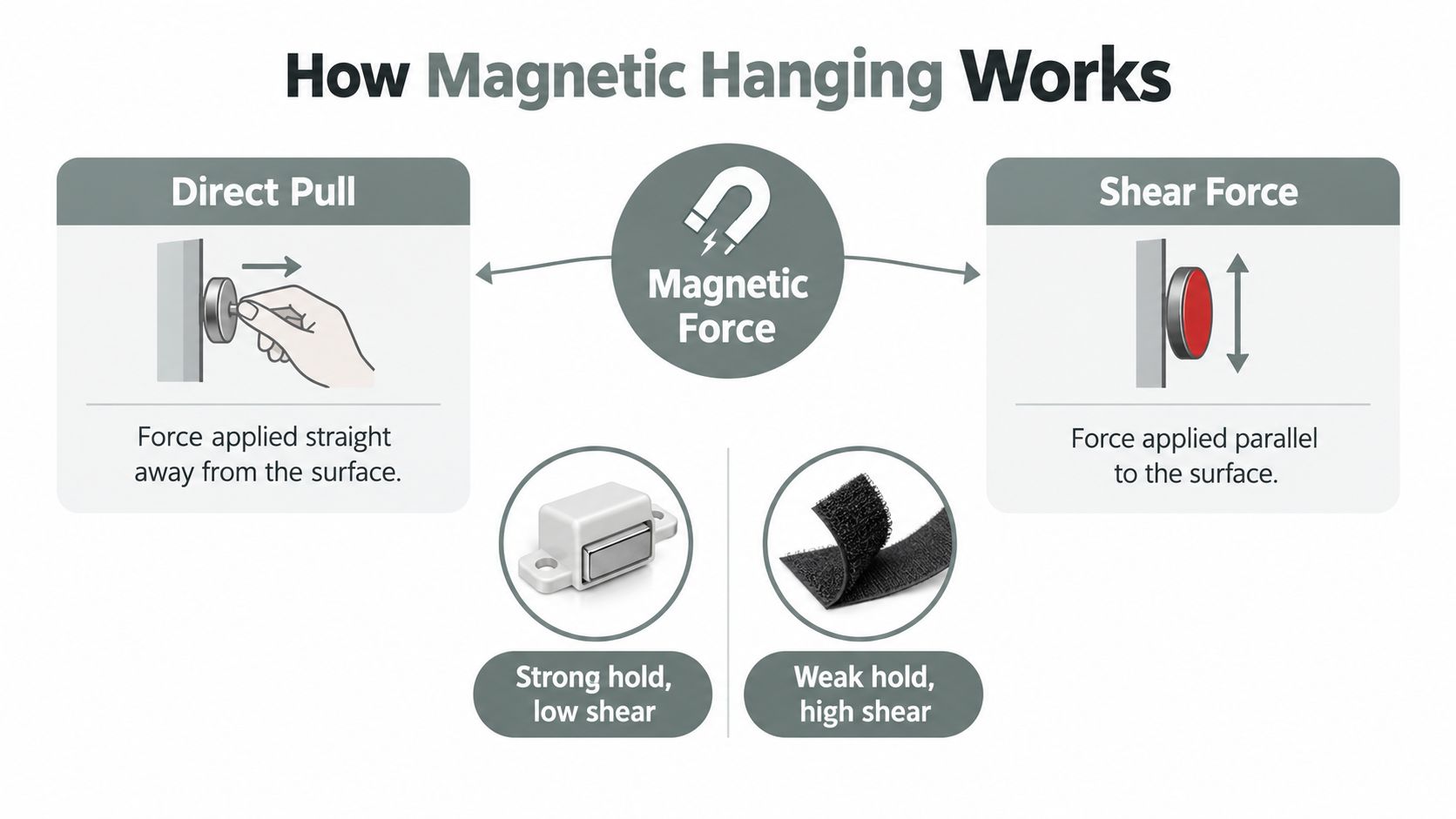
Distance is another part of the physics. A frame's backing, a spacer, paint texture, or a slightly bowed plate can leave a gap between the magnet and its target. Attraction can fall quickly as that gap grows, so a magnet that feels forceful in direct contact may perform quite differently in the assembled mount.
It also helps to separate magnetic closure from magnetic hanging. A closure holds a photograph or front panel in place; a hanging system supports a complete display on a wall. U.S. patent records describe both types of magnetic picture devices, including an early-2000s magnetic-frame patent, illustrating why the term covers different designs rather than one standard hardware category. For any installation, match the system to the actual load path, not just to the word “picture” on the packaging.
Types of Magnetic Hanging Systems You Will Actually Find
Magnetic hardware comes in several forms, and each solves a different problem. A neodymium disc paired with a steel plate is a common starting point for a controlled display, provided the plate is securely attached and the surfaces meet as intended. It can work well for lightweight prints or interchangeable panels, but it still needs a deliberate plan for sliding resistance and frame stability.
Rubber-coated pot magnets and magnets with hooks are easier to handle as standalone hardware. The coating can improve grip on some surfaces, while a hook offers a familiar place to hang a lightweight item. These products still depend on what the magnet is attaching to. A painted drywall surface isn't a steel target, and a hook doesn't make an unsuitable wall magnetic.
Flexible magnetic sheets and strips are useful for lightweight display pieces, labels, and closures. They distribute contact over a broader area, but they aren't interchangeable with a high-capacity mount for a glass-fronted frame. Encapsulated magnet bars, often used for retail displays, protect the magnetic element and can make repositioning convenient on a compatible panel.
Museum-grade mounts are designed around controlled contact and the object's materials, not maximum attraction. The Asian Art Museum describes a system using rare-earth magnets set into archival board strips to press artwork against a padded steel sheet hidden in the backing. That method allows pressure adjustment by changing the number of magnets or the padding, as described in its conservation guide to magnet mounts.
Magnet Type | Best For | Key Limit |
|---|---|---|
Neodymium disc with steel plate | Lightweight framed prints and panels | Needs a secure steel target and controlled gap |
Rubber-coated pot magnet or hook | Small displays on compatible metal surfaces | Hook and surface conditions determine stability |
Flexible magnetic sheet or strip | Labels, light panels, and closures | Not a default choice for heavy framed art |
Encapsulated magnet bar | Retail signage and frequently changed displays | Requires compatible backing and careful load planning |
Archival magnet mount | Textiles and sensitive objects with a designed support | Needs appropriate padding, pressure, and object testing |
A sales description may emphasize strength or repositioning. Ask instead what surfaces the product is designed to join, how the frame is supported, and whether the rating addresses vertical sliding. Those answers separate a useful display component from a complete hanging solution.
Load Capacity and Shear Force on Real Walls
A pull-force rating is not a ready-made frame-weight limit. On a vertical wall, the artwork's mass loads the mount in shear, and the magnet's grip depends largely on friction. One technical guide puts practical shear capacity at about 10–30% of normal holding force, while explaining that the exact result depends on contact conditions and friction (magnetic adhesion force guidance).
Consider the guide's example of a 5 × 5 × 1.2 mm N38 neodymium magnet. Its listed direct pull is approximately 4.3 N at zero gap, while reported shear strength is about 1.4 N. With a 1 mm gap, the pull falls to about 2.2 N, and at 2 mm it falls to about 0.8 N. These are specific example values, not universal ratings; they show why contact, surface conditions, and frame geometry matter.
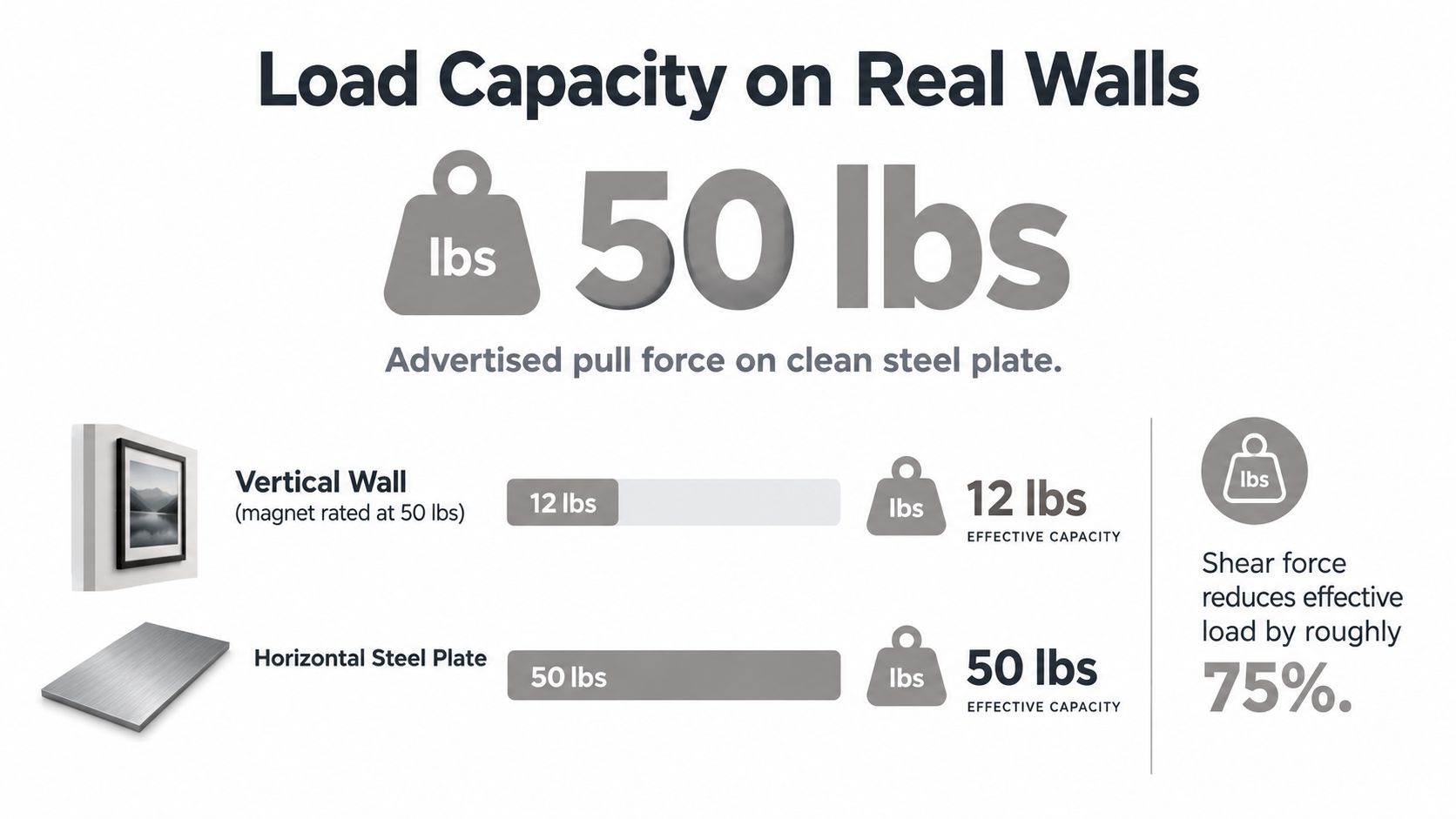
To estimate a system, weigh the complete artwork, including glass, mat, frame, and backing. Then identify the magnet's rating and the conditions used to measure it. Don't convert a direct-pull label into a safe wall load without accounting for shear, the gap, the steel target, and a conservative working margin.
Distributing several contact points can help control tilt and pivoting, but adding magnets doesn't fix a weak wall connection or a flexible backing board. The magnets must also be spaced so the frame sits flat and shares load rather than rocking on one point. For a general look at the wall side of the equation, see this guide to drywall load capacity.
If the frame creeps downward, tilts after release, or shifts when someone walks by, treat that as a failure warning, not as a cue to trust it and leave it. Large frames, mirrors, valuable objects, or pieces above areas where people sit or walk need a more dependable mounting plan than trial-and-error with magnets.
Walls, Frames, and Surfaces That Change the Equation
A magnet needs a ferromagnetic target. Most painted drywall, plaster, wood paneling, and brick won't provide one on their own. In those settings, a magnetic system may require a properly anchored steel plate, a sheet-metal insert, or a purpose-designed panel. Magnetic-receptive coatings may be another option, but the installation still depends on the product, the prepared surface, and the object's load.
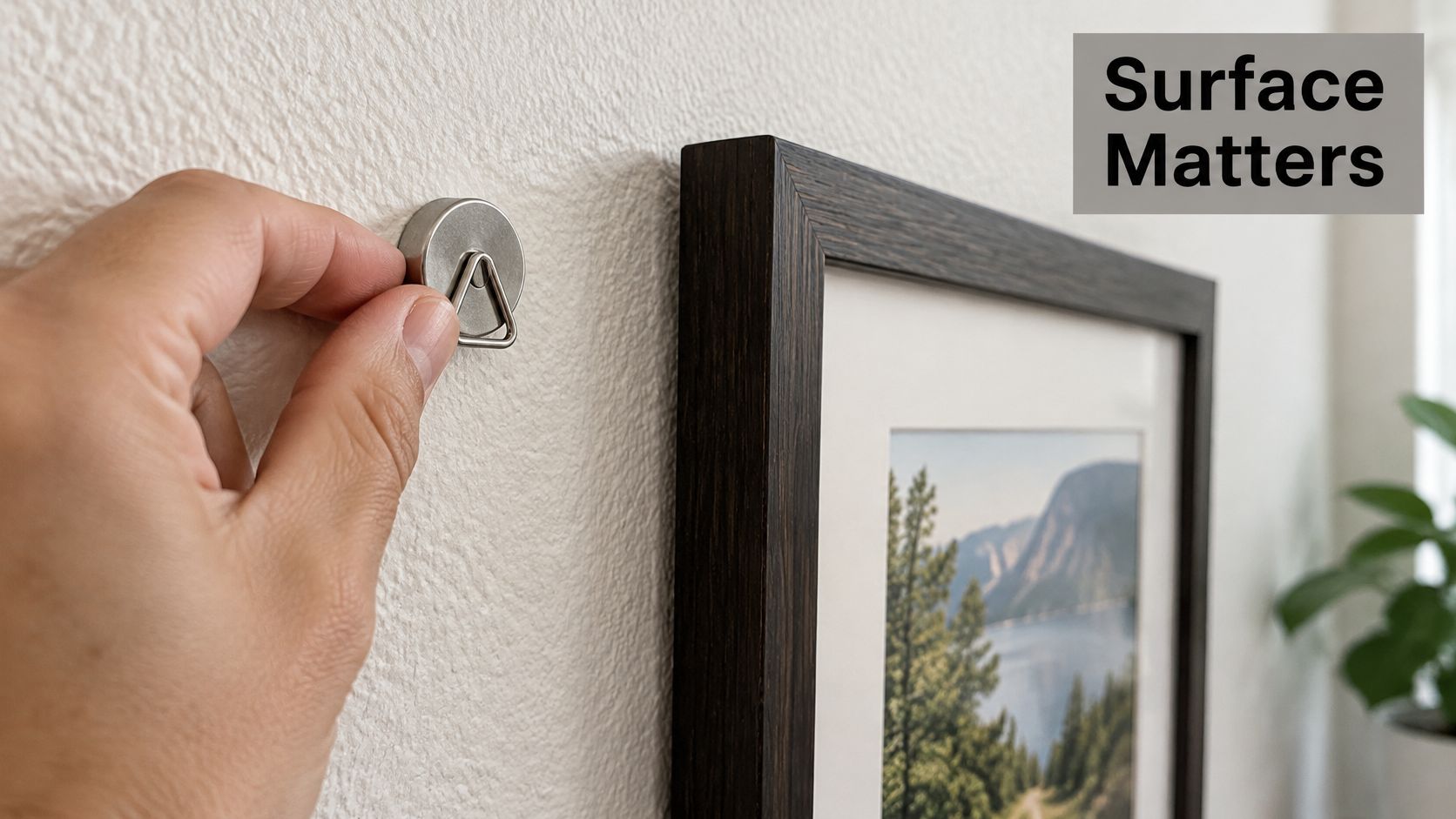
Wall texture and finish also affect contact. A textured surface can create a gap or uneven pressure, and a magnet attached to a plate is only as secure as the plate's own connection to the wall. If the plate relies on adhesive, its bond and the wall finish become part of the load path. Advice on hanging pictures on plaster walls can help clarify why a wall's construction matters before choosing hardware.
Frames add their own complications. Glass adds mass, a deep frame can create leverage, and a flexible backing board may bow instead of distributing force evenly. Closely spaced magnets may hold one edge while allowing the frame to pivot; a stiff, well-supported backing and balanced spacing make the assembly easier to control.
Go or no-go: Proceed only when you can identify the magnetic target, confirm how it's fixed to the wall, and account for the complete frame and its depth. If the wall is textured or the surface contact is uncertain, compare the setup with guidance on applying decals to textured walls, then test the actual mounting materials rather than assuming they'll behave alike.
For heavier work, a mechanical anchor or rail may be a more direct way to carry the load into the building. The right choice depends on the wall and the object, not on which system promises the fewest visible holes.
Magnetic Mounts Versus Mechanical Anchors and Rails
Magnetic mounts are useful when the art is light, the target surface is compatible, and frequent changes matter. They can make repositioning easier, but the plate still needs a sound attachment and the frame must remain stable under shear. For a fixed display carrying more weight, a mechanical connection may be less convenient but more predictable.
Picture rails suit layouts that change often, though the rail itself must be installed securely. French cleats provide a broad, interlocking support for larger pieces, while an anchor-and-hook setup offers a straightforward mechanical connection into an appropriate wall substrate. Adhesive strips avoid drilling, but their performance depends on surface preparation and the condition of the finish. For temporary hooks in compact spaces, these cruise-cabin hook tips offer useful context on magnetic hardware, though a cabin hook isn't a substitute for a load-rated art mount.
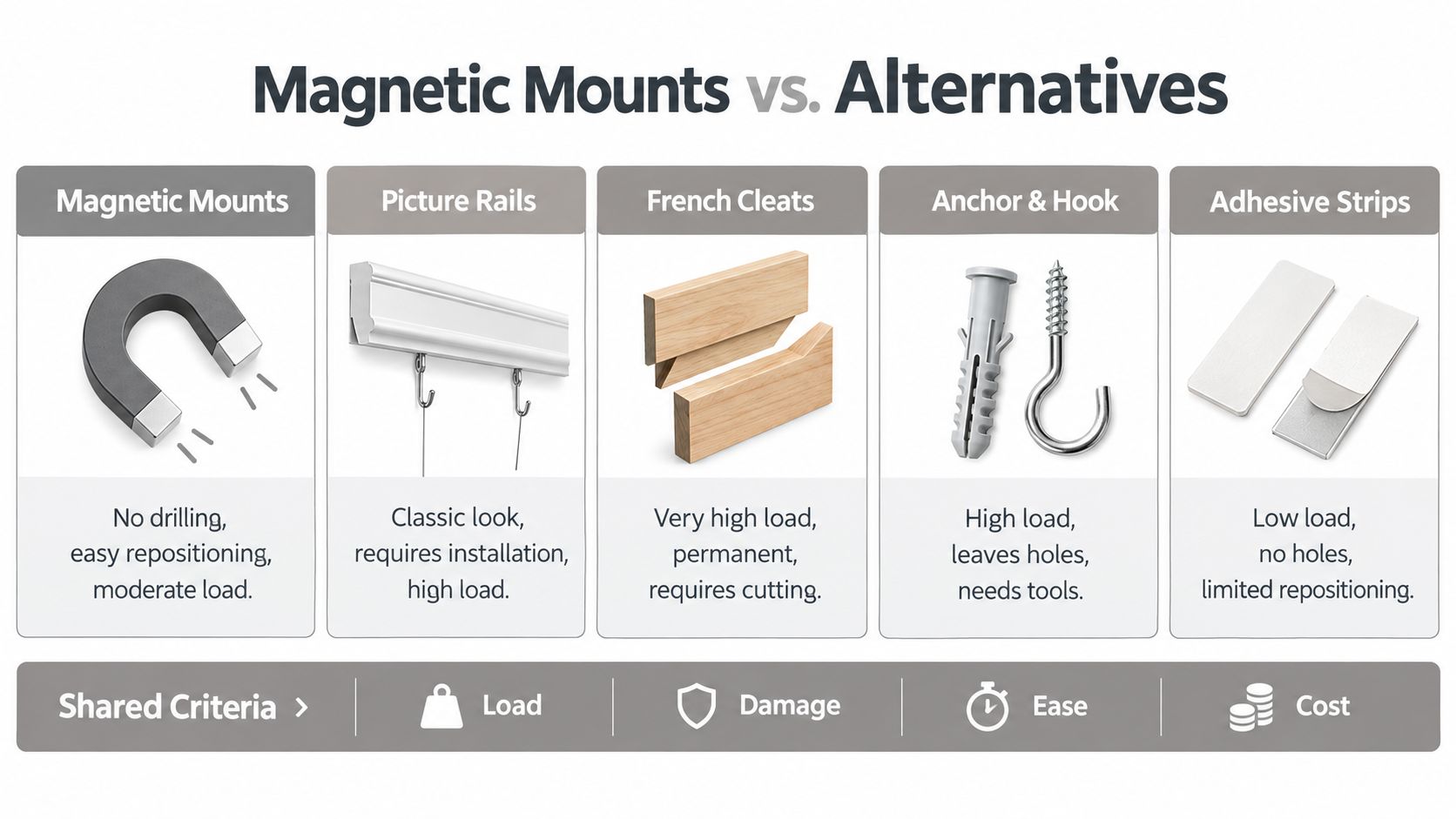
A practical choice comes down to the object, wall, and cost of failure:
Choose magnets for lightweight, frequently changed displays on a suitable magnetic surface.
Consider a rail or cleat when the layout needs adjustment or the piece needs a more substantial mechanical support.
Use anchors and hooks when the wall and frame hardware suit a direct fixed connection.
Treat adhesive systems cautiously on textured, fragile, or uncertain finishes, and don't assume “no holes” means “no risk.”
The art hanging systems overview can help compare approaches for a room or collection. The choice isn't a contest with one universal winner. It's a decision about which system controls the object most reliably while meeting the project's needs for appearance, reversibility, and wall impact.
Installing and Testing a Magnetic Mount the Right Way
Before installing, confirm that the receiving surface is magnetic or that you have a suitable steel target. Clean the contact areas, check whether the wall and plate sit flat, and inspect the frame's backing. If the wall varies, a carefully fitted backer board or shim may produce more consistent contact than trying to force a magnet against a crooked surface.
Mark the planned magnet positions and check that they support the frame without letting it rock. Painter's tape can help mark the layout or establish a consistent spacer during a test fit. Attach the steel target securely, place the magnets, then level the frame before testing it.
Test before you trust: Support the artwork while you check for downward movement, edge lift, or pivoting. Don't perform a test over people, fragile flooring, or valuable objects.
A controlled slide-and-tug check can reveal problems, but it doesn't certify long-term capacity. If the frame shifts during testing, change the design rather than accepting a marginal hold. Handle paired neodymium magnets carefully; strong pieces can snap together, pinch fingers, or chip nearby surfaces. Slide them apart rather than pulling directly against the full attraction.
Magnetic mounting can be reversible, but that doesn't make every removal harmless. Conservation guidance emphasizes controlled pressure and padding, and strong magnets can make separation difficult if the release isn't planned. For a small decorative wall display, these horseshoe-hanging tips offer a separate example of thinking through placement and support before fixing an object in place.
Conservation, Safety, and the Real Cost of Reversible Mounts
“Damage-free” describes an intention, not a guarantee. A magnetic mount can avoid piercing the artwork while still applying enough concentrated pressure to dent a frame, distort a textile, or scuff a finish. The object's materials, the backing, the padding, and the way a person releases the magnets all matter.
Museum practice offers a more careful model. The Asian Art Museum's archival-board system uses adjustable pressure against padded steel, rather than treating maximum magnet strength as the goal. In a separate textile installation, the Denver Art Museum used approximately 40 neodymium magnets to provide distributed tension. That example shows the value of broad, controlled support, not a universal magnet count or prescription.
For sensitive work, weaker contact at multiple points may distribute pressure more evenly than a few powerful clamps. Use a protective interface between magnets and the object, and test the arrangement on a representative sample when possible. This is especially important for textiles, works on paper, and irregular pieces that can crease or distort under localized force.
There are risks beyond the artwork. Multiple small magnets present a serious swallowing hazard to children; if swallowed, magnets can attract inside the body and cause severe injury or death. Keep loose magnets secured and out of reach, and don't leave them where children can handle or swallow them.
Wall finishes need their own safeguards. Plaster, wallpaper, textured paint, or a recently altered surface may react differently to plates, coatings, or adhesive attachments. A reversible display can still pull at paint during removal, and a mount that works in a quiet room may need inspection if people bump the wall, clean around the artwork, or change the display often.
A decision check before you buy
Ask these questions before choosing a system:
What does the complete piece weigh? Include glazing, frame, mat, and backing.
What is the wall target? Identify metal, steel plate, or a nonmagnetic substrate that needs another mounting method.
Where does the force travel? Check each connection from artwork to frame, magnet, target, and wall.
What could go wrong? Consider vibration, accidental contact, a high placement, or a fall onto people or fragile objects.
Can the object tolerate the pressure? Protect delicate surfaces and avoid direct contact without a suitable interface.
For a light interchangeable display on a purpose-built panel, magnetic hardware may be a sensible fit. For a heavy mirror, a large-format frame, a valuable object, or a commercial area with regular traffic, mechanical mounting or professional assessment is the safer direction. A professional installer can also help with high placements, gallery layouts, sculpture, and collection rehangs where the wall condition and load path deserve careful attention.
Colorado Art Services provides residential and commercial art installation, mirror and sculpture hanging, heavy-piece mounting, and art storage across the Denver Metro area and Front Range. If you're weighing magnets against a rail, cleat, or anchored mount, share the object, wall, and display goals with the installer before buying hardware.
For help planning a safe, well-aligned art display, contact Colorado Art Services about installation, heavy-piece mounting, or a collection rehang. The team serves homes and commercial spaces across the Denver Metro area and Front Range, and can help match the mounting approach to your artwork and wall.
Comments