


Art Hanging Systems Explained for Homes and Galleries
You're standing in front of a wall with a frame in one hand and a tape measure in the other. Maybe it's a family photo above a console table. Maybe it's a lobby refresh in an office that changes displays every quarter. The first question usually sounds simple: “What hook should I use?”
That's almost never the question.
The question is whether you want to make one hole today, or create a setup that still works when the art moves next month. That choice affects wall damage, layout flexibility, how level the art stays, and how much trouble you'll have when the collection changes.
Why Your Hanging Method Matters More Than the Hook
A single nail solves a very small problem. It holds one object in one spot. If the frame needs to move two inches left, go higher, swap with another piece, or become part of a grouped display, that simple solution starts multiplying repairs.
Homeowners run into this when a “quick hang” turns into six patched holes. Facilities managers see the same pattern on a larger scale. Staff update signage, rotate art, or rework a corridor display, and the wall takes the punishment every time.
An art hanging system changes the logic. Instead of asking one hook to do all the work, you install a continuous support line such as a rail or track. Then you hang, adjust, and rehang from that line. The wall stops being a pin cushion. The layout becomes editable.
What usually goes wrong with basic hardware
Three headaches show up again and again:
Repeated drilling: Every layout change creates another hole, another patch, and another paint touch-up.
Crooked groupings: One frame might be easy. A row of frames, a salon wall, or a long office corridor is where tiny measuring errors pile up.
Poor future flexibility: A child's room becomes a study. A lobby gets rebranded. A gallery rotates a show. Fixed points don't adapt well.
A hanging method should fit the life of the room, not just the weight of the frame.
This is one reason the category has grown well beyond specialty galleries. The global picture hanging system market was valued at about US$1.2 billion in 2021 and was projected to grow at a 5.6% compound annual growth rate from 2022 to 2030, while another industry estimate placed the market at USD 916 million in 2024 with a projection to USD 1.58 billion by 2031 at an 8.3% CAGR. That points to steady adoption across homes, offices, museums, and institutions where flexible displays help reduce repeated wall repairs and reinstallation work, according to picture hanging system market projections.
Who benefits most from a system
A system makes the most sense when the art won't stay frozen forever.
Renters and homeowners: You want cleaner walls and fewer repair cycles.
Offices and public spaces: You need displays that can change without maintenance work each time.
Collectors and designers: You care about exact placement and the ability to fine-tune a room.
Galleries and schools: You need fast turnover without fresh drilling for every show or season.
How Art Hanging Systems Actually Work
You are standing in a lobby with a freshly painted wall, a 12-foot ceiling, and six framed pieces that may need to move again in six months. In that situation, the system matters more than the visible hook. The job is to create one stable support line near the top of the room so the art can shift without turning the wall into a patchwork of old holes.
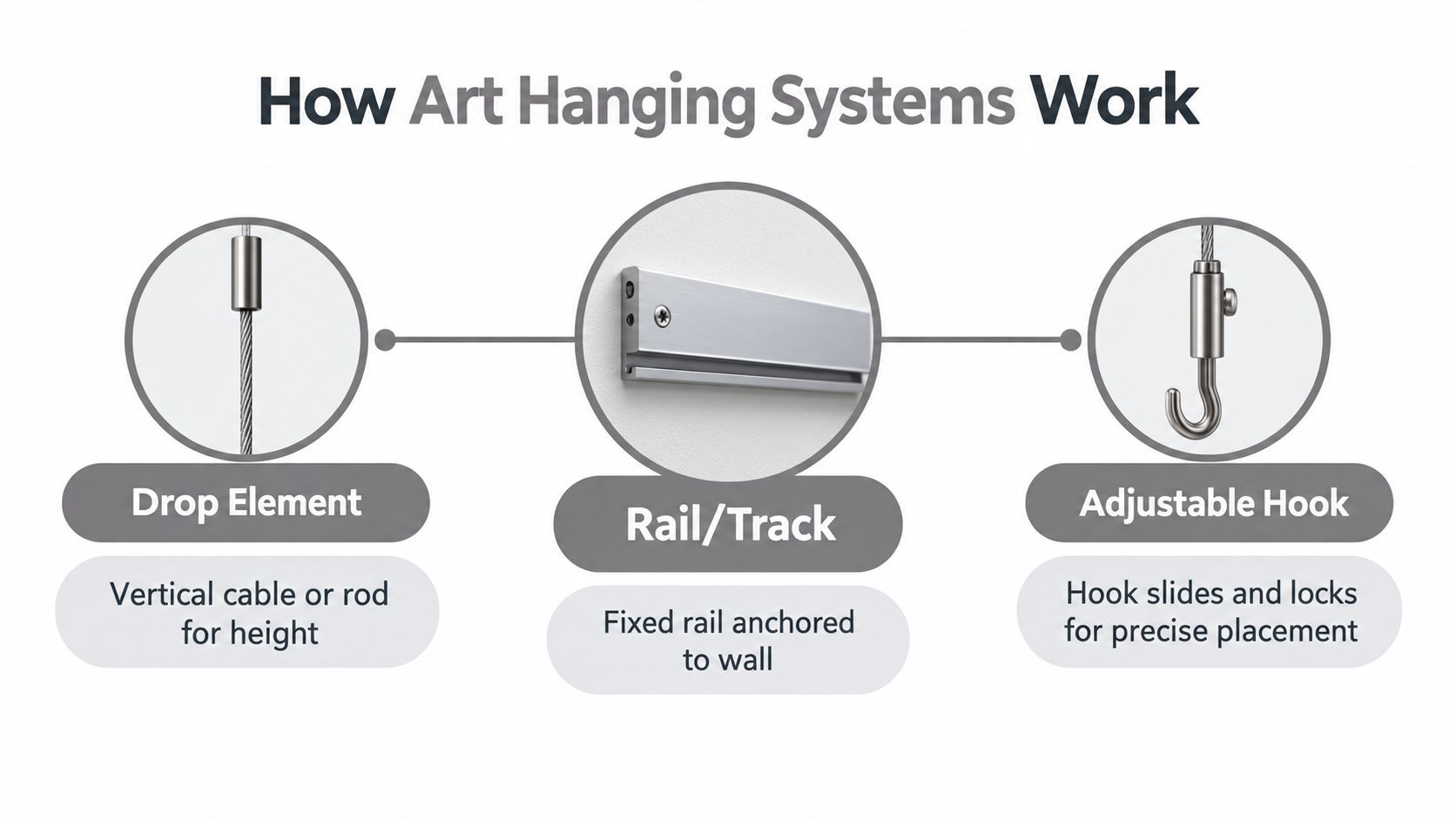
At a basic level, an art hanging system works like a curtain track for framed objects. A rail stays fixed to the wall or ceiling. A cable, rod, or chain drops from that rail. A hook or gripper rides on the drop element and holds the frame at the height you choose.
That arrangement changes the decision you make. With a nail, you choose the frame position first and drill right there. With a hanging system, you install the support structure first, then adjust the art below it. For rentals, galleries, offices, and tall rooms, that often matters more than squeezing out the highest weight rating on paper.
The three working parts
Most systems rely on three parts that pass the load from the frame into the building.
Rail or track
The rail is the fixed anchor. It mounts high on the wall or to the ceiling and stays there as the long-term support piece.
This is the part that protects future flexibility. If the artwork changes, the rail usually stays put. You are no longer drilling a new hole for every new layout.
Drop element
The drop element is the vertical hanger. It may be a steel cable, clear line, chain, or rigid rod, depending on the look and the load.
Ceiling height affects this choice more than many buyers expect. In a room with standard ceilings, a cable gives plenty of adjustment. In a tall stairwell or a corporate atrium, a rigid rod can control sway better and make the installation feel more deliberate.
Adjustable hook or gripper
The hook or gripper holds the frame on the drop element. You raise or lower it until the artwork lands where you want it.
Good grippers make fine adjustments easier, which matters when you are lining up several frames across one wall. For a practical example of this setup, Colorado Art Services shows how cable hanging systems work in adjustable displays.
How the load actually travels
The frame does not hang from the hook alone.
The weight moves in a chain. The artwork pulls on the hook. The hook transfers that force into the cable or rod. The cable or rod transfers it into the rail. The rail passes it through its fasteners into the wall, ceiling, or blocking behind the finish.
That is why two systems with similar hooks can behave very differently in real use. A modestly rated system installed into solid backing can be the smarter choice than a heavier-duty system installed in a way that limits adjustment, damages finished walls, or fights the room's height and layout.
Why this feels different from nails
A nail creates one fixed point. If the frame is too high, too low, or one inch off center, you start over with another hole.
A hanging system changes the wall into a support zone rather than a row of permanent guesses. You set the rail once, then move art side to side and up or down within the system's limits. In a home, that means fewer repairs after redecorating. In an office or gallery, it means updates happen with less disruption.
This is also why a lower-rated but more adaptable system can be the better investment. If your pieces are well within the load limit, the bigger win may be cleaner walls, better use of tall vertical space, and the freedom to rehang without calling for patching and paint every time.
The Main Types of Art Hanging Systems and How They Compare
If you search for art hanging systems, you'll run into a lot of names that sound similar. It helps to sort them by how they behave in a room, not just by catalog label.
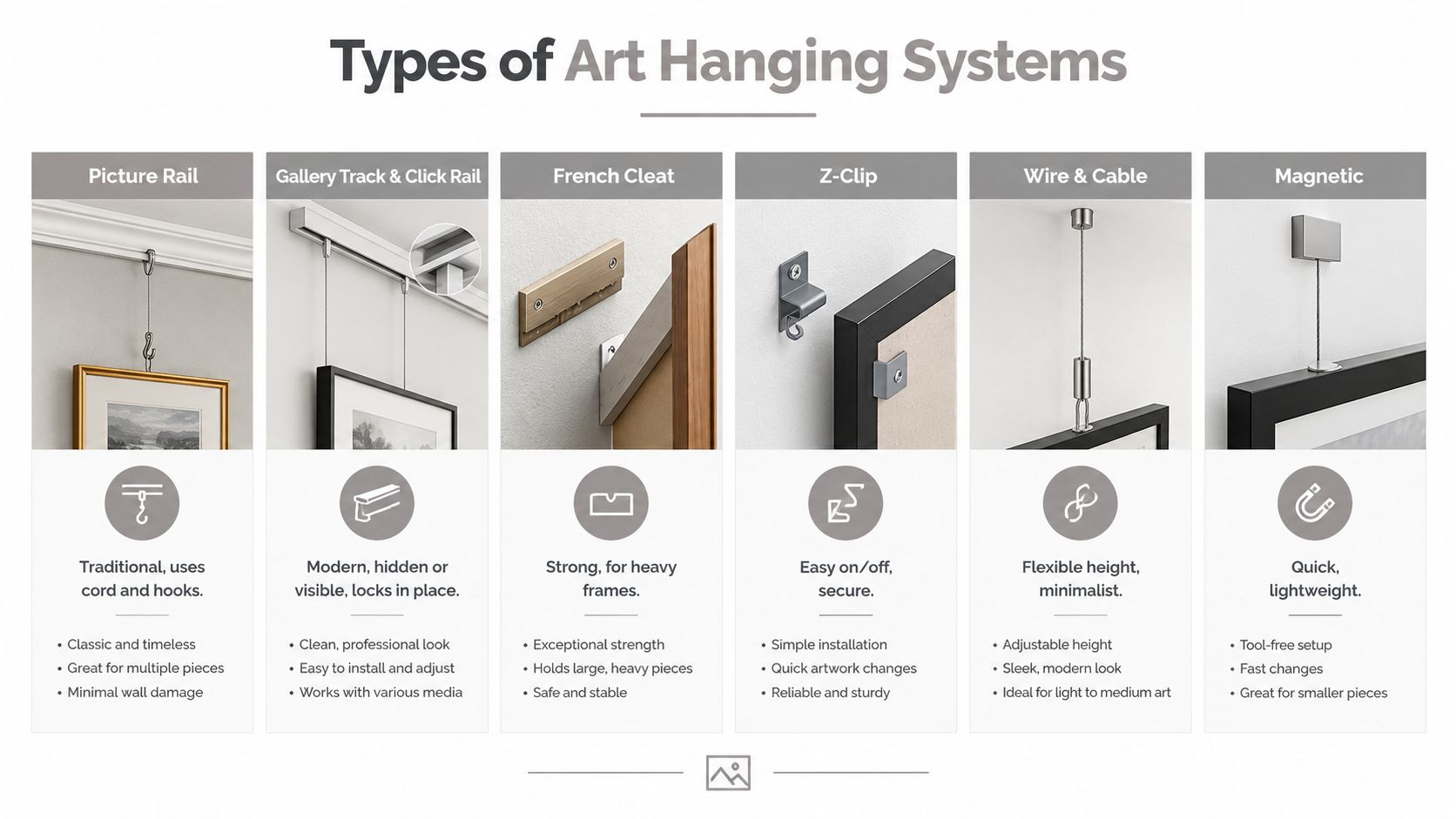
Picture rail and gallery rail systems
These are the classic adjustable systems. A rail mounts high on the wall, and cords, chains, cables, or rods hang down from it.
They're especially useful when you want to regroup art without redrilling. In a living room, that might mean replacing seasonal prints. In a gallery, it means changing a full wall quickly. If you want a modern version of this approach, Colorado Art Services also outlines the basics of a track hanging system.
Click rails and gallery tracks
These are the cleaner, more modern cousins of traditional picture rail. Some are visible as a design line near the ceiling. Others are visually quiet once painted or integrated into trim conditions.
Their biggest strength is adjustability with a finished look. They tend to suit offices, contemporary homes, schools, and exhibition spaces where frequent changes matter but the hardware shouldn't dominate.
To see several system types in action, this short demo is useful:
French cleats and Z-clips
These are less about flexible rehangs and more about secure, flush mounting.
A French cleat uses interlocking angled strips. One attaches to the wall. The other attaches to the artwork or panel. The piece drops into place and stays close to the wall. Z-clips work on a similar principle with metal hardware.
These shine when you have heavier pieces, signs, acoustic panels, or anything that needs a snug, low-profile installation. The tradeoff is that they don't offer the same casual height adjustment as a rail-and-hook system.
Wire and cable systems
These overlap with track systems but deserve their own mention because the visual effect is different. The hanging line becomes part of the look.
That can work well in modern interiors, retail, offices, or spaces where you want the display to feel light and airy. They're flexible, but some people don't like seeing the vertical lines in traditional rooms.
Magnetic mounts
Magnetic options are usually for lighter display needs or specialty surfaces and panels. They can be handy for fast swaps, but they're not a universal answer for framed art collections.
They make sense when speed matters more than long-term heavy-duty support.
Art Hanging System Types at a Glance
System Type | How It Works | Adjustability | Best For |
|---|---|---|---|
Picture Rail | High rail with hanging cords, chains, or wires | High | Traditional homes, changing displays |
Gallery Track and Click Rail | Mounted track with sliding droppers and hooks | High | Homes, offices, schools, galleries |
French Cleat | Interlocking wall and frame strips | Low after install | Heavy pieces, flush mounts |
Z-Clip | Metal interlocking clip system | Low after install | Panels, signage, secure wall-hugging installs |
Wire and Cable | Suspended display using cable-based support | Medium to high | Modern interiors, flexible layouts |
Magnetic | Magnet-based attachment for compatible uses | Medium | Lightweight or specialty applications |
Lower adjustability isn't a flaw if the goal is a clean, fixed, secure mount.
Understanding Load Capacity and Wall Compatibility
Many buyers get tripped up. They see a strong hook, or a thick cable, and assume that must be the safe load limit. In practice, the rail and wall assembly usually matter more.
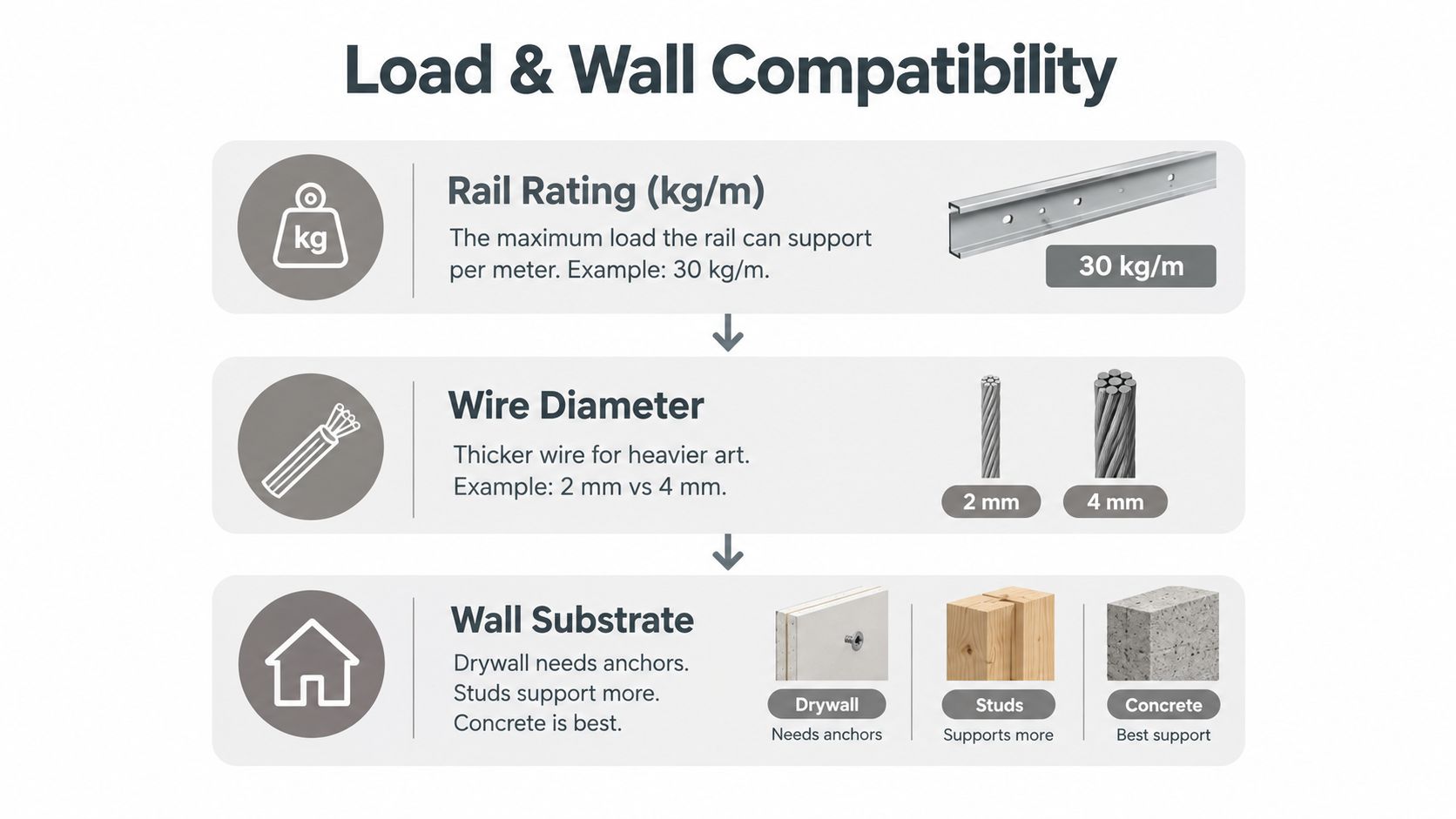
Some professional museum and gallery tracks are engineered around linear load ratings, with systems rated up to 200 kg per meter and compatible with 1.8 mm and 2.5 mm steel hanging wire in heavy-duty configurations, according to the Artiteq museum rail brochure. That detail matters because it shows how capacity is often defined across the rail length, not just at a single hook.
What a per-meter rating means
A linear rating tells you the system is designed to carry load along the mounted track. That's different from hanging everything from one screw like a giant coat hook.
Independent premium rail specifications show a common engineering range of about 50 to 70 kg per meter, with examples including 50 kg/m, about 100 kg/m from a reinforced aluminum rail listed as 68 lbs/ft, and 70 kg/m for a museum-oriented system, as shown in these premium rail specifications.
That distributed-load logic helps in two ways:
It spreads force across a longer mounted element
It supports layout flexibility because the art can move without new main penetrations
Why the wall still decides everything
A strong rail mounted into weak conditions is like bolting a sturdy shelf onto crumbling plaster. The product may be capable. The installation may not be.
Look at the wall in layers:
Finish surface such as paint, tile, paneling, or plaster
Base material such as drywall or masonry
Structural support such as studs, blocking, or solid substrate
If the fasteners don't transfer load into reliable material, the published rating won't save the installation.
For planning around anchors and substrate conditions, a practical reference is Colorado Art Services' anchor selection guide.
Common compatibility mistakes
Overtrusting the hook: The hook may be fine while the wall anchor fails first.
Ignoring spacing: Fastener placement along the rail affects how well the load distributes.
Forgetting wall finish behavior: Tile, brittle plaster, and decorative wall panels can change how you mount the system.
Using a heavy-duty rail for a light-duty wall: Capacity is only as good as the weakest part of the chain.
If you're hanging something large or valuable, treat the wall as part of the hardware.
Choosing the Right System for Residential and Commercial Spaces
A tenant swaps one framed print for a mirror. An office manager needs to update a hallway of branded graphics before a client visit. A gallery registrar has six works to rehang before opening night. All three jobs involve hanging art, but the best system for each one is not decided by weight rating alone. Wall damage, ceiling height, and how often the layout changes usually matter more.
Design coverage on the picture rail design trend reflects that shift. The conversation has moved toward room scale and placement freedom, not just how much a hook can hold. That is a useful correction, because a system that handles repeated changes cleanly often serves a space better than a heavier system that locks everything into one position.
Homes usually reward flexibility
A house rarely stays still for long. The frame above a console becomes a pair of prints. The nursery turns into a study. A large piece moves from the dining room to the stair wall.
In that setting, a rail system works like a curtain track for artwork. The main mounting line stays put, while the hanging points can shift as the room changes. That lowers the number of new holes, patch jobs, and paint touch-ups.
For rentals, that tradeoff is often the smartest one. A lower-rated system with enough capacity for normal framed art can be the better investment if it avoids repeated wall repair. Landlords notice the wall first. Guests notice the art second.
Ceiling height also changes the answer. In a tall room, a higher rail can give you longer drop options and more freedom to stack or center pieces well. In a low room, a bulky or poorly placed system can crowd the top of the wall and call attention to itself.
Offices and public spaces reward repeatability
Facilities managers usually need order more than maximum strength. They are trying to keep corridors aligned, conference rooms presentable, and updates quick enough that no one needs to schedule patching, sanding, and repainting after every graphics change.
That is why rails and cable-based systems often fit office use so well. They turn a wall update into a hardware adjustment instead of a maintenance ticket.
Wall preservation matters here in a very practical way. Every new hard point creates a small repair cycle. One hole is minor. Twenty changes across a floor of offices becomes labor, paint matching, drying time, and disruption.
Galleries, schools, and museums reward controlled change
These spaces rehang often, sometimes under deadline. The goal is precise placement without treating the wall like scrap material.
A flexible rail system helps staff shift pieces by inches, level groups, and test spacing without drilling again and again. For teaching spaces and exhibition rooms, that adaptability can be more valuable than choosing the highest-capacity hardware on the shelf. If the collection changes weekly, adjustability is part of the load requirement.
A practical way to choose by setting
Rental apartment: Favor low wall damage and easy rehangs over extra capacity you may never use.
Private home with evolving decor: Choose a system that lets one picture become a group without new holes every time.
Corporate office: Pick for repeatable alignment, quick updates, and fewer repair calls.
Gallery, school, or public display area: Choose for frequent repositioning and clean visual control.
Heavy piece that must sit tight to the wall: A cleat or clip system often makes more sense when future adjustment matters less than close wall contact.
The best choice is often the system that protects the wall while giving you enough freedom to recompose the display later. A lower-rated rail that fits the room, the ceiling, and the rehang schedule can outperform a stronger fixed-point setup because it causes less damage and asks less of the wall over time.
Installation and Maintenance Essentials That Protect Your Walls and Art
Installation starts before the first hole. The best results come from planning the line of the rail, checking the substrate, and deciding how the art will change later.
A common mistake is placing the rail only where it's easy to drill. That can produce awkward drop lengths, poor proportions, or a display that fights the room. Start with the wall and ceiling relationship first. Then locate the mounting strategy.
Before mounting anything
Think through these decisions in order:
Rail position: The height should make sense with the ceiling and the size of the wall, not just the tallest person in the house.
Wall condition: Fresh drywall, old plaster, masonry, tile, and millwork all behave differently.
Artwork behavior: One heavy centerpiece asks different things than a rotating group of framed works.
Future changes: If you know the wall will evolve, leave yourself room to adjust later.
If your biggest struggle is keeping layouts level and visually balanced, a practical outside reference is this guide on how to hang a picture straight. It's useful because the alignment habits matter whether you're using one hook or a full rail system.
During installation
Once mounting begins, precision matters more than speed.
A rail that's slightly out of level creates a problem you'll keep seeing every time you hang art from it. Fasteners need to match the substrate, and spacing needs to support the rail as a structural element rather than treating it like trim. Cables or rods should hang cleanly, and hooks should be tested under load before valuable work goes up.
Colorado Art Services provides planning, placement, and installation for adjustable rail and cable-based displays in residential and commercial settings. That's one example of where a professional installer can help when the work is high, heavy, valuable, or spread across many pieces.
Check the whole path. Rail, fastener, wall, cable, hook, and frame hardware all need to agree with each other.
Ongoing maintenance
Art hanging systems don't need much day-to-day attention, but they shouldn't be forgotten.
Inspect droppers: Look for frayed wire, bent rods, or worn connection points.
Retighten hardware: Building movement and repeated rehanging can loosen components over time.
Recheck balance: A frame that was level last season may need a small correction after being moved.
Watch wall changes: Paint buildup, minor cracks, or moisture issues can affect long-term reliability.
If the piece is oversized, unusually valuable, or installed over stairs, in double-height spaces, or on a delicate wall finish, calling a pro is usually the safer route.
How to Select the Best Art Hanging System for Your Project
Start with five questions.
How often will the display change?If the answer is “rarely,” a cleat or fixed mount may be right. If the answer is “whenever the room changes,” a rail system usually makes more sense.
What is the wall made of?A strong system still depends on a sound substrate and appropriate anchors.
How important is wall preservation?For rentals, offices, galleries, and homes with evolving layouts, fewer new holes is often the biggest win.
What does the room need visually?Some spaces benefit from nearly invisible support. Others can carry a visible picture rail as part of the design.
Is the goal maximum capacity or better flexibility?Those aren't always the same choice. A lower-rated but adaptable system can be the better investment when rehangs, reduced wall damage, and layout freedom matter more than extreme load.
If you're hanging a few modest pieces on a straightforward wall, DIY may be reasonable. If the project involves heavy art, specialty surfaces, tall placements, grouped installations, or a space where precision counts, professional installation usually saves time and prevents expensive mistakes.
Colorado Art Services helps homeowners, collectors, offices, and cultural spaces plan and install art hanging systems with careful attention to wall conditions, layout, and long-term flexibility. If you want help choosing between rails, cables, cleats, or other mounting approaches for your specific space, visit Colorado Art Services.
Comments