


Hanging Sculpture from Ceiling Safely and Securely
You've unboxed the sculpture, found the spot where it looks right, and reached for the drill. Then you lift it and realize it weighs more than you expected. Pause there. The ceiling's appearance doesn't tell you what's behind it, and the sculpture's weight alone won't tell you what each attachment point must carry.
Hanging sculpture from a ceiling is a structural decision dressed up as an art decision. The work, its cables and connectors, the building structure, and the forces created by movement all have to work together. A careful assessment before drilling protects the artwork, the building, and anyone who walks beneath it.
The Moment Before You Drill
A homeowner has the sculpture in one hand and a drill in the other. The ceiling looks solid, the chosen spot seems centered, and the work feels manageable until it's lifted into place. That pause, before a hole is made, is the right time to establish what the object weighs, what it will hang from, and how its force will reach the structure above.
The history of modern ceiling-hung sculpture helps explain why this isn't just a question of choosing a hook. Alexander Calder began developing abstract moving sculptures in 1931, and Marcel Duchamp named them “mobiles” during a visit to Calder's studio that year. Calder's first fully suspended mobile, Small Sphere and Heavy Sphere, followed in 1932–1933. Its suspended elements moved and struck one another as air currents changed, joining visual movement and sound in the work (Calder catalogue text from the Neue Nationalgalerie).
That legacy still matters in homes, galleries, and public spaces. A mobile responds to its surroundings: airflow can turn it, a cable arrangement can affect its balance, and a poorly chosen attachment can concentrate force where the ceiling can't safely resist it. What looks like a graceful object in the room is also a load moving through a series of connected parts.
Before drilling, define the load path. Follow the force from the sculpture through each cable and connector to an attachment that reaches the building's structure.
Write down the questions that determine whether the installation can proceed: What's the sculpture's full weight with hardware? Where are its intended attachment points? Does it move, and could that motion load the supports unevenly? What structural material is above the visible finish? Are utilities in the way? If any answer is unknown, choosing an anchor is premature. The costly mistake isn't taking time to assess the job. It's making a hole before knowing what the hole needs to connect to.
Weighing the Piece and Finding Its Center of Gravity
A sculpture's appearance is a poor guide to its weight or balance. Start with the object itself, not an estimate based on size or material. Check for maker-provided suspension points and installation instructions first. Don't drill, clamp, or tie onto an artwork unless its design permits that method.
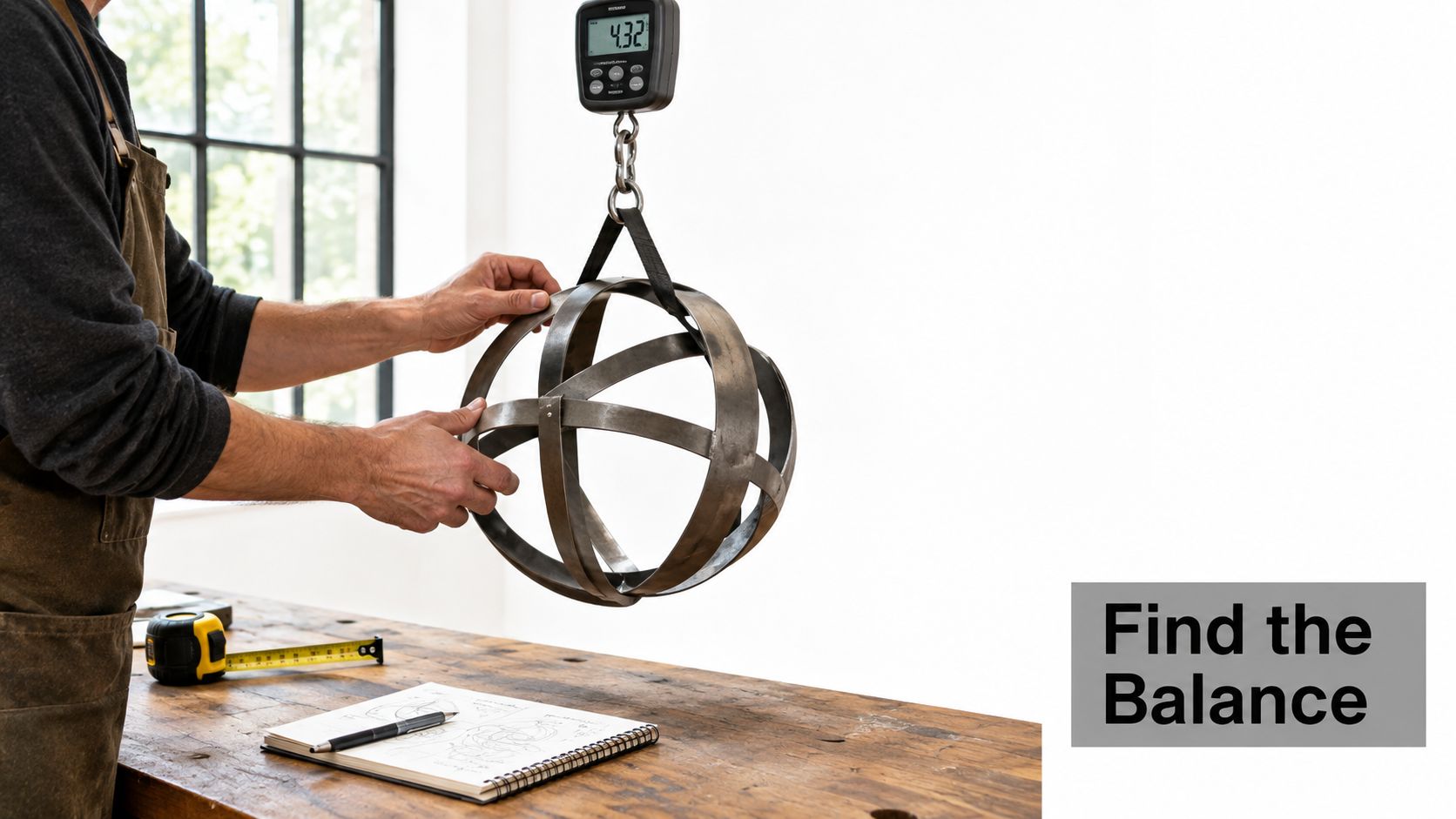
If the artist or fabricator hasn't supplied a verified weight, use a suitable scale. A bathroom scale can work for a stable object that can be safely supported and weighed without tipping; a luggage scale can help measure a suspended load when the attachment method is secure and appropriate. Don't improvise a test lift using an unverified hook or a fragile part of the sculpture. For valuable, delicate, or awkward pieces, ask the fabricator or an art installer to weigh it safely.
Record more than the total weight
Make an install sheet with the sculpture's weight, dimensions, materials, intended attachment points, and any hardware that will remain suspended with it. Note whether the piece is static, kinetic, or motorized, and identify lighting or wiring attached to it. Keep the record with the artwork so future handlers aren't left guessing.
For an asymmetric piece, the total weight doesn't tell you how much force reaches each attachment point. A practical balance check can help reveal the center of gravity: when suitable and safe for the object, suspend it temporarily from one known support point, observe its resting orientation, then repeat from another point. A hanging rod can help position the temporary support without gripping the artwork directly. The point is to understand how the object settles, not to treat an informal test as an engineered load calculation.
That distinction matters because cables at different positions or angles won't necessarily share the load equally. An offset center of gravity, angled lines, or a support that goes slack can increase the reaction at another point. Record the suspension geometry and have the per-point reactions assessed before selecting anchors.
Also identify what's concealed above the ceiling before making any hole. A scale tells you about the sculpture, not the joists, slab, wiring, or pipes that will determine whether the proposed location works.
Identifying What Is Above Your Ceiling
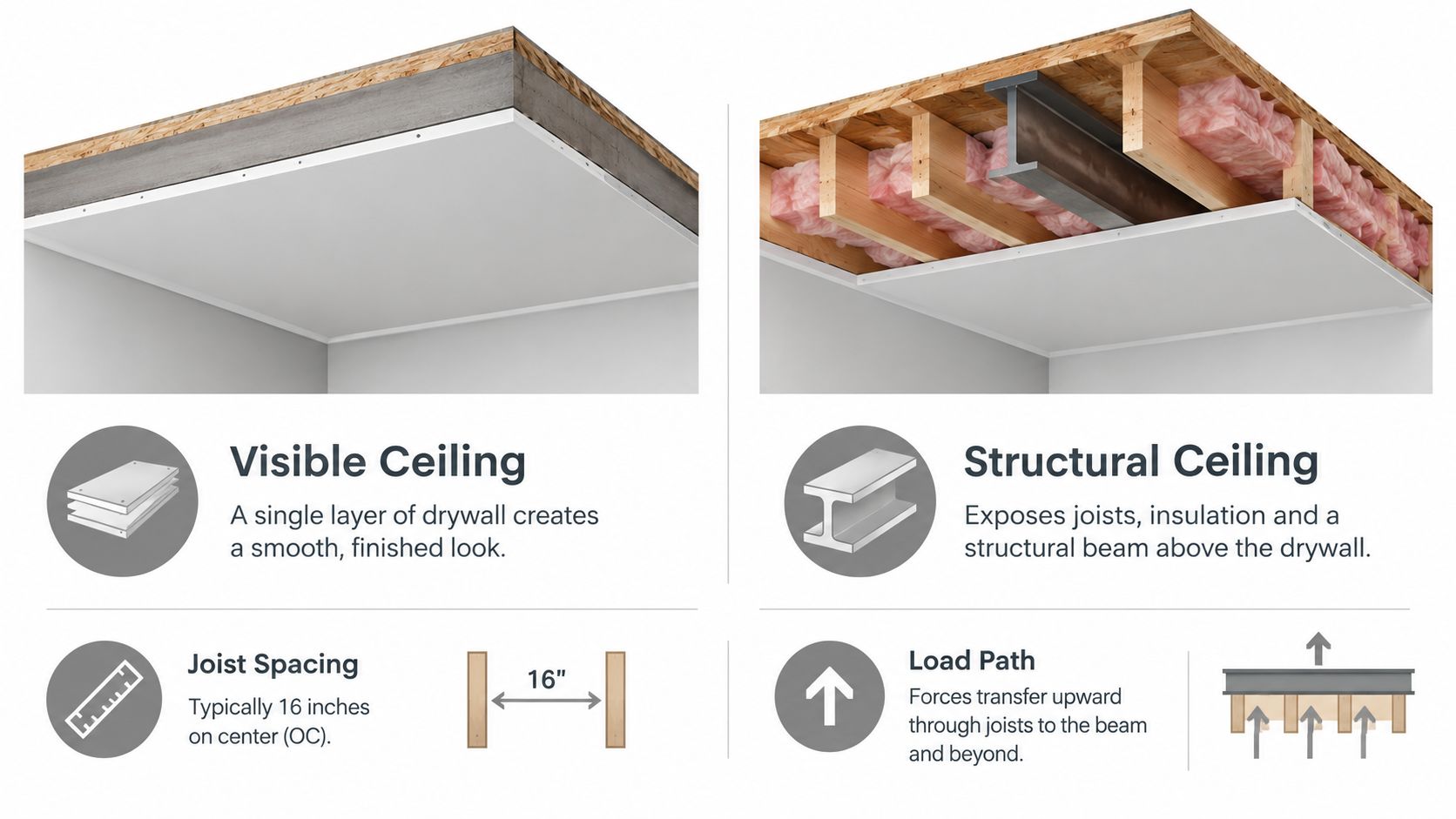
The surface you see is usually a finish, not proof of structural support. A drywall ceiling may conceal joists or a concrete slab; a decorative baffle may hang from a separate support system; a tile ceiling may have a grid designed to carry ceiling components, not a sculpture's concentrated or moving load. Before choosing an anchor, confirm what the anchor will engage.
Match the ceiling to its structure
What you see | What may be above it | What to confirm |
|---|---|---|
Drywall or plaster ceiling | Wood joists, steel framing, or a slab | The actual structural member and its condition |
Exposed beam or joist | Structural timber or steel, or a decorative element | Whether it's designed to carry the proposed load |
Concrete finish | Structural concrete or a separate finish layer | Slab location, utilities, and an anchor suitable for that substrate |
Suspended tiles or baffles | Ceiling grid, hangers, and structure above | A direct, engineered connection to primary structure |
A stud finder can help locate framing, while a rare-earth magnet may help identify fasteners or metal components. Neither tool proves a support is suitable for the sculpture. Building drawings, a careful inspection, and, where appropriate, a small exploratory opening can help verify the assembly. Before cutting or drilling, check for concealed electrical, plumbing, HVAC, sprinkler, and fire-protection systems.
For help locating framing, review joist spacing tips from HomeProBadge. Treat any location estimate as a starting point, not confirmation that a joist is accessible, sound, or adequate for a concentrated sculpture load.
Don't mistake a finish system for a support
Suspended-ceiling grids, mineral-fiber tiles, plasterboard, and decorative baffles should be treated as finish systems rather than structural supports. The support must reach a suitable slab, beam, joist, or engineered transfer structure, and each attachment point needs a documented reaction load. Don't divide the sculpture's weight evenly between points without accounting for eccentricity, cable angles, unequal tension, or the possibility of a slack or failed cable (ceiling-suspension planning guidance).
Once you know the substrate, an installer or engineer can specify a compatible anchor and connection. If you can't confirm what's overhead, don't proceed on the assumption that a stronger-looking hook will solve the problem. It won't turn a finish system into a structural support.
Calculating the Actual Load on Every Anchor
Start with the verified weight of the piece, then add everything that will hang with it: suspension cable, shackles, turnbuckles, connectors, integrated lighting, and the secondary restraint itself. As a working allowance, I add 10% to 20% on top of the listed weight for rigging hardware, because the cable package on a large mobile can weigh more than people expect. I have watched installers approve an anchor rated to the bare sculpture weight, then exceed that rating once the turnbuckles and safety line went in.
Then trace the load through the attachment geometry. Two cables sharing a hang rarely split the weight evenly, and cable angle changes the math fast: at a shallow angle to the ceiling, the tension in each leg climbs well past half the piece's weight. Balance matters the same way. Calder spent years tuning mobiles so each arm found equilibrium at its pivot point, and any off-center attachment does to your anchors what a misplaced pivot did to his mobiles: it shifts load onto one connection and unloads the other. The output you want is a documented reaction load at every anchor.
Read the hardware rating correctly
Breaking strength and working load limit are different numbers, and only one of them belongs in your calculation. Use components with a stated working load limit suited to the application, and follow the manufacturer's installation requirements. For rigging components covered by the construction rigging standard, the assembly and its attachment points need specified maximum capacities, with a 5:1 safety factor applied (OSHA rigging guidance). On permanent installations over occupied space, the engineers who have signed off my jobs have asked for design factors of 8:1 to 10:1 for life-safety exposure. Neither factor substitutes for engineering judgment on an unusual hang.
Hardware | Typical Working Load | Best For | Key Caveat |
|---|---|---|---|
Rated wire rope or suspension cable | Use the manufacturer's rating for the exact cable and termination | A fixed suspension line with a documented load | Termination, wear, and cable angle affect performance |
Rated shackle or quick link | Use the marked or documented rating | Connecting compatible rigging components | Don't side-load or substitute unmarked decorative hardware |
Turnbuckle | Use the manufacturer's rating and installation instructions | Fine adjustment when the connection is designed for it | Secure against unintended loosening |
Structural anchor | Specify for the verified substrate and reaction load | Connecting the rigging to primary structure | An anchor's capacity depends on the substrate and installation |
A kinetic piece fails the static-weight test the moment air moves through the room. Acceleration, stopping, vibration, and years of repeated small movements impose demands beyond resting weight, which is why a permanent installation gets an independent secondary safety cable or restraint wherever a failure could reach people below. For larger or geometrically complex works, grid and large-format installation services are worth pricing alongside a qualified rigger and a structural professional.
The Installation Day Sequence
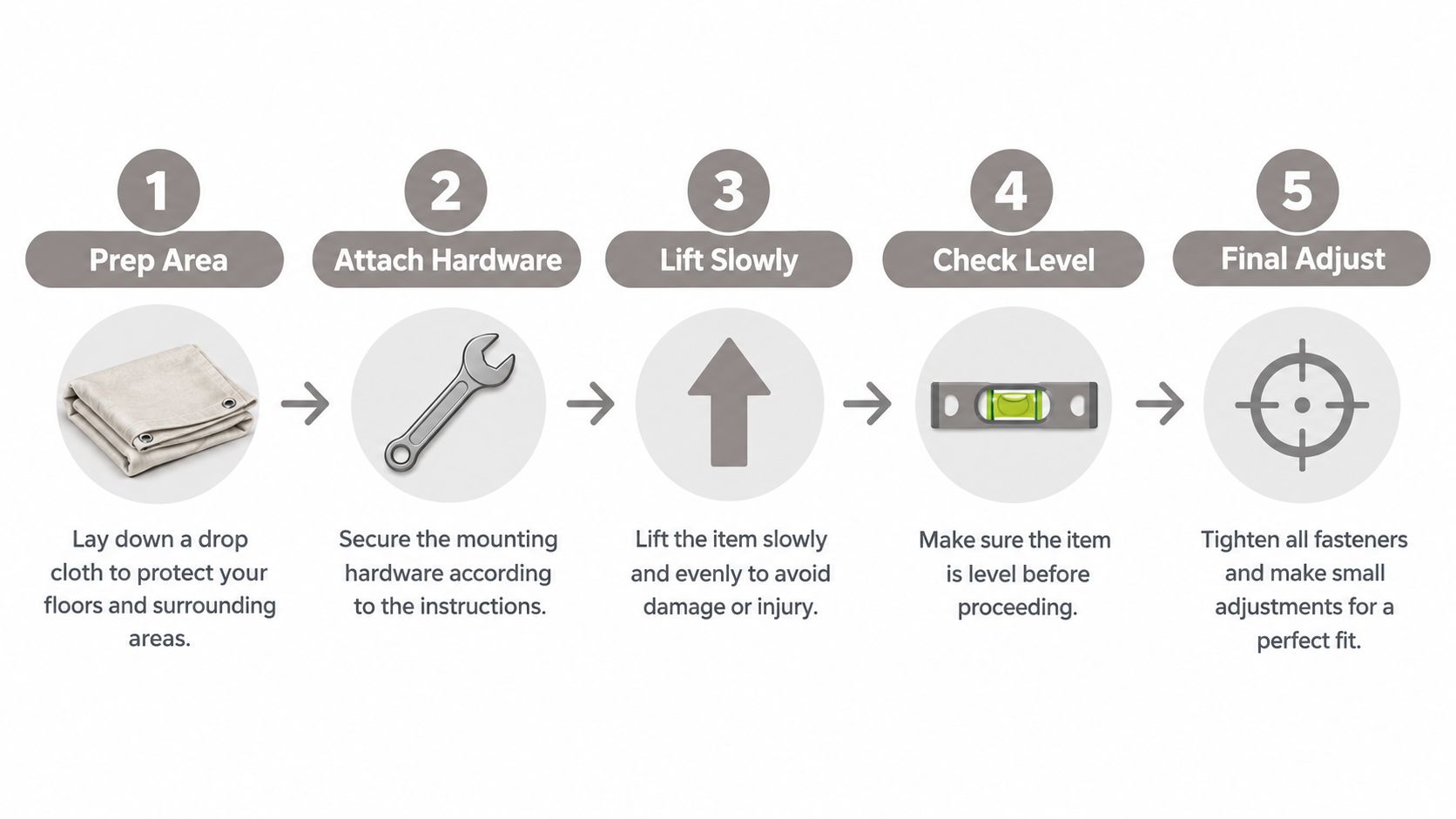
A sound installation begins before anyone lifts the artwork. Prepare a written rigging plan that records the verified load, attachment geometry, rated capacities, travel path, exclusion zone, access equipment, and agreed communication signals. Everyone involved should know who directs the lift and who watches the anchors and ceiling services.
OSHA's cited rigging guidance requires inspection before each shift and again during use when service conditions warrant. Damaged or defective components must be removed from service; the load must be rigged to prevent unintended displacement, hooks need self-closing safety latches or an equivalent retention method, and a qualified rigger must rig the load (OSHA rigging guidance). Keep people out from beneath the suspended load, and barricade the area so occupants don't enter the lift path.
Make the lift controlled and observable
Before lifting, inspect the slings, cables, shackles, latches, anchors, and secondary restraint. Confirm that each component is the specified one, correctly connected, and free of visible damage. Photograph the rigging for the installation record, but don't let documentation replace the physical inspection.
Raise the sculpture only enough to take up the rigging and perform a low-height test lift. Watch for unexpected tilt, cable slip, anchor movement, changing tension, or contact with sprinklers, lights, ducts, or other ceiling services. Stop if anything shifts or behaves differently than expected. Don't correct an unexplained tilt by tightening a turnbuckle while the load is suspended; lower the piece and reassess the geometry.
If the test is stable, continue the lift with the exclusion zone maintained and one person communicating clear instructions to the crew. At final elevation, check the sculpture's position and movement, secure any adjustment hardware as specified, and confirm that the secondary restraint is independently attached. A careful residential installation still needs that same disciplined approach; the room may be private, but a falling or swinging object can injure someone or damage the artwork. For a home project involving delicate, heavy, or hard-to-reach work, residential art installation services are one professional option.
Close out by recording the final hardware, attachment locations, ratings, photographs, and inspection intervals. That record gives the next installer a reliable starting point instead of leaving them to infer how the sculpture was hung.
Hazards That Weight Alone Does Not Predict
A light sculpture isn't automatically a safe one. A static object and a moving mobile behave differently, and a work that swings near a walkway can put people at risk even when its resting weight is modest. The important question is how the object, its movement, its height, and the room interact.

Kinetic pieces need assessment for acceleration, stopping, vibration, and cyclic loading, not just the force they exert while still. Moving parts may strike someone nearby, and a low cable or loop can snag, entangle, or invite a child to pull. Sharp edges, openings that could trap fingers, climbable forms, combustible materials, and energized lighting also deserve attention. These are hazards associated with the object and its use, not just its weight.
Check the room as carefully as the sculpture
Map how people move beneath and around the work. Consider whether a swinging element can enter a circulation path, whether a child can reach or pull it, and whether the piece obscures sprinklers, exit signs, or access to emergency equipment. Coordinate the location with lighting, HVAC, fire protection, and required egress. A sculpture can be securely attached and still be badly placed.
FEMA's guidance recommends checking diagonal bracing, compression struts, and the security of decorative ceiling components. It also advises safety cables for hanging sculptures to limit excessive swinging or falling during earthquakes. The same guidance identifies hazards such as sharp edges, entrapment openings, combustible materials, electrical energy, moving components, and hanging cables (FEMA 74 field manual).
A restrained sculpture can still be a hazard if it swings into people, blocks an exit route, or creates a reachable loop.
In earthquake-prone areas, ask a qualified professional whether the ceiling support and restraint plan suit the building and sculpture. The region's seismic conditions matter, but no location should be treated as exempt from considering movement, attachment security, or what might happen after an impact.
Before leaving a piece in place, review its clearances, moving parts, cable routing, edge conditions, electrical components, and relationship to exits and building systems. Set an inspection routine that fits the installation and its environment, and recheck it after an earthquake, impact, or unexpected change in movement. Safety is an ongoing condition, not a box checked when the sculpture first reaches its final height.
When to Call a Professional Installer
A confident homeowner may be able to hang a small, static sculpture when its weight and attachment points are known, the ceiling structure is confirmed, and the connection is straightforward. Stop and bring in qualified help when the substrate is uncertain, the work is kinetic or motorized, the suspension has multiple points with unequal reactions, or a failure could endanger the public. Commercial and institutional spaces also bring coordination and life-safety requirements that a private room may not.
The scale of a sculpture can mislead. The Metropolitan Museum of Art records a Calder mobile from 1941 in two sections weighing approximately 2.7 pounds and 0.9 pounds, while the National Gallery of Art reports that Calder's East Building atrium mobile weighs 920 pounds and was designed to move solely through air currents (Met collection record). Those examples underline why visual size alone can't establish a safe installation method.
Ask for decisions you can verify
A qualified installer or structural professional should be able to explain the load path, identify the verified substrate, document the reaction at each attachment, and specify compatible rated hardware. For a public or complex installation, ask how the plan addresses dynamic movement, secondary restraint, access, nearby building systems, and ongoing inspection. Don't accept a vague assurance that a hook or ceiling grid is strong enough.
Before hiring, ask:
What will support the sculpture? The answer should identify the primary structure, not just the visible finish.
How are the loads determined? Request the weight and attachment geometry used to assess each support.
What happens if a primary connection fails? Confirm whether an independent secondary restraint is specified.
How will the lift be controlled? Ask about the rigging plan, exclusion zone, and inspection of components.
What will be documented? Keep records of installed hardware, capacities, photographs, and inspection needs.
Colorado Art Services offers residential and commercial art installation, including sculpture and heavy-piece mounting; commercial installation services may be relevant when a project involves a workplace, gallery, or other public setting.
Save the installation record and revisit it if the sculpture moves, the room changes, or the building experiences an earthquake or impact. If you can't verify the support, calculate the attachment loads, or manage the lift safely, pause the project and bring in a qualified installer or structural professional.
Colorado Art Services provides sculpture hanging, heavy-piece mounting, and residential and commercial art installation across the Denver Metro area and Front Range. If you're planning a ceiling installation and want help assessing placement, support, and rigging needs, visit Colorado Art Services to discuss the project.
Comments