


Art Consultant Explained: Role, Process and Fees
The wall above the sofa has been empty for eight months. You've saved the money, measured the space twice, and still haven't bought anything, because every time a piece almost convinces you, a quieter voice asks whether it's any good, whether the price is right, and what happens if you spend five figures and fall out of love with it in a year.
That paralysis isn't a taste problem. It's an information problem, and it's the reason people pay an art consultant.
The same problem runs larger elsewhere. A company closes on a new headquarters, the furniture arrives, and forty works arrive with it, none of them tested against the building.
What an Art Consultant Does and Does Not Do
Say a company buys forty works for a new headquarters and then discovers nobody on staff can say which pieces belong in the lobby, which need glass and a dimmer, or whether the prices were fair. That gap between owning art and knowing what to do with it is where an art consultant works.
The role is a paid advisory one. Plan the collection or the display, find and vet the works, check price and paperwork, then coordinate the people who crate, move, hang, insure and light them. The consultant is the architect of the project; the installer is the builder. One designs the plan and tests it against what the client needs, the other executes it to the millimetre.
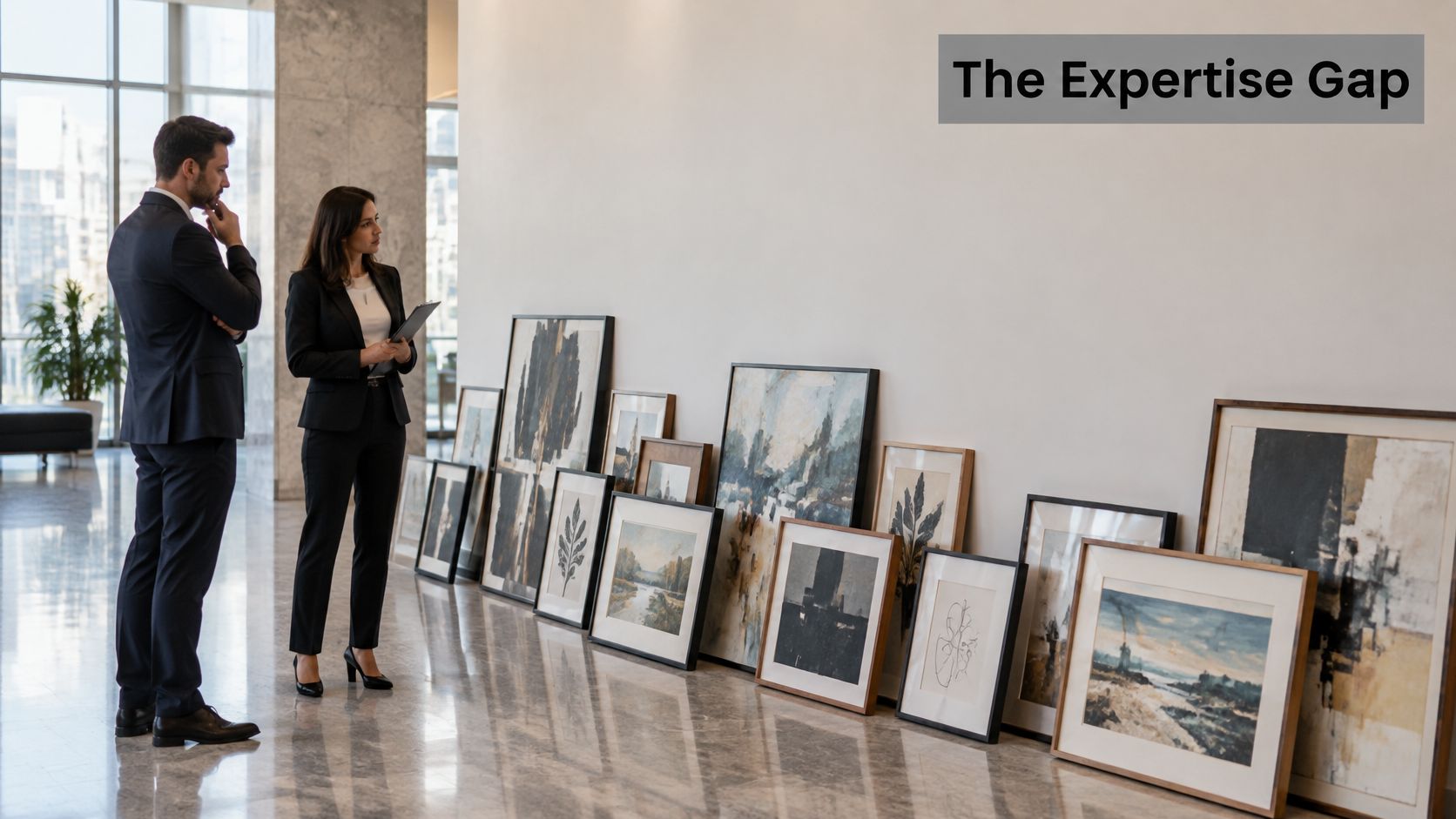
A plan on paper is where most of the money is saved or lost, so it's worth seeing one being discussed rather than described.
Private collectors hire for this. So do corporate offices, hotels, galleries, museums and homeowners whose collection has outgrown the wall space. Ownership tends to follow experience: the Art Basel and UBS art market report for 2022 found that 15% of collectors with more than 20 years of collecting experience used an advisor, against 5% or less among collectors who had been collecting for up to 10 years. The same report put buying through an advisor at an average of 6% of collectors' purchasing channels in 2021, and cautioned that the number understates influence, because consultants often do the research before a client walks into a gallery and buys direct.
The global market is crowded. Artprice's review of the 2023 auction market counted more than 1 million artworks offered at auction worldwide, producing roughly 763,000 transactions, with 35% of global auction turnover generated in the United States and 33% in China. Pricing a painting in Denver against what the same artist fetches in Hong Kong is part of the job description, not a bonus.
Here's how the roles split once a project involves more than one professional.
Task | Art consultant | Interior designer | Professional installer |
|---|---|---|---|
Brief, goals and budget | Defines and documents | Sets palette and style | Not involved |
Sourcing and shortlisting works | Leads | Sometimes recommends | Not involved |
Provenance and condition review | Leads | Not usually involved | Not involved |
Placement and grouping plan | Leads, with designer input | Leads on room fit | Not involved |
Hanging, anchoring and leveling | Oversees, does not usually hang | Not involved | Leads |
Crating, transport and storage | Coordinates vendors | Not involved | Often handles or subcontracts |
Four signs you need advice, not just a hanging crew: you're buying several pieces at once, you're working in a market you don't know, the deadline was set by someone else, or one purchase carries more value than you'd be relaxed about losing. Two of those and an advisor's fee is usually cheaper than the mistake.
How an Art Consultant Works From Brief to Handover
Every engagement looks different on the surface and follows the same spine underneath. Here is that sequence, with the reason each step exists rather than a description of the paperwork.
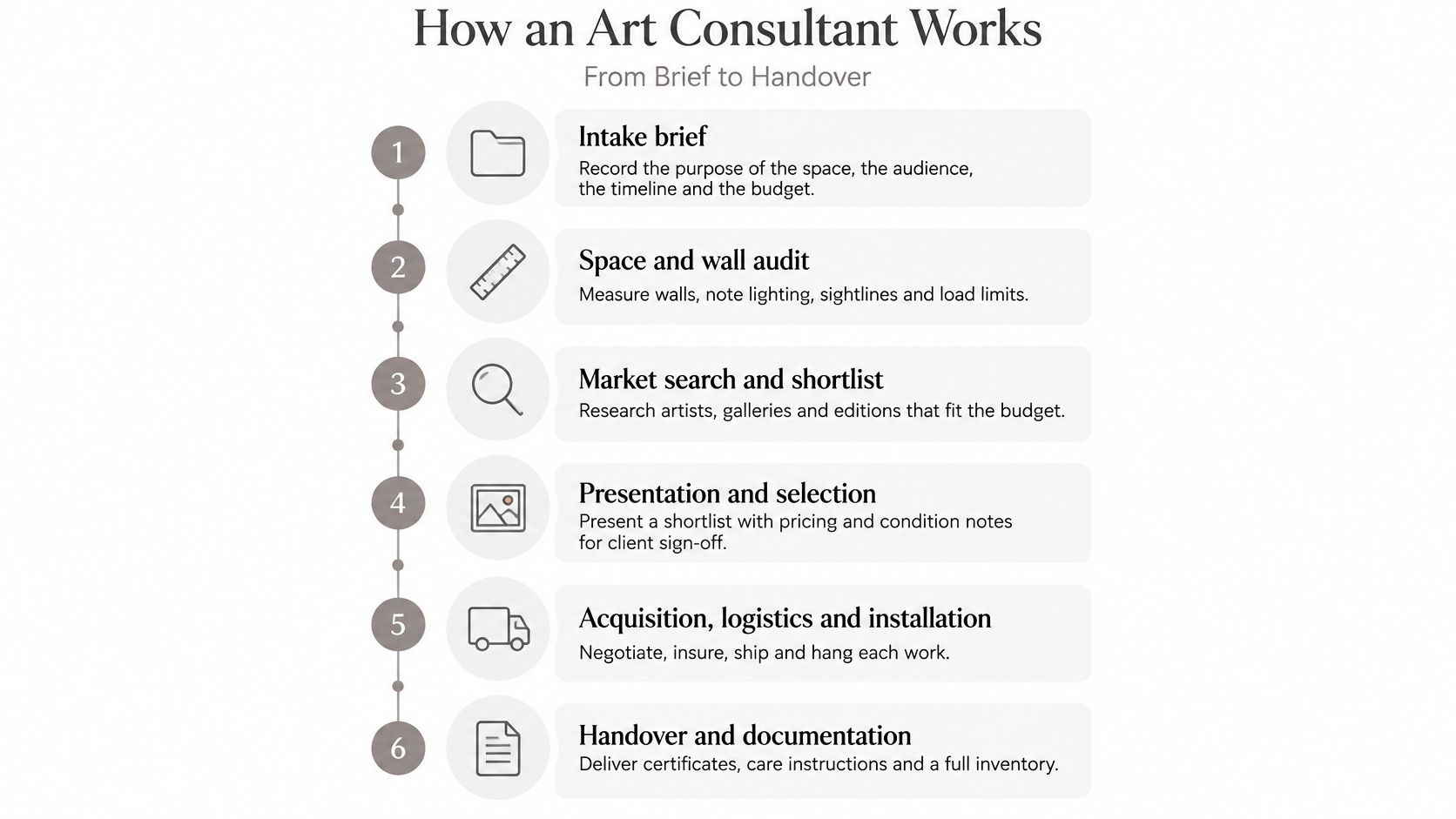
Intake brief. Record what the space is for, who walks through it, the timeline, and the budget with framing, crating and installation money already carved out. A brief that says "something modern for reception" guarantees a shortlist you'll reject three times, and each rejection costs a week.
Space and wall audit. Measure the walls, note window orientation, HVAC vents, radiators, existing fixtures, ceiling height and what the wall is built from. Projects lose money because the two-metre oil you fell for sits directly above a radiator that cooks it every winter.
Market search and shortlist. Six to twelve works, each with an image, dimensions, price, edition size where relevant, and one line on why it fits the brief. More than twelve and the client picks by colour instead of by merit.
For a client-facing overview of the delivery end, this short walkthrough is worth ten minutes before the first meeting.
Due diligence. Verify the ownership chain, condition report, edition and publication records, resale restrictions, and the seller's right to sell. This is the only step that can kill a purchase, and killing it early is much cheaper than discovering the problem at resale.
Price and terms review. Compare the ask against documented sales of comparable works by the same artist, confirm in writing who pays whom, and log the alternatives you rejected and why. The record protects the client and the consultant alike.
Layout plan. A scaled drawing or mockup showing groupings, centre-line heights, spacing, sightlines, fixture positions, and which pieces need a different wall or a different room. Installers can't guess, and when they do, you pay twice.
Handover. Give the installer a schedule, a hanging specification with heights and hardware, a photo of each work, and a file with every document you verified.
A clean handover produces three things: a signed layout, a documented file per work, and a written list naming who carries insurance, transport and storage risk after the last anchor goes in. If a project ends with a beautiful wall and no paperwork, the consultant stopped one step early.
Selection Criteria Beyond Personal Taste
Appearance gets a work onto the shortlist. Evidence decides whether it stays. Consultants judge on artist track record, medium, size, condition, exhibition history and current market liquidity before anyone argues about whether they like it.
Provenance is where this stops being admin. A study published in the Journal of Cultural Economics analyzed provenance records from 656 Post-War and Contemporary Art auctions, drawn from catalogues at two leading international auction houses, and found those records carry measurable information about how a work has moved through the private market. That information can be folded into valuation models, including liquidity signals that influence auction reserves and seller guidance.
In practice, one file per work: ownership history, exhibition and publication records, invoices, certificates, condition reports, restoration disclosures. Then the harder discipline of separating what is proven from what is merely stated.
Verified versus asserted: an original invoice naming the buyer is evidence. "From a private European collection" with no name attached is an assertion, and it should be priced like one.
Red flags worth walking away from:
A gap in the ownership chain with no explanation and no supporting document.
No condition report, or one written by the seller with no conservator named.
Restoration disclosed verbally only, never in the file.
A seller who won't share documents before you commit, which usually means there's something to find.
Weigh provenance alongside the artist, the medium, the condition and the liquidity. A flawless chain on a minor work doesn't make it a better buy than a strong painting with one documented gap. If the goal is furnishing a room rather than building a collection, spend the money on walls first, and a working guide to shopping for art on a budget will take you further than a paid engagement. On the Front Range, local supply also shapes what's realistic, and knowing where art is for sale in Denver keeps a shortlist honest about both price and availability.
Placement and Lighting Standards by Medium
The medium sets the limits. Get this wrong and the loss doesn't show up for three years, and by then it can't be reversed. Light damage on paper is cumulative and effectively permanent; no restoration brings faded pigment back.
Medium | Maximum light | Relative humidity target | Placement note |
|---|---|---|---|
Works on paper, textiles, watercolors, photographs | 50 lux | Stable range, avoid sustained below 35% or above 65% | Keep out of direct daylight and UV |
Oil paintings and less light-sensitive organic materials | Up to 200 lux | Stable range, avoid sustained below 35% or above 65% | Keep clear of vents and radiators |
Sculpture in stone or metal | No photochemical limit, shield from direct sun | Stable range, avoid sustained below 35% or above 65% | Check for thermal swings near windows |
Those figures come from U.S. Department of the Interior museum standards, which recommend a stable relative humidity range and warn against sustained levels below 35% or above 65%, since extremes and swings accelerate deterioration and raise mould risk. The same standards cap illuminance at 50 lux for especially light-sensitive objects and allow up to 200 lux for oil paintings and many less sensitive organic materials.
The controls that matter in a real room
Identify the medium before choosing the fixture. A watercolor in a sunlit lobby and an oil in a shaded corridor need different walls, not just different bulbs.
Cut daylight and UV at the source. Blinds, film or a rehang beat a stronger lamp every time.
Specify dimmable or timed fixtures. A dimmer at 30% preserves what a switch at full power destroys.
Keep works off HVAC vents and radiators. Moving a piece two metres sideways is the cheapest conservation work you'll ever commission.
Record the targets in the project file. Humidity and illuminance numbers written into the handover survive staff changes and renovations.
For a corporate lobby, that can mean a timed circuit running only during business hours, with the works on paper rotated seasonally rather than displayed permanently. These controls cost a fraction of restoration and prevent most of the damage restoration can't fix.
Fee Models and Conflicts of Interest to Check
Here's the part most guides skip. Access is not the same as impartiality. A consultant who can get you into a gallery's back room or onto an artist's studio list has a relationship that costs money to maintain, and that relationship carries incentives you may never see.
Model | How the consultant is paid | Main conflict risk | Request in writing |
|---|---|---|---|
Fee-only advice | Hourly or flat fee from the client | Low, no sale commission | Scope, hours and rationale for each recommendation |
Buyer-paid advisory, no transaction compensation | Client pays the fee, sellers pay the consultant nothing | Low to moderate, may still depend on gallery access | Total price, alternatives considered and provenance limits |
Hybrid advisory | Client fee plus dealer or gallery commission or discount | High, incentive to steer toward commissioned works | Every commission, discount and ownership interest declared |
Recent collector research identifies transparency, including opaque pricing, hidden fees and conflicts of interest, as a leading concern, and 30% of collectors rely on art advisors for advice, according to the Holland Ridge Group advisory practice. That's a lot of people taking recommendations whose financial plumbing they haven't inspected.
Before any recommendation is made, get these documented: the total purchase price, every form of advisor compensation, the alternative works that were considered and rejected, any provenance limitation, resale restrictions, and who controls installation, insurance, transport and storage decisions.
Ask at the first meeting: who pays the consultant if you don't buy, and whether they will share documented comparable sales to support the price. Clear answers to both are worth the fee. Deflection is an answer too.
Fees get quoted differently by model: an hourly or flat project fee for fee-only advice, a client-side fee for buyer-paid advisory, and a dealer commission or retained discount inside hybrid arrangements. No published rate range holds across markets, so request a written quote with the total cost before assuming a number. If a consultant coordinating several vendors won't state where aesthetic advice ends and paid project services begin, treat the recommendations with caution, and treat any reluctance to put compensation in writing as the answer.
Three Projects Where a Consultant Changes the Result
These three composites are assembled from ordinary project decisions. They're illustrations rather than case reports, and in each one the value sits in the choice made before anyone touched a wall.

A dining room that needed twelve works on paper
The family wanted a salon-style wall of a dozen framed pieces, and the room had two tall south-facing windows. Left alone, the obvious move is twelve frames under bright spotlights, which is how pastel drawings and watercolors die. The consultant grouped the set by palette and subject, capped the fixtures at 50 lux on a timer, and planned a rotation so only eight hung at once with the rest stored flat. The risk avoided was invisible: fading that wouldn't show until the work was worth less than they paid.
A first serious painting, two candidates
A homeowner had narrowed a five-figure decision to two works of similar size and price. One came with a complete chain of invoices and exhibition records; the other arrived with a certificate and a story. The consultant requested the seller's documents, got nothing usable on the second piece, and recommended the first. The buyer avoided a title and authenticity risk that would have surfaced at insurance, at resale, or at both.
A gallery install with four days on the calendar
A show opened on a Friday and the space became available on a Monday. The consultant coordinated crating, transport and a hanging plan so the installer arrived with a complete file, a signed layout and hardware spec in hand. One visit instead of two, no re-hanging, and no scuffed corner from moving a piece twice. The risk avoided was a rushed install with a second crew call billed at weekend rates.
The same discipline scales to a workplace. A guide to office wall art design covers how groupings, sightlines and light limits get planned across a whole floor plate rather than one room.
What you're actually paying for: the decisions made before a hammer touches a wall. Everything after that is execution.
Deciding Between a Consultant, an Installer or Both
The rule is simple. Hire a consultant when the works still have to be chosen, bought or planned. Hire an installer when they're already selected and the job is hanging, leveling, mounting a heavy piece or reaching a high ceiling. Hire both when the project runs from selection to wall, with the consultant planning and vetting and the installer executing to the same specification.
Three things to settle before you sign:
Is the scope in writing? It should state which tasks the consultant leads and which the installer leads, with nothing left as "we'll figure it out on the day."
Is every form of compensation disclosed? The arrangement, the rate and any dealer-side money, in writing, before recommendations start.
Does a layout plan exist before anyone is booked? Groupings, heights, fixture positions and light limits, drawn and signed.
If the job is hanging only, it helps to know what the crew will do on the day, and this outline of professional art installation sets out the sequence from wall check to final level.
If you're in the Denver metro or along the Front Range, send a short description of the space and the works to Colorado Art Services and ask for a free estimate. Whether you need advice, installation or both, that conversation is cheaper than a second visit.
Colorado Art Services handles the half of this work that happens after the decisions are made: placement and layout design, commercial and residential art installation, grid and large-format displays, heavy-piece and high-placement mounting, sculpture and mirror hanging, plus secure short- or long-term storage for works that come off the wall. If your project is past the choosing stage, or you want a hanging plan reviewed before anything goes up, visit Colorado Art Services with photos of the space and the dimensions of your pieces, and the team will scope the install and schedule it around your building.
Comments