


Art for Sale Denver: Where to Buy and Install
You're standing in a bright Denver living room with your phone in your hand. A photograph you saved last night looks perfect on the screen, calm and confident, and then you look up at the actual wall. It's wider than you remembered, the afternoon sun hits it directly, and you have no idea whether it's drywall over studs or something less forgiving.
That gap between liking a work and living with it is where most art purchases stall. This guide closes that gap step by step, so you can judge Art for Sale in Denver by what matters after the image catches your eye: what the object is, what paperwork comes with it, whether your wall and light suit it, and who moves and hangs it safely.
Start with the Wall Not the Listing
A buyer at a RiNo opening falls for a large painting on Friday night. By Saturday morning, she's measuring her stairwell with a tape and wondering whether the canvas will even turn the corner at the landing. The painting hasn't changed. Her understanding of the project has.
That's a common pattern for shoppers looking for Art for Sale in Denver. They start with artist names and prices, build a shortlist of appealing images, and only then discover the questions a listing photo can't answer. Will the work fit the wall without crowding the trim? Can it travel across town without a scuffed corner? Who hangs it level, and into what?
The Questions a Listing Rarely Answers
Think of three real shortlists. A homeowner saves a set of prints for a hallway. A designer holds a photograph for a client's sunlit dining room. An office manager picks several modest works for a reception area, assuming small means simple.
Each of them needs the same missing information before money changes hands:
What is it exactly: An original, a limited edition, or a reproduction, and how would you know from the listing alone?
What documents travel with it: An invoice, a certificate, condition notes, or nothing but a receipt.
Where will it live: Which wall, what surface, and how much direct sun that wall receives across a full day.
How does it get there: Wrapped how, carried by whom, and hung with hardware suited to its weight.
A useful test: If you can't describe the wall, the light, and the ride home, you aren't ready to pay, even if you love the image.
Why the Order Matters
Reversing the order saves you from expensive corrections. When you start with the wall, size stops being a guess. You measure the space, note outlets, sconces, and furniture heights, and shortlist works that fit the architecture instead of forcing the room to forgive a purchase.
Starting with the wall also changes how you read a price. A work that needs reframing, special glazing, or a two person delivery isn't the same purchase as one that arrives ready to hang. You're comparing finished walls, not just sticker prices.
What Buying Confidence Looks Like
Confidence isn't expertise. It's a short chain of confirmed facts. You know what the object is. You have the price and condition in writing. You've checked the light on the intended wall. You've arranged transport and hanging before the work leaves the seller.
The sections that follow build that chain in order. You'll get the local collecting context first, then the channels where works change hands, then the paperwork checks, the light and wall checks, whole space planning, and a concrete sequence for the moment after you choose.
Keep one habit throughout. Write things down as you go. Measurements, wall type, and seller answers feel obvious in the moment and blur within a week, especially when you're comparing several works at once.
Why Denver Is a Collecting City
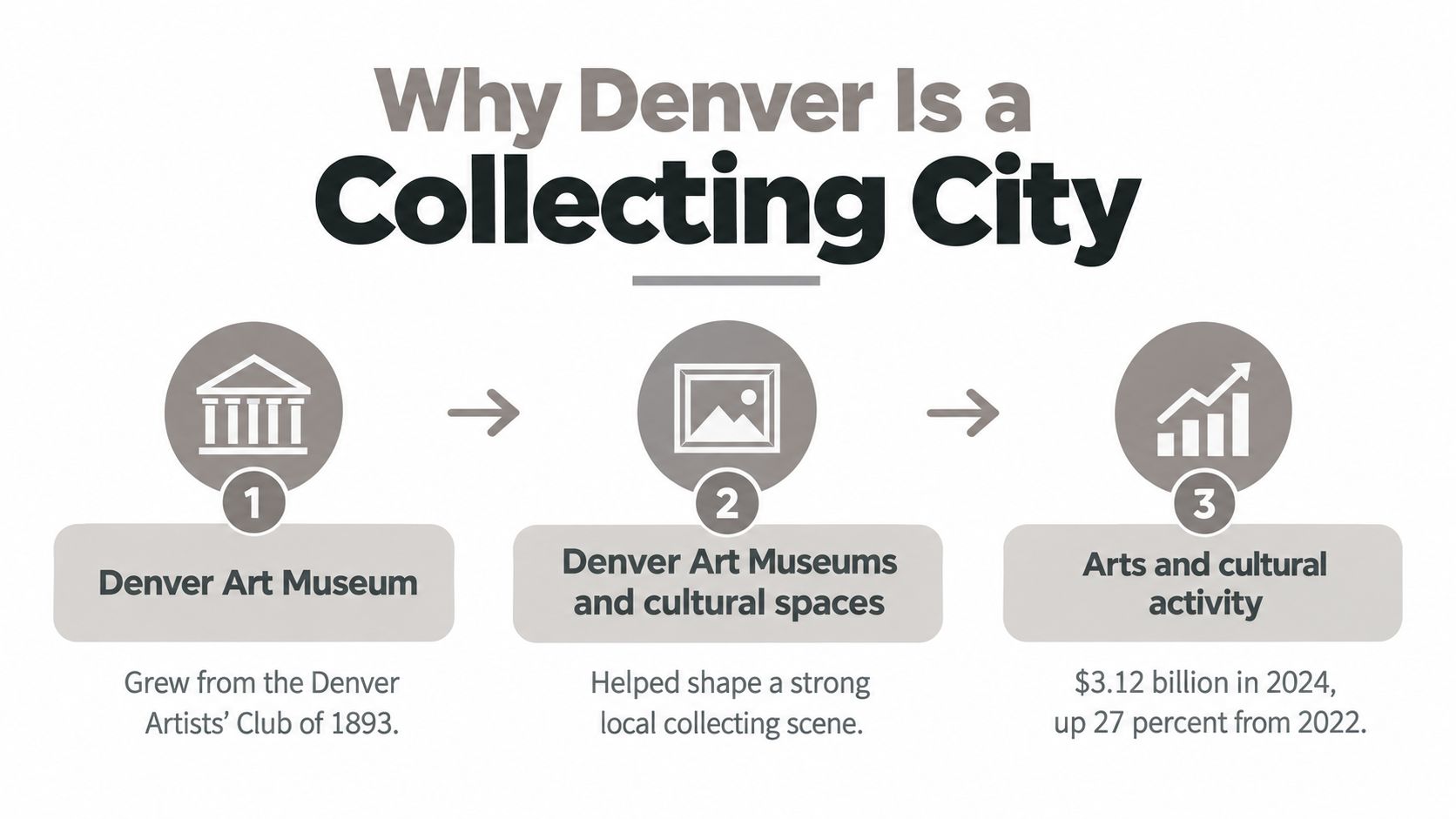
Denver's collecting culture has deep roots, and those roots shape what you can buy here today. The Denver Art Museum traces its origins to the Denver Artists' Club, founded in 1893, became the Denver Art Association in 1917, and adopted the name Denver Art Museum in 1923, according to the museum's own history of its founding and growth. In 1971 it opened its North Building, now the Martin Building, designed by Italian architect Gio Ponti.
That timeline matters to a buyer for a practical reason. A city whose main museum has collected for well over a century has generations of donors, framers, conservators, shippers, and installers who know how to handle art properly. You're not buying into a thin market that appears on weekends and vanishes on Monday.
A Collection Built Across Cultures
The museum reports more than 80,000 works across 13 permanent collections, spanning African art, Asian art, European and American art, Indigenous arts, Latin American art, modern and contemporary art, photography, textiles, and Western American art. That breadth signals something useful when you're shopping. Denver buyers and sellers are used to many categories of work, not only regional craft or Western subjects.
For a first time collector, breadth lowers the risk of a narrow education. You can stand in front of a textile, a photograph, and a contemporary painting in one visit and start learning what you respond to. If you're curious how natural objects enter collecting conversations too, reading about what makes amethyst stalactites collectible shows how rarity, formation, and presentation shape value in a neighboring field. A broader look at art across Colorado and how regional scenes connect helps place Denver within that wider picture.
The Spending Behind the Scene
Institutions alone don't make a market. Audiences and budgets do. Nonprofit arts and culture organizations in metro Denver generated $2.6 billion in total economic activity in 2022, a 13.6% increase from 2019, as reported in coverage of the Colorado Business Committee for the Arts economic study. Within the City and County of Denver, arts and culture activity generated $399 million in the same period and supported 5,414 jobs.
Those figures aren't gallery receipts, and you shouldn't read them that way. They include operating spending, facility work, and what audiences spend around cultural participation. What they prove is simpler. Denver sustains a large professional ecosystem around art, so the people who frame, transport, insure, and install work are established businesses, not improvisations.
A strong arts economy means your purchase can be supported after the sale, with real services for delivery, storage, and preservation.
What This Means at the Moment of Purchase
When a city expects art in homes, offices, hotels, and public buildings, sellers expect informed questions. Asking about provenance, condition, or delivery won't mark you as difficult in Denver. It marks you as normal.
It also means competition for good work exists across many categories. You don't have to settle for the first appealing listing because you fear nothing else will appear. You can compare channels, compare paperwork, and walk away from a thin offer knowing the market will show you another option.
Where to Find Art for Sale in Denver
Art changes hands in Denver through several distinct channels, and each one gives you a different mix of guidance, documentation, and responsibility. Choosing a channel is really choosing how much of the verification work you want to do yourself. Match the channel to your goal before you fall for a specific piece.
Galleries and Artist Run Spaces
A commercial gallery represents artists over time. You'll usually get a conversation with someone who knows the work's history, an invoice that names the artist, title, and medium, and help arranging delivery. Prices may be posted or given on request, so ask early and ask what the price includes, especially framing and tax.
Co-ops and open studios put you closer to the maker. Artists share the sales floor or open their workspaces, and you can ask directly how a piece was made and how it should be cared for. Documentation may be simpler, so request a written receipt that describes the work fully, even if the setting feels informal.
Fairs, Estates, and Private Sellers
Seasonal fairs and exhibit sales compress many decisions into a short window. The energy is helpful for discovery and unhelpful for measuring your wall, so arrive with dimensions and photos of your space already on your phone. Confirm pickup timing before you bid or buy, because some works stay on display after purchase while others leave the same night.
Private dealers and estate sales can surface work with real history and, sometimes, gaps in it. The object may be strong while the paperwork is thin. Treat that gap as part of the price conversation, and don't let a good story substitute for a written description of what you're buying.
Online marketplaces are now a normal starting point for Denver buyers, including listings that still require local pickup. A screen can't show surface texture, true color, or frame condition reliably. Use the listing to shortlist, then verify in person or through detailed written answers before paying.
Denver Art Buying Channels Compared
Channel | Best for | Price clarity | What to confirm before paying |
|---|---|---|---|
Commercial gallery | A statement piece with guidance | Often posted or on request | Invoice details, framing, delivery terms |
Co-op or open studio | Meeting the maker, accessible work | Usually posted | Written receipt, edition status, care needs |
Fair or exhibit sale | Fast discovery across artists | Posted, bid, or set by artist | Pickup date, payment deadline, wrap and transport |
Dealer or estate sale | Older or secondary market work | Negotiable, sometimes unstated | Ownership history, condition notes, return terms |
Online marketplace | Remote browsing and comparison | Posted but variable | Condition report, shipping or local pickup, returns |
Matching the Channel to the Project
A homeowner buying one anchor piece benefits from gallery guidance and delivery help. A designer filling a lobby rotation may prefer a channel that can supply several coordinated works with consistent documentation. An office manager buying multiple lower priced pieces online needs to budget separately for framing, delivery, and hanging, because none of that arrives automatically.
Choose the channel that answers your questions in writing, not the one with the prettiest thumbnail.
Whichever route you pick, don't pay yet. Take the specific work you've found into the paperwork checks that follow, because a trustworthy channel and a well documented object are two different things.
Read Price Edition and Paperwork First
A Denver print catches your eye online, but the listing says little about its edition or condition. Before you pay, ask for the details that let you understand what you're buying and how it will fit into your collection. Artsy's reporting on art market trends and collector behavior discusses collectors' concerns about unclear prices and limited information. When details are thin, a few written questions can turn an appealing image into a more informed decision.

A Short Script for Any Seller
You don't need specialized vocabulary. Ask for clear answers in writing, then keep them with the work's records.
What is it: Is it a unique original, part of a limited edition, or a reproduction?
How is the edition marked: What is the impression number, how many are in the edition, and where is it signed?
What paperwork comes with it: Will you receive a certificate, detailed invoice, prior bills of sale, or exhibition records?
Who owns it now: Is the seller the owner, the artist, or an agent acting for someone else?
What condition is it in: Are there repairs, fading, frame damage, or glazing issues? Ask for any known issues to be recorded.
A signature or a convincing story does not establish authenticity on its own. If you have doubts, pause and learn how professional art authentication services evaluate a work before relying on either as proof.
Three Buys, Three Different Risks
With a unique painting from a gallery, focus on ownership and condition. The invoice should identify the artist, title, medium, and date. Confirm whether the frame is included, since that affects both the purchase and how the piece can be placed at home.
A numbered print bought directly from a studio brings a different concern: the edition details help identify the specific impression. Confirm its number and the edition's total size, and keep the certificate with your records. Don't tuck it behind the frame, where it may be difficult to find when you need it.
An online listing with an attractive photograph but no condition report leaves important questions unanswered. Ask the seller to describe the work's condition in writing and clarify its ownership history. A nearby seller still needs to provide those details. If they refuse, move on rather than paying for uncertainty.
Plain rule: If a seller won't put the price, edition, and condition in writing, you're being asked to fund someone else's ambiguity.
What to Keep After You Pay
Keep the invoice, certificate, and condition notes together, both digitally and on paper. Before hanging the work, photograph its front and back, along with any labels or inscriptions. These records can support insurance, future resale, estate planning, and later conservation discussions.
Paperwork helps establish what you own and what was disclosed at purchase. Keep it accessible alongside the work's other records.
Check Light Walls and Condition Before You Buy
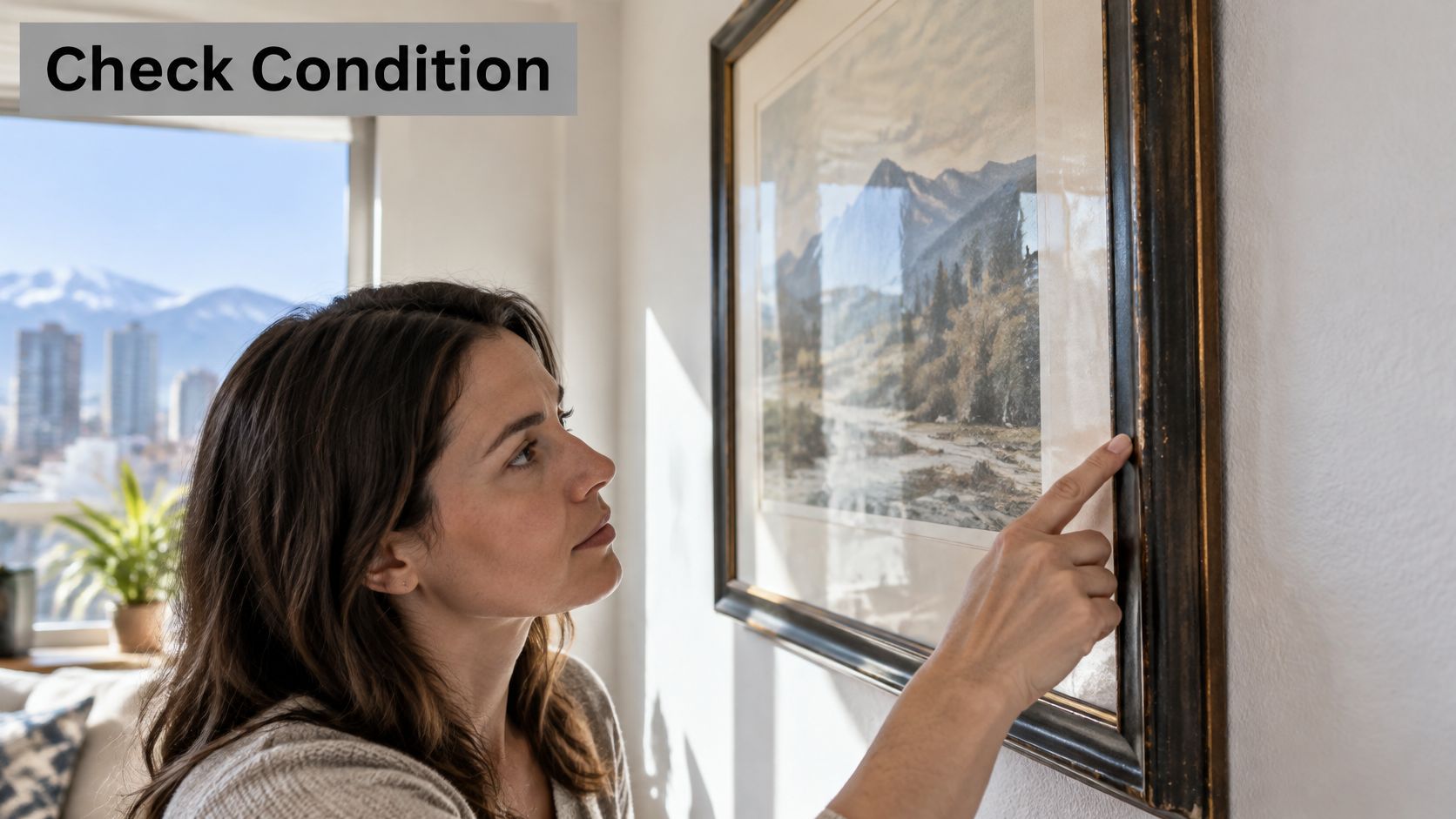
Denver light is generous, and art pays for that generosity over time. Museum conservation guidance sets a maximum of 50 lux for highly light-sensitive works such as works on paper, watercolors, textiles, and photographs; 150 lux for moderately sensitive oil paintings, acrylics, wood, and leather; and 300 lux for stone, glass, ceramics, and most metals, as set out in conservation guidance on light exposure for artifacts on exhibition. Ultraviolet exposure should ideally remain between 0 and 10 microwatts per lumen and never exceed 75 microwatts per lumen.
Lux is a measure of how much light lands on a surface. You don't need to become a conservator. You need to classify your work, check the wall, and decide before purchase whether the two are compatible.
Classify the Medium First
Start with what the work is made of, not where you wish it could hang.
Highly sensitive: Works on paper, watercolors, textiles, and photographs belong on your dimmest suitable walls, away from direct sun.
Moderately sensitive: Oil and acrylic paintings, wood, and leather tolerate more light, but daily sun still works against them.
Relatively insensitive: Stone, glass, ceramics, and most metals handle brighter placements that would harm paper based work.
Fading and embrittlement from light are cumulative and irreversible. A low level of exposure over many months can do damage comparable to a short burst of intense sunlight, which is why a wall that seems fine in winter can harm a print by the following year.
Measure at the Artwork, Not the Ceiling
Light readings belong at the surface of the artwork. A bright ceiling fixture may barely reach a low wall, while a modest window can throw hard sun onto one exact spot each afternoon. Stand where the work will hang, at different times of day, and note where sun patches land and how long they stay.
If you're grouping works, plan around the most sensitive one. A photograph hung beside an oil painting sets the limit for the whole arrangement.
Check the Wall Itself
Light is half the physical test. The wall is the other half. Drywall, brick, stone, and plaster each need different anchors, and a heavy framed work or mirror on the wrong hardware is a safety problem, not a style choice. High placements add ladder work and physical demands that change what one person can reasonably do alone.
Ask yourself three questions before committing. Can this wall hold this weight with proper hardware? Is there a less sunny wall that serves the room just as well? Would protective glazing or fewer display hours be realistic for how you live or work?
If the honest answer to any of those is no, you haven't failed. You've learned, cheaply, that this work belongs on a different wall or in a different collection.
Plan the Whole Space Then Place the Work
Single pieces are the exception in real projects. Homes fill room by room, offices hang floor by floor, and developments need coherent work across lobbies, corridors, and amenity spaces. Planning at that scale is a different skill from choosing one painting, and it's where modest purchases become complicated.
The demand behind those projects is substantial. Arts and cultural activity in the Denver metro area reached $3.12 billion in 2024, up 27% from 2022, while attendance at arts and science institutions remained 5% below 2019 levels, as reported in coverage of Denver's arts economy reaching a new milestone. The same reporting notes online only art transactions reached an estimated $10.5 billion in 2024, with 62% of that value occurring below $50,000.
Read plainly, people increasingly meet art in residences, workplaces, and hospitality spaces rather than museums alone, and much of what's bought sits at accessible prices. That doesn't simplify your project. Several modest works need spacing, alignment, consistent hardware, and a layout that survives furniture changes. One large painting needs one correct decision.
The screenshot below shows how a placement focused service presents that kind of whole space work.

Planning Moves That Prevent Rework
Start with dimensions for unfamiliar walls. Photograph each wall straight on, record its width and height, and mark outlets, switches, and vents. Tape outlines at the sizes you're considering and live with them for a day before buying anything.
Grids reward precision and punish approximation. A grid of prints looks effortless only when spacing is identical and every frame hangs level. Decide the grid on paper first, including the gaps, then transfer it to the wall rather than improvising hole by hole.
Sculpture and mirrors add weight, depth, and reflection to the plan. A mirror changes what light does in a room, which loops back to the limits covered earlier. A sculpture needs a sightline and a safe clearance from foot traffic, not just an empty corner.
Phased work helps larger projects stay sane. Hang anchor pieces first, live with them, then add supporting works. During a renovation, office move, or seasonal property closing, plan short or long term storage in advance so finished work isn't leaning against a garage wall while painters come and go.
Do It Yourself or Bring in Placement Help
Hanging one light, ready to hang piece on drywall is a reasonable weekend task for many people. The calculation changes with heavy or high placements, brick or stone walls, tight grids, mirrors, sculpture, and any work you can't afford to drop. It also changes when a building requires insured handling for freight elevators and common areas.
For readers previewing spaces remotely, resources on AI-powered tours for art galleries show how virtual walkthroughs can help you study sightlines and spacing before anyone picks up a drill. A virtual pass doesn't replace measuring, but it catches awkward adjacencies early.
The video below shows placement work in progress, which is useful when you're judging whether your own project has outgrown a ladder and a level.
This is the work Colorado Art Services handles across Denver and the Front Range: picture hanging and museum quality placement for homes and commercial spaces, grids and large formats, sculpture and mirrors, heavy and high placements, insured local pickup and delivery, and secure storage. Layouts are matched to wall conditions, lighting, and budget, so the plan you approved is the wall you get.
Take the Next Step After You Choose
Assume you've chosen a work and you trust it. What remains is a sequence, done in order, that turns a purchase into a finished wall without last minute improvisation. Most post purchase stress comes from skipping one step and discovering it while a wrapped painting leans in your hallway.
Confirm Everything in One Pass
Before the work moves, confirm the essentials together rather than across scattered messages:
The object: Artist, title, medium, and whether it's unique or editioned, with the number recorded.
The price in writing: Including tax, framing, and any delivery charge, so the final figure isn't a surprise.
The condition notes: Any restoration, fading, or frame issues stated plainly by the seller.
The release: Whether the seller will hand the piece to your shipper or installer, and what identification or paperwork that requires.
Then name the destination with equal precision: which wall, what surface, what light it receives, and whether the work must wait in storage during painting, construction, or a move. If you're still deciding how installation works in practice, a walkthrough of professional art installation in Denver clarifies what's involved before anyone arrives.
Book Placement Instead of Improvising Hardware
With the work and the wall both defined, schedule the finish. Contact Colorado Art Services at coloradoartservices.com to arrange pickup or delivery, a site look at wall type and height, and installation or storage timed to when your space is ready. Booking before the work leaves the seller keeps it wrapped, insured, and handled once rather than repeatedly.
One sentence to remember: Decide who hangs it before you decide how it gets home.
The same team can place a single residential piece or coordinate a larger office, gallery, or development layout. Coverage extends across Denver, Boulder, Aurora, Highlands Ranch, Castle Rock, Fort Collins, Vail, Aspen, and nearby communities, so a work bought in one city can be installed in another without you brokering each handoff.
You started with an image on a screen and a wall you weren't sure about. You end with documentation you can file, a wall you've assessed, and a scheduled install. That's the whole arc of buying Art for Sale in Denver well, and none of it requires you to become an expert. It requires you to ask in the right order.
You've chosen the work and checked the wall, so let Colorado Art Services handle insured pickup and delivery, museum quality hanging for everything from single pieces to grids, mirrors, and sculpture, and secure storage while your space is finished. Visit the site to schedule a site assessment and installation date, and turn your Denver art purchase into a finished, level, safely mounted wall.
Comments