


Heavy Duty Picture Rail Hangers: How to Choose Safely
Heavy-duty picture rail hangers are the hooks, cords, and fittings that carry a framed piece from a rail near the ceiling, so the rail does the hard work instead of the wall. That setup lets you slide a hook sideways, level a canvas, or swap art without patching plaster.
What Heavy-Duty Picture Rail Hangers Are and When to Use Them
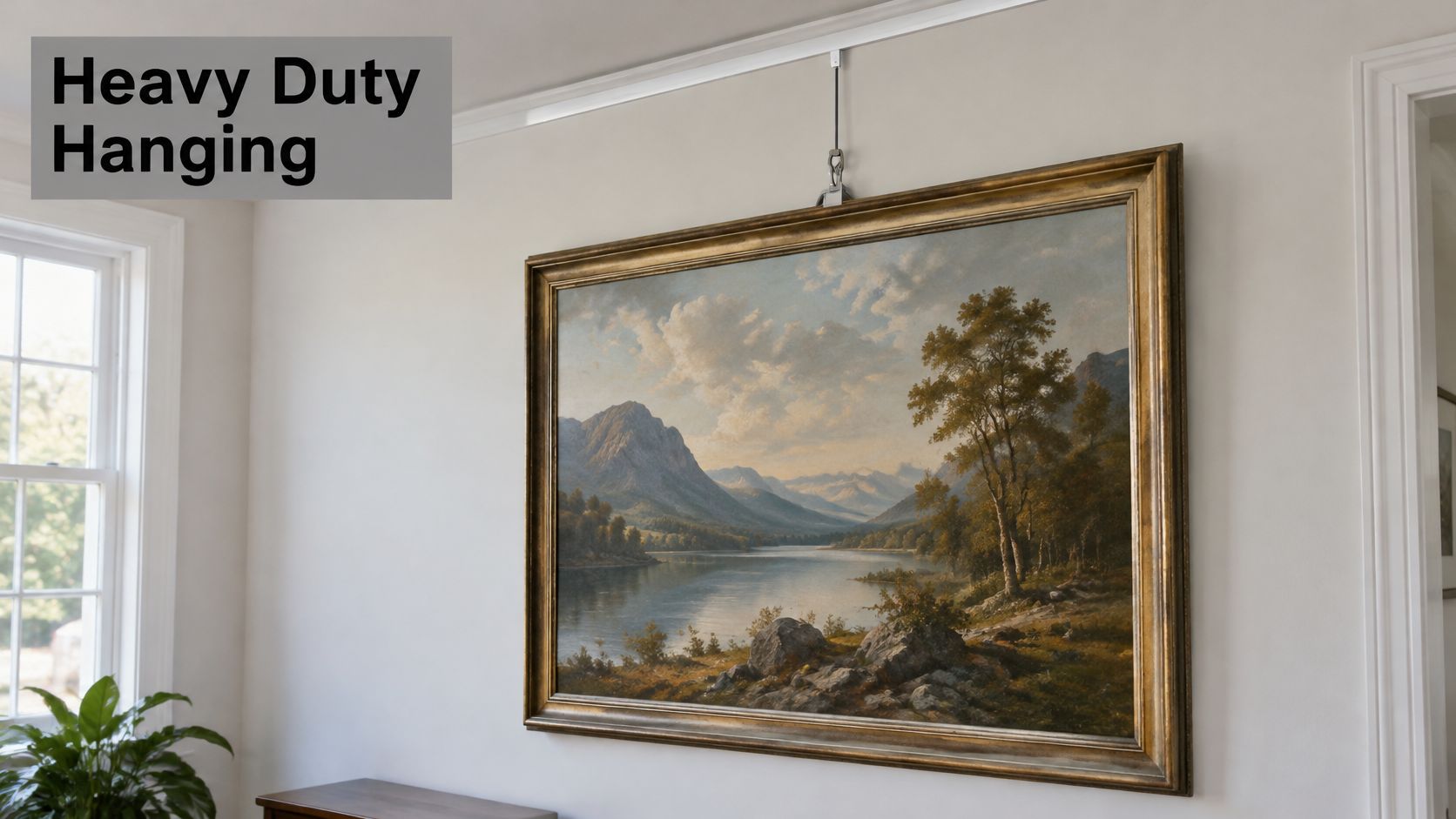
A picture rail works a bit like a clothesline for art. The rail carries the load, while the hook rides along it and can be moved when your arrangement changes.
Small picture hooks are fine for light prints. Larger oil paintings, mirrors, and heavy gilded frames usually need a system with a real rating and a rail anchored into structure.
Quick Comparison of Picture Hanging Hardware Tiers
Use this table to place your artwork in the right category before choosing hardware.
Hardware Tier | Typical Artwork Weight | Rail or Wall Requirement | Best Use Case |
|---|---|---|---|
Standard picture hooks | Under 10 lb | Any wall, small nail | Small prints |
Medium-duty rail hangers | 10–25 lb | Solid rail, plaster or drywall | Framed prints |
Heavy duty systems | 25 lb and up | Rail anchored to structure | Large oil paintings |
If the piece sits near a boundary, treat the heavier tier as the safer starting point. The rail, hook, cord, and wall all have to work together.
A heavy-duty setup usually earns its keep in situations like these:
Large oil paintings that exceed what basic hooks can carry.
Framed mirrors that need secure, level support.
Gilded frames with deep moulding and weight concentrated at the corners.
Fragile plaster or old masonry where extra drilling can crack the surface.
Why Rails Protect Delicate Walls
Picture rails were common in European interiors, where art hung from molding near the ceiling line. That kept nails out of finished plaster and made rooms easier to rearrange.
Key idea: the wall keeps the rail, and the rail keeps the art.
For a careful walkthrough on placing and hanging a piece accurately before you get into specialized hardware, see Miller Waldrop's picture hanging walkthrough.
Deciding Whether Your Piece Needs Heavy-Duty Hardware
Start with two checks: weigh the framed piece, then look at the wall and rail. If the artwork is heavy, the plaster is brittle, or the rail fastening is questionable, move up to the stronger system.
Weight alone is only part of the picture. Load ratings, wall material, frame design, cord angle, and how often you plan to move the piece all shape the result.
Read labels carefully and treat the rating as a safe ceiling, then leave margin. A hanger that is barely adequate on paper is usually the wrong choice on an old wall.
Picture rails are older than most people realize. Long before drywall and adhesive strips, European homeowners protected their plaster walls by hanging art from a molding fixed near the ceiling line.
Why Victorian Rooms Loved the Rail
Victorian interiors took the idea further. Tall rooms covered in patterned wallpaper, silk panels, and ornate paneling showed every nail hole, so a rail was a much tidier option.
The real advantage was flexibility. Hanging from a rail let owners move a painting, swap a favorite piece, or rebalance a wall without ever touching the plaster.
The rail carries the weight, and the hook simply rides along.
How the Same Logic Became Engineered
Today's rails have moved well beyond plaster-era moldings. Manufacturers use engineered profiles, and thin, flimsy fittings have given way to much stronger metals. Hooks now grip the rail far more securely, so the same basic idea can hold substantial framed works.
That is why heavy-duty picture rail hangers still follow the same logic, just with better materials behind them.
Where the Rail Still Makes Sense
Historic homes are the clearest case. Original plaster is brittle, and a single nail can start a crack that spreads across the wall.
Galleries, offices, and other spaces with delicate walls benefit too:
Galleries rearrange exhibitions without repeated drilling.
Offices can refresh décor without damaging shared walls.
Private collectors keep valuable pieces easy to reposition.
If you're weighing up different ways to display artwork, custom wall art prints can be a useful alternative to traditional hanging setups. The wall print guide for UK homes has some ideas worth a look.
Choosing the Right Setup Today
Modern rails work well in historic homes, galleries, and offices alike. They protect fragile walls while letting you change arrangements whenever your collection grows.
Compared with older setups, today's systems usually bring:
Stronger metal rails that resist sagging.
Hooks that lock securely in place.
Cords rated for heavier frames.
Hang the art from the rail, and the wall never has to bear the full load alone.
Understanding this history explains why heavy-duty picture rail hangers remain so practical. The principle hasn't changed, but the hardware has grown much stronger. Start with the rail, then match the hardware carefully to the artwork and the wall.
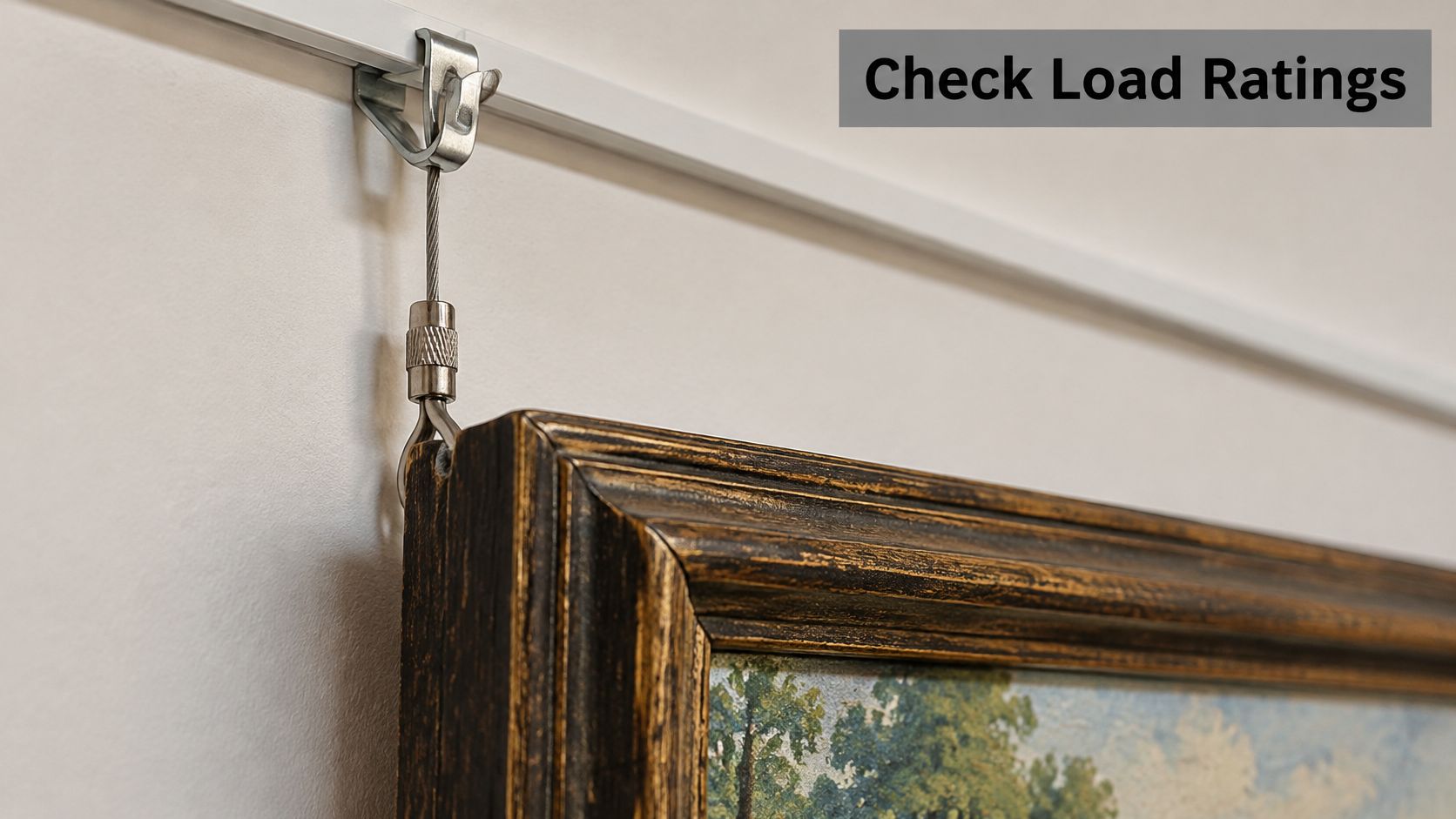
Load ratings are usually the first thing people look at, and the first thing they get wrong. That number is guidance from the engineers who tested the hardware, not an invitation to push a frame right up to its limit.
A good comparison is the sign on a bridge reading 40 tons. No engineer assumes a truck weighing exactly 40 tons should roll across it, since vibration, wind, and years of wear all chip away at that margin. Rail hardware deserves the same healthy skepticism.
What the label really tells you is what the fitting survived under controlled testing. It says nothing about how it will cope in a busy household.
Ratings Are Given Per Hook or Per Length of Rail
Read the label closely and you'll notice two very different kinds of promise. Some describe what one hook can hold. Others describe what an entire rail system can carry spread over a distance, like 40 pounds per yard or about 20 kilograms per meter, assuming proper mounting.
A rail rated at 40 pounds per yard does not mean a single hook can carry 40 pounds. Nor does it mean an unanchored stretch of molding can.
A rail capacity is a system figure, not a free pass for a single hook.
So before comparing products, check the unit. Per hook, per yard, and per meter answer different questions, and confusing them is exactly how fittings end up overloaded.
Find the unit first. Then read the fine print underneath it.
Static Weight Is Only Half the Story
The next question worth asking: does that number account for anything besides a frame sitting perfectly still? Real walls deal with bumps, vibration, slamming doors, and the jostling that comes with installation and cleaning.
Any rating that pretends those forces don't exist is optimistic at best. Treat it as a starting point, then build in extra margin based on how the piece will actually live on the wall.
A frame hanging beside a hallway gets knocked around far more than one tucked above a quiet sofa.
That additional allowance is what keeps a rail system dependable through years of everyday use, not just the first few months.
Match the Rating to the Whole System
Remember that the load travels through a chain: hook, cord, rail, and the fasteners holding everything to the wall. A strong hook on a poorly fixed rail still ends in failure, and a well-anchored rail means little if the cord is worn out.
Check the rating on every link in that chain, then let the lowest honest figure set your limit. That simple habit is what keeps heavy-duty picture rail hangers working safely for the long haul.
A solid weight rating tells you only part of the story. A hook can be built like a tank and still let a framed print crash to the floor if the rail, the wall, and the frame don't work together. Heavy-duty picture rail hangers earn their keep only when every link in the chain suits the piece you're hanging.
Think of the check as a three-legged stool. Remove any one leg, and the whole thing tips.
Match the Rail Profile to the Hook
Start with the rail. Look closely at its shape and depth before you spend a dime.
A shallow, rounded molding won't accept a deep hook built for a taller profile. The reverse problem happens too: a narrow hook can slip right off a wide rail that was never meant to carry it.
Before you order, hold the hook drawing up against the rail you already have.
Measure the rail's depth and the lip the hook needs to grab.
Match the shape to the hook style, not just the weight rating on the package.
Ask the supplier whether the hook is designed for that exact profile.
A perfectly rated hook still fails if it can't seat fully in the rail.
Match the Wall to the Fastener
The wall is the next test, and it's where many people get caught out. Plaster, drywall, masonry, and wood each hold a fastener in their own way.
Picture a shelf bracket. Screw it into a stud and it feels rock solid. Drive the same screw into hollow drywall and it may pull loose, since there's little behind the paper face to grip.
Plaster can crack if you drive a fastener in too hard.
Drywall needs a proper anchor or, better yet, a stud.
Masonry needs anchors made for brick or stone.
Wood generally holds screws well when the grain is sound.
The diagram below shows how those three checks fit together into one safe hanging system.
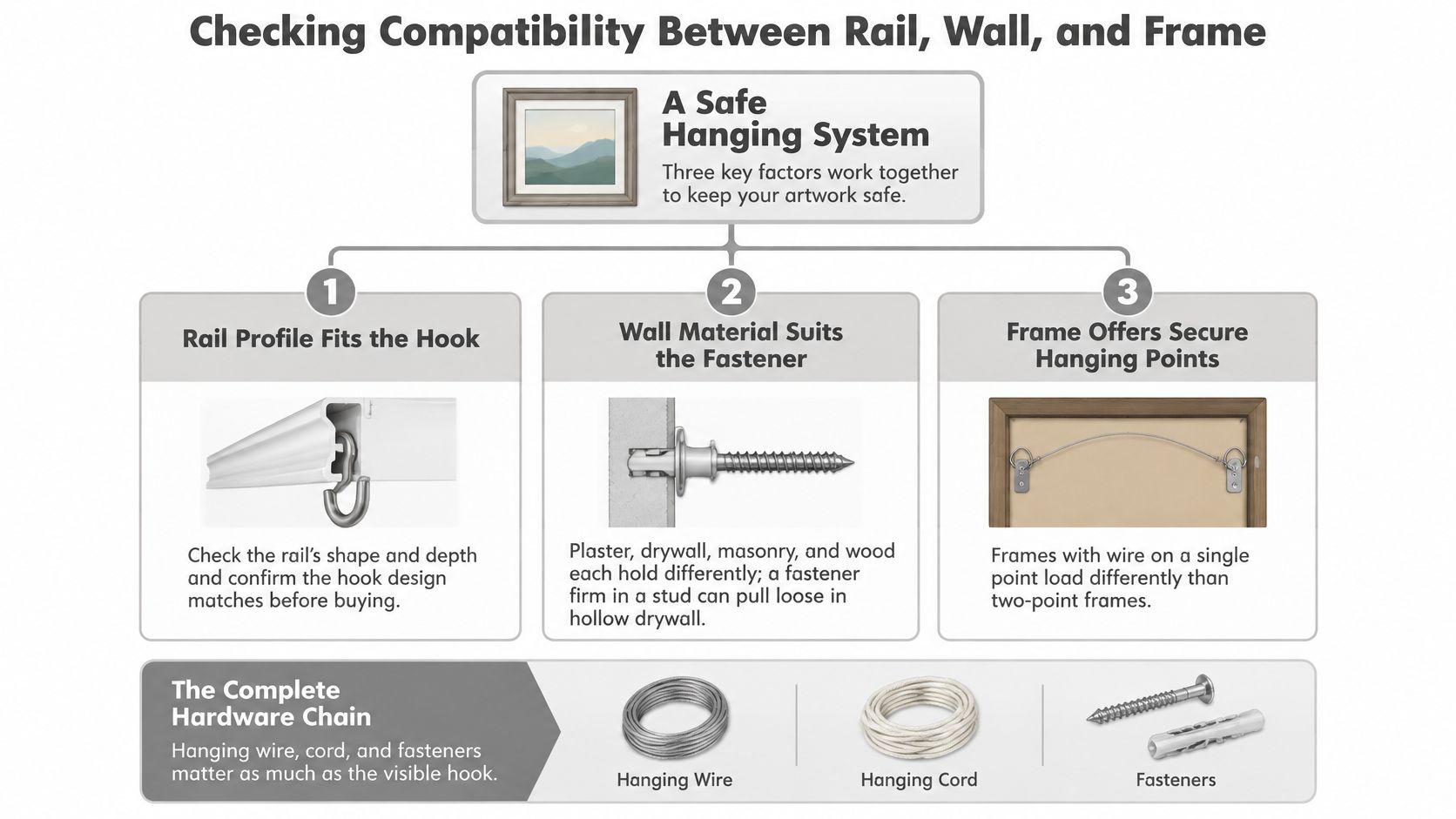
The picture makes the point well. The rail, the wall fastener, and the frame all need to agree, and the wire, cord, and frame screws matter just as much as the hook you can see.
If you're adding a rail instead of using one that's already there, this guide on picture rail installation covers the mounting side of the job.
Check How the Frame Carries the Load
The frame is the last leg. Two hanging points spread the weight evenly across the piece. A single wire anchored at one point concentrates everything there, which can tilt the frame or put stress on its corners.
The chain is bigger than the hook. The hanging wire, the cord, and the screws in the frame all share the load, so one weak link undermines the rest.
Confirm those three matches before you hang anything. If one is weak, upgrade the hardware or take a second look at the wall.
Knowing the ratings is one thing. Turning them into a decision is another, and that is where a simple safety margin earns its keep.
The widely recommended rule is to add 25 to 50 percent above the actual weight of your piece. Think of it like packing a suitcase with a strict weight limit. You leave room, because something extra always shows up before the airport.
Running the Numbers on Real Pieces
Take a 40-pound framed oil painting. Adding 25 to 50 percent means hardware rated for roughly 50 to 60 pounds or more. A lighter 20-pound piece calls for a rating of around 25 to 30 pounds at minimum.
Key takeaway: the rating on the package is the ceiling, so aim well below it.
That margin is easier to see when you map it across common artwork weights.
Suggested Minimum Hardware Ratings by Artwork Weight
Use the table as a matching guide, then round up when a piece sits between rows or when the hanging conditions are less than ideal.
Artwork Weight | Minimum Margin Applied | Suggested Minimum Hardware Rating | Recommended Hanging Method |
|---|---|---|---|
10 lb | 25–50% | 13–15 lb | Single rail hook, standard cord |
20 lb | 25–50% | 25–30 lb | Single hook, braided cord |
40 lb | 25–50% | 50–60 lb | Two-point hanging, steel cable |
60 lb and up | 50% or more | 90 lb and up | Two hooks, rail anchored to structure |
The pattern matters as much as the numbers. As weight rises, the margin rises too, because a heavier piece has more momentum when it gets bumped.
Why the Whole Setup Beats One Strong Hook
A single heavily rated hook can look reassuring on paper, yet it concentrates every force at one point. Two-point hanging spreads the load across two hooks and two cords, so one weak spot has a backup.
Choose cord or cable with a rating that clears the same margin.
Favor steel cable or heavy braided cord for heavier frames.
Anchor the rail into studs or solid masonry whenever possible.
Stronger cord matters just as much. A steel cable or heavy braided cord absorbs the shock of a knock far better than aging wire. Learn more about choosing the right cord in our guide on heavy duty picture hanging wire.
A rail anchored into studs or solid masonry gives the entire chain something trustworthy to pull against. Two modest hooks, strong cord, and a well-anchored rail will usually serve you better than one oversized hook on a shaky rail.
Run the numbers, then build the margin into every link, including the parts you cannot see once the frame is up.

Theory only gets you so far. The real lessons show up once you're standing on a ladder with a level in one hand and a piece of art in the other. These three situations show the decisions that separated a good installation from a risky one.
A Gilded Mirror in a Denver Dining Room
A homeowner in the Denver area wanted a heavy gilded mirror above the sideboard. The walls were plaster, and the mirror weighed about 35 pounds.
The team chose a picture rail fitted with heavy-duty picture rail hangers rated well above the mirror's weight. That gave the owner a bonus they hadn't planned on: the mirror could slide along the rail whenever the furniture moved.
Without the rail, two screws driven into plaster would likely have cracked the surface. The mirror would also have been locked into one spot for good.
Lesson: Choose hardware that lets you change your mind later.
A Two-Point Canvas in a Corporate Lobby
A large framed canvas in a corporate lobby needed a secure hang. Visitors walked past it all day, so it had to look effortless and stay put.
The installers used two-point hanging, which spreads the load across two hooks instead of one. Think of it like carrying a heavy grocery bag with both hands rather than hooking it onto a single finger. They also anchored the rail into structural backing behind the wall rather than relying on the plaster surface alone.
Use two hanging points for wide or heavy frames.
Anchor the rail into studs or solid blocking.
Check the lobby's traffic patterns before choosing hardware.
A single hook in drywall might have held at first. Over months of bumps and vibration, though, the anchor could loosen, and the canvas could tilt or drop.
A Historic Home with a Settled Picture Rail
A historic home had an original picture rail, but decades of settling had pulled the molding away from its fasteners. Its capacity was far lower than when it was first installed.
The fix started with the rail, not the art. The team re-secured the molding into solid framing, then hung each piece with cords matched to its weight.
Hanging directly from the loose molding would have invited a slow, dangerous slide. The painting would have dropped at the worst possible moment.
Lesson: Test the rail before trusting it with anything valuable, every time.
Across all three situations, the pattern is the same. The rail carries the weight, the hardware matches the piece, and the wall stays intact. Follow those decisions, and your installation should hold up for years.
Some jobs are better left to a trained installer than to a weekend and a borrowed ladder. Heavy-duty picture rail hangers look straightforward enough, but the stakes climb quickly when the artwork, the mounting height, or the wall itself is unusual.
Picture the rail as a clothesline and the hook as a clothespin. If the line is sagging, a stronger clothespin won't keep the laundry off the ground.
Signs the Job Has Outgrown DIY
Call a professional if any of these sound familiar:
The piece is very heavy, expensive, or impossible to replace.
The hang point is high enough to require ladders or scaffolding.
The wall is fragile plaster, a historic finish, or old masonry.
The rail itself needs inspection before anyone trusts it.
What a Denver Installer Checks
Colorado Art Services has spent 15 years hanging and handling art across the greater Denver metro area. A good installer doesn't treat the hook as the whole story. They look at the artwork, rail, wall, and hardware together, because each one affects the others.
What a Free Estimate Covers
A free estimate usually settles three things: where the piece should go, which hardware suits it, and whether the existing rail can handle the load. The contact form asks how many pieces need installing, whether ladders or scaffolding are needed, whether the job involves drilling into hard surfaces, and the size of the largest piece.
Clear photos help a lot, so bring them along if you have them.
A safe hang depends on the whole chain, not just the hook.
If you're still deciding between doing it yourself and hiring a crew, take a look at our guide on DIY versus professional installation.
That point matters most with heavy-duty picture rail hangers. A rated hook can't rescue a loose rail, a weak cord, or a fastener sitting in brittle plaster. When any part of the chain is uncertain, a measured installation is the safer route.
Can Heavy-Duty Hangers Go on Plaster Walls?
Yes, though the rail usually matters more than the hook. Plaster can crack around a poorly placed fastener, so the safer move is to anchor the rail into studs or solid masonry. Pick hardware rated comfortably above the artwork’s weight.
Next step: Run a stud finder over the wall before drilling anything into plaster.
Can a Rail Be Added to an Existing Room?
Yes. A rail can often be mounted along the top of a wall, and an experienced DIYer may finish the job in an afternoon. First check for wiring and plumbing behind the surface, then confirm the mounting points can carry the load. If the wall looks questionable, have a local hardware pro inspect it before you start.
How Do I Know a Rail Is Securely Mounted?
Give the rail a firm tug at several points along its length. Movement, gaps between the molding and wall, or fresh cracks are signs it needs to be refixed. Check it again after a few weeks, since settling can loosen fixings. A rail that shifts under light pressure is not ready for a heavy frame.
Is a Single Hook Ever Enough for a Heavy Piece?
Rarely. Two-point hanging spreads the load across two hooks, so if one shifts, the whole frame is less likely to drop. A single hook can work for lighter pieces well inside its rating. Test each hook with a light weight first before trusting it with artwork.
When to Call a Professional
The rail feels loose or sags under light pressure.
The artwork is heavy, gilded, or irreplaceable.
The wall is historic plaster or old masonry.
Ladders or scaffolding are needed to reach the rail.
Need a second opinion on a heavy piece? Colorado Art Services offers a free estimate for heavy piece hanging across the Denver area. Visit coloradoartservices.com to get started.
Comments