


Where to Hang Large Artwork at Home That Looks Balanced
You've found the wall, bought the oversized canvas, and held it against the paint while standing back with your head tilted. It still feels wrong. Above the sofa, the lower edge seems too close to the cushions, but moving the piece upward leaves a dead band of wall beneath the ceiling. In many Denver homes, the problem isn't the artwork. It's treating a large piece like a small picture and measuring from the frame's top edge instead of building the placement around the room's sightlines.
The most reliable approach starts with a museum-style center height, then adjusts for furniture, ceiling height, viewing distance, lighting, and wall construction. Large artwork needs precise placement because small errors become obvious at scale. The right question isn't “how high should a picture hang?” It's where should the artwork's visual center sit in relation to the people, furniture, and architecture around it?
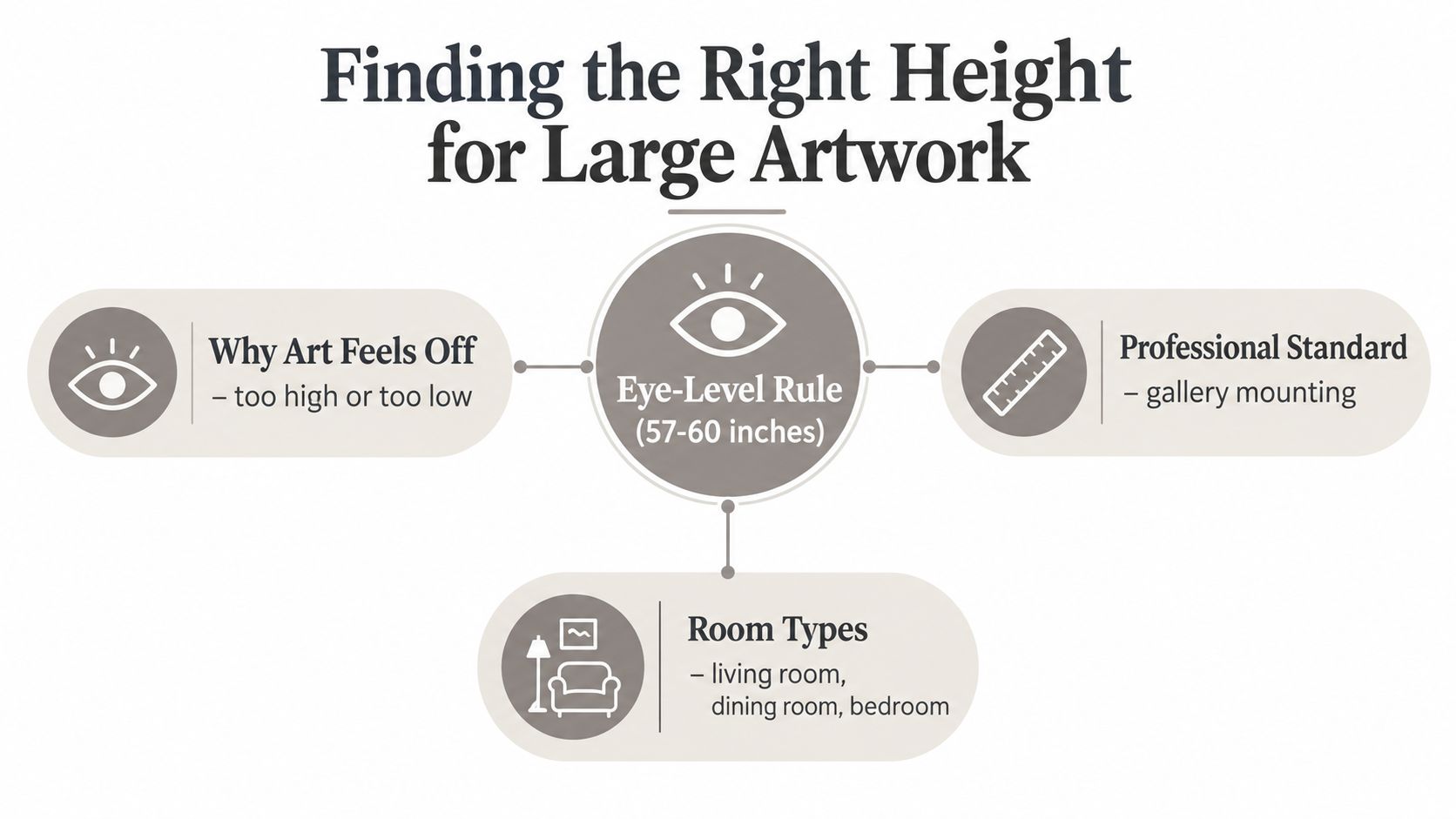
Finding the Right Height for Large Artwork
A large painting can be level, centered on the wall, and still feel too high. The problem usually appears when the top edge is aligned with trim or another convenient architectural line. With a large format piece, that choice can place the visual center above a comfortable viewing height and force people to lift their chins.
The professional starting point is the 57-inch rule. Set the artwork's vertical center about 57 inches, or 145 cm, from the finished floor, a height commonly used as average eye level in galleries and museums. Christie's and professional art-hanging references describe this as a durable starting point, while modern and contemporary works are often centered at 1.55 metres. Measure to the artwork's center, not to the top of its frame.
Why large pieces need a centerline
A small framed print can tolerate a minor height error because its visual mass is limited. A six-foot canvas cannot. If the upper edge determines placement, the center can end up well above comfortable eye level, leaving the work detached from the room. Historical exhibition guidance commonly places the center between 56 and 58 inches, while residential and gallery recommendations often broaden the target to 57 to 60 inches. The Practical Art World explains the center-height approach and the hardware calculation behind it.
Treat that range as a target, then account for the room's fixed elements. A sofa, mantel, console, or headboard creates a second visual reference. If the standard centerline leaves a large canvas floating above the furniture, lower it enough for both elements to read as one composition. If low furniture makes the artwork feel crowded, raise it modestly while keeping the sightline comfortable.
Practical rule: Establish the artwork's center first, then adjust for the room. Don't establish the top edge first and hope the center works out.
Check the view from the sofa, doorway, and main circulation path. In a dining room, seated sightlines matter more than the installer's standing height. In a hallway, the centerline should feel natural as people approach from either direction. This guide to eye-level art hanging presents the gallery standard as a foundation that still allows for furniture, ceiling height, and real sightlines.
How to Measure and Mark Placement Like a Pro
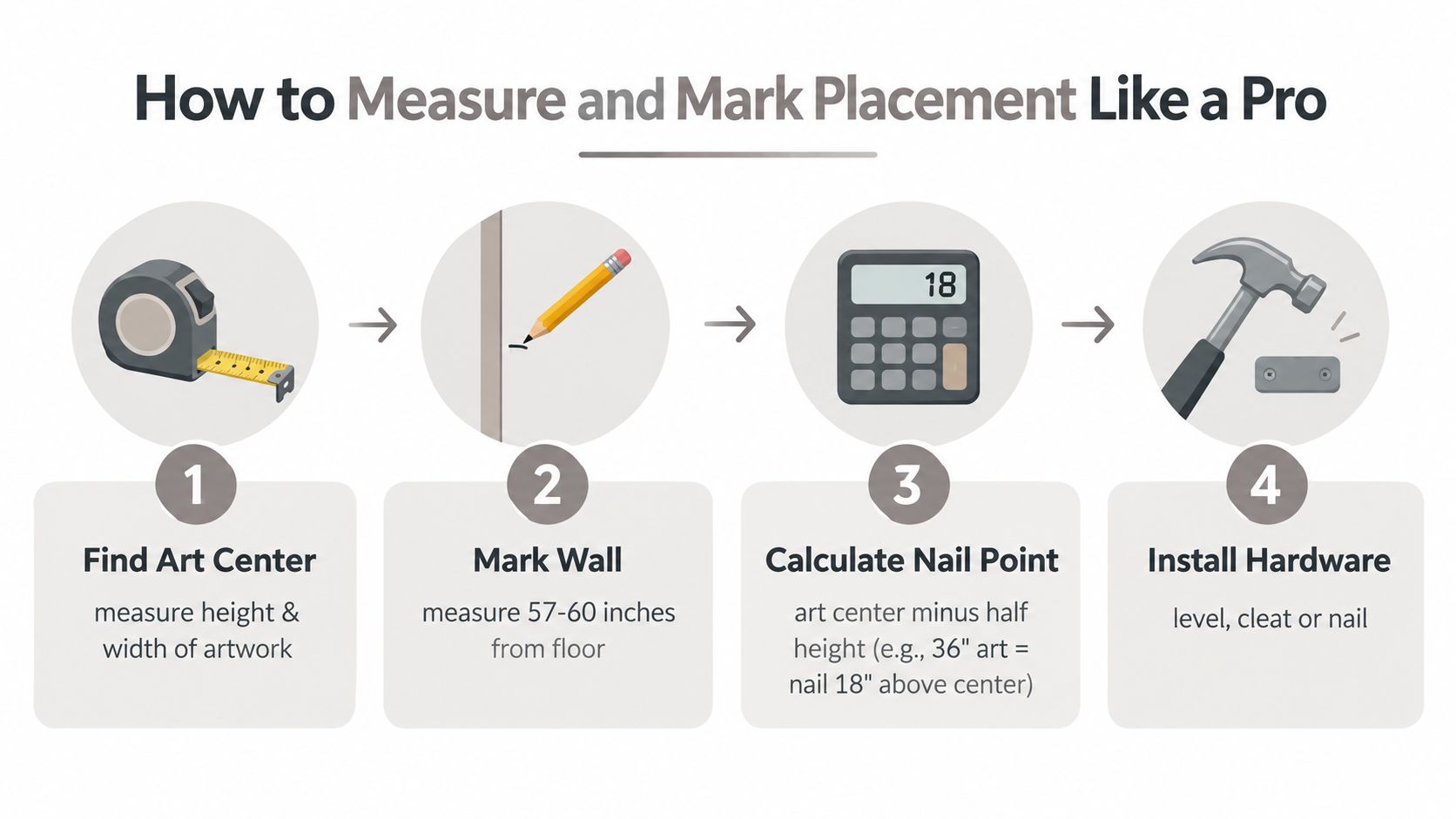
The most common installation mistake happens before the drill comes out. Measuring from the floor to the top of a frame can leave the artwork's center too high, and large pieces make that error obvious. Measure from the artwork's center and its actual hanging hardware instead.
Gather a tape measure, pencil, painter's tape, level, and a second person to hold the piece. For a heavy frame, identify the mounting system before marking the wall. A wire, D-rings, and a cleat each create a different drop between the wall hardware and the frame's top edge.
The installer's calculation
Start from the center height selected above, using the 57-inch baseline, then apply the hardware drop to find the wall mark:
Find the artwork center. Measure the overall framed height and divide it by two. Mark that midpoint on the back with removable painter's tape.
Measure the hardware drop. Pull the wire taut and measure from its hanging point to the frame's top edge. For a cleat or D-ring, measure from the actual mounting point to the top of the frame.
Mark the wall center. Measure upward from the finished floor, not from the baseboard, and mark the selected center height.
Calculate the nail or cleat position. Subtract half the artwork height from the center mark, then add the hardware drop. The result is the wall position for the nail, hook, or cleat.
For a piece that is 36 inches high, half the height is 18 inches. With a center target of 57 inches and a wire hanging point 3 inches below the top edge, the hardware mark is 57 minus 18 plus 3, or 42 inches from the floor. The same center-based calculation applies to other frame sizes and mounting systems, provided the measurements come from the actual hardware position.
Test before drilling
Cut painter's tape to the frame's outside dimensions and place the outline on the wall. View it from the main seating position, then check it from the doorway and the primary circulation path. The template shows whether the piece feels too high, too low, or too dominant before drywall is damaged.
Measure a wire under load, with it pulled into the position it will occupy. A slack wire gives the wrong drop. For a large frame with two D-rings, measure the distance between the rings and transfer both points to the wall. A laser level helps keep those marks aligned across a long wall. This picture-hanging laser level guide explains how to create a reliable level reference rather than relying on a single mark.
For another practical method of measuring and securing framed artwork, consult the Giorgi Bros. Furniture hanging guide.
Before drilling, confirm that the mark matches the frame's actual hanging point. The wall mark indicates where the nail, hook, or cleat carries the load. It does not indicate the artwork's top edge.
Choosing the Best Wall and Focal Point in Every Room
Height and wall selection solve different problems. A piece can sit at an excellent center height and still be on the wrong wall, competing with a television, disappearing beside a window, or creating glare in the main seating area.
In a living room, the wall above the sofa is often the natural anchor because the furniture gives the artwork a clear visual base. A large empty wall can work better when the sofa faces it directly and the artwork becomes the room's primary destination. The television usually has strong visual dominance, so placing major art immediately beside it can create two competing focal points unless the composition is deliberate.
Room-by-room placement decisions
Dining rooms need a seated sightline and clearance from chair movement. A large piece on the long wall can anchor the table, but avoid positioning fragile frames where chair backs or guests could strike them.
Bedrooms usually benefit from artwork centered over the headboard or on the wall first seen from the bed. If the headboard is tall, the furniture relationship may take priority over a strict gallery center.
Entryways reward impact, but check the approach. A piece that looks balanced from inside the house may catch glare from the front door or become vulnerable to bags, coats, and traffic.
Hallways need depth and clearance. Large artwork should not narrow the walking path or sit where shoulders, doors, or moving furniture will contact the frame.
Commercial lobbies require a broader sightline review. Visitors may approach from several directions, while reception desks, security equipment, and seating can change the focal point. In a gallery, office, or client-facing space, it helps to preview the arrangement virtually. Virtual Tour Easy's creator guide for art galleries provides useful context for presenting artwork and evaluating a space before installation.
A quick wall filter
Choose the primary wall when it:
Controls the first view: People naturally see it when entering or sitting in the room.
Supports the artwork: A sofa, console, mantel, or headboard gives the piece a visual base.
Avoids direct glare: Glass and glossy surfaces shouldn't face a strong window or unshielded light.
Allows safe movement: Doors, chairs, and circulation paths won't collide with the frame.
Leaves competing elements manageable: The artwork won't fight a television, mirror, or crowded architectural feature.
If the best wall fails the glare or traffic test, use the secondary wall rather than forcing the installation. Large art needs room to command attention without creating a practical problem.
Getting Scale and Spacing Right Above Furniture
Furniture changes the answer to where to hang large artwork. A strict center height can leave a painting visually disconnected from a sofa, while a furniture-only approach can place the art too low for comfortable viewing. The strongest installations balance both references.
For artwork above a sofa, console, table, or headboard, start by judging the combined unit. The furniture and artwork should read as one composition, not two unrelated objects separated by a broad blank strip. Guidance for large-format placement commonly recommends artwork at roughly two-thirds of the furniture width, with about 4 to 12 inches of space above sofas or tables. Arts Producer discusses those furniture-scale and spacing trade-offs for large artwork.
A practical proportion guide
Furniture Width | Ideal Artwork Width | Gap Above Furniture | Best For |
|---|---|---|---|
Narrow console | About two-thirds of the console width | Keep the gap visually open without separating the composition | Entryways and small dining areas |
Standard sofa | About two-thirds of the sofa width | Use the furniture relationship and sightline together | Living rooms |
Wide sectional | A broad canvas or unified grouping that can hold the sectional's visual mass | Avoid leaving the art stranded over one small section | Open-plan family rooms |
Bed or substantial headboard | A piece or grouping proportionate to the headboard and wall | Preserve clearance above the headboard | Bedrooms |
These are starting relationships, not rigid purchase instructions. If a 72-inch canvas sits above a 90-inch sofa, its width is close to the recommended two-thirds relationship, so the composition can feel substantial without overwhelming the seating. The remaining question is vertical placement. If the sofa is tall, the piece may need to sit below the pure eye-level target so the gap remains connected and comfortable.
Tall ceilings create the opposite problem. Raising the art because blank wall exists usually makes the lower part of the room feel empty. Keep the center near the established viewing height, then use a larger piece, a taller frame, or a deliberate grouping to engage more of the wall. This guide to hanging art above a sofa addresses the relationship between furniture, artwork, and the visual gap.
Watch the viewing distance
Oversized work needs enough distance for the eye to take in the composition. In a tight room, a very deep frame or projecting canvas can feel physically imposing even when the wall proportions are right. Check the view from the main seating position and from the room entrance before committing to a large format.
A piece that's slightly larger than expected often looks intentional. A piece that's too small tends to look accidental, especially on a broad wall with no furniture beneath it. When in doubt, test the full frame dimensions with tape and judge the negative space around the entire rectangle.
Lighting Wall Structure and Safe Mounting for Heavy Pieces
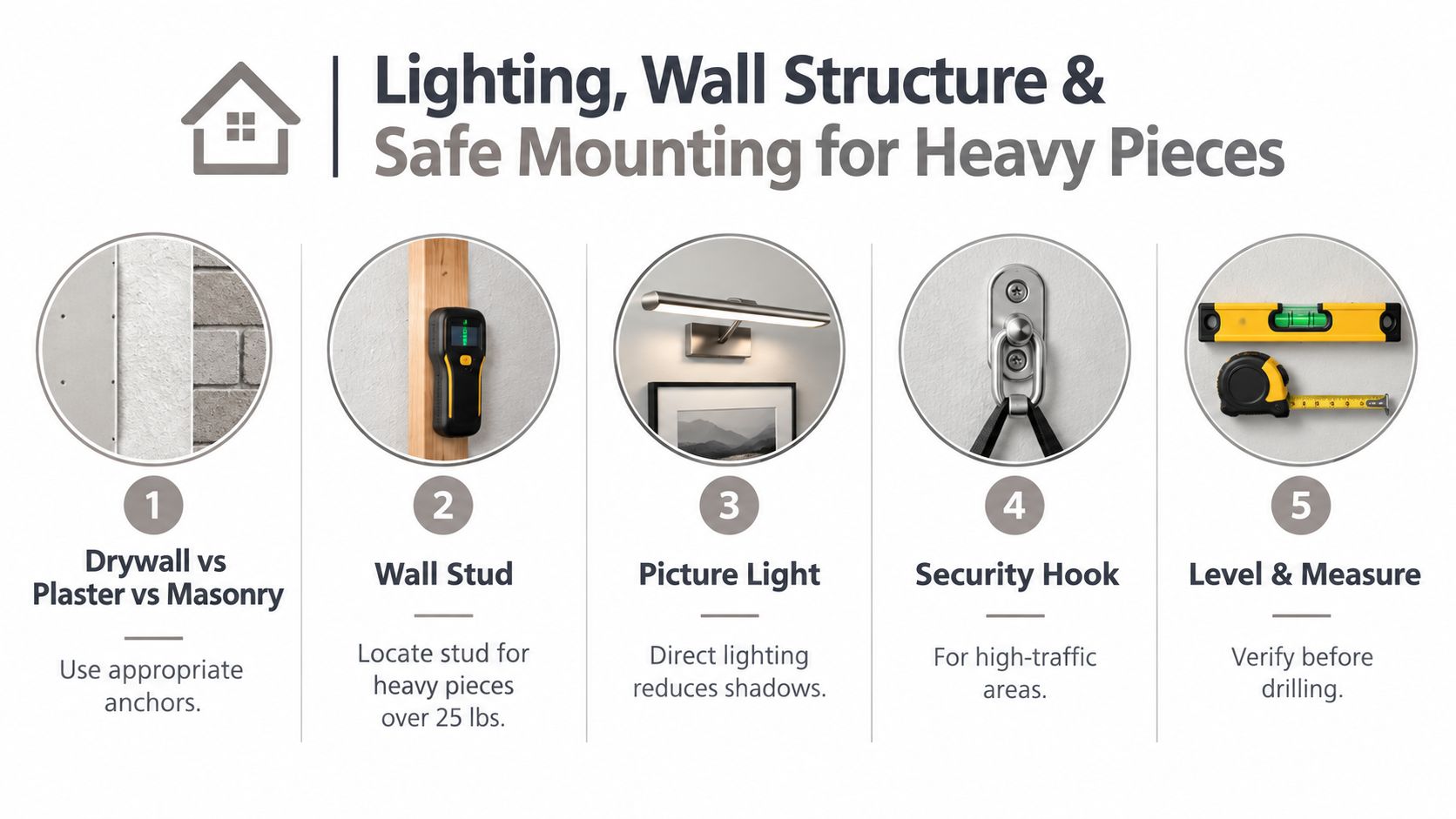
A large artwork installation has two separate requirements: it must look right, and it must stay secure. Drywall, plaster, and masonry don't accept the same hardware, and the frame's package rating doesn't automatically account for long-term movement, repeated vibration, or installation handling.
Start by identifying the wall surface. Drywall may allow a toggle-style anchor where no stud is available. Plaster can crumble around an unsuitable fastener. Masonry requires a compatible bit and anchor system. Locate a stud whenever possible, particularly for a heavy frame or a piece installed above a high-traffic area.
Match the hardware to the load
Independent anchor guidance gives approximate working ranges of 10 to 25 pounds for plastic expansion anchors, 25 to 75 pounds for threaded drywall anchors, 50 to 75 pounds for molly bolts, and 100 to 200 pounds for toggle bolts. Colorado Art Services' drywall load-capacity guidance explains those ranges and why anchors that spread load behind the wall can support more.
Treat those ratings as maximum package claims, not as your target. A practical benchmark is to choose hardware with at least a 2x safety margin over the frame's actual weight, as the same guidance recommends for dynamic loading and long-term creep. For heavier artwork, stud-backed mounting or toggle-style fasteners are generally more dependable than a simple nail or plastic plug.
Solve the light before the artwork arrives
Light changes how a large piece reads. Direct sun can affect finishes and create harsh reflections on glass, while a ceiling fixture positioned directly in front of the artwork can produce glare. Aim picture lighting so it washes the surface evenly rather than striking it straight on.
For canvas, check whether the texture creates strong shadows under directional light. For glazing, move the light source off the direct reflection path. If the wall is in a hallway, review overhead fixtures and circulation together. This discussion of pendant lights in a hallway is useful when a corridor's lighting design affects how wall art is seen.
Before mounting, run this checklist:
Wall type: Confirm drywall, plaster, or masonry.
Stud position: Locate framing and use it where practical.
Frame weight: Weigh the complete artwork, including glazing and hardware.
Anchor capacity: Choose a system with an appropriate safety margin.
Hanging method: Use a cleat or two-point mounting when the frame calls for it.
Leveling: Check the hardware and the finished frame separately.
Security: Add a security hook or restraint in a high-traffic setting when appropriate.
Large or high-placement work deserves caution. If you're balancing a tall frame on a ladder, drilling into an uncertain wall, or installing above a stairwell or commercial lobby, professional mounting can prevent both personal injury and avoidable wall damage.
Final Checks Before You Hang and When to Get Help
Before drilling, run the installation as a visual rehearsal. Put up the painter's tape outline, sit in the main seat, stand in the doorway, and walk past the wall. The artwork should feel connected to the furniture, visible from the room's main approaches, and free from glare.
Check the decisions in this order:
Center height: Is the artwork's center near the selected eye-level target?
Furniture relationship: Does the piece feel anchored rather than separated?
Scale: Does the frame hold enough visual weight for the wall?
Sightline: Can seated and standing viewers see it comfortably?
Hardware: Does the wall system match the frame weight and construction?
Lighting: Will glass reflect windows or fixtures directly?
Level: Have you checked both the mounting points and the finished frame?
If the art feels too high, lower the entire composition rather than tilting the top toward the viewer. If it feels too small, don't compensate by pushing it upward. Reconsider the width, add a deliberate grouping, or choose a wall with a tighter architectural boundary. If the frame tilts, inspect the hardware and the wire before adding random wedges behind one corner.
DIY installation is reasonable for a lighter piece on a known wall with accessible mounting points. Call for help when the artwork is oversized, heavy, unusually valuable, placed high, or being installed in a commercial environment where the wall finish and public safety matter. Colorado Art Services handles heavy-piece mounting, large-format layouts, high-placement installations, and residential or commercial art placement across the Denver Metro area and Front Range.
If you're ready to place a large painting, mirror, or framed work, Colorado Art Services can help evaluate the wall, calculate the mounting point, select suitable hardware, and install the piece level and secure. Visit the site to request professional art hanging or large-format installation support for your home, office, gallery, or commercial space.
Comments