


Picture Hanging Cord: Pick the Right Type for Your Art
You've just hung a framed picture, stepped back, and admired the level lines. The cord is hidden, the hook is barely visible, and everything looks secure. Months later, the frame is on the floor, the glass is broken, and the wall hardware is still attached. In many failures, the cord didn't just “snap.” The installation was overloaded by poor geometry, weak frame attachments, unsuitable anchors, or a rating that was mistaken for a safe working load.
Picture hanging cord is part of a suspension system, not a standalone safety device. Material, diameter, construction, attachment method, wall substrate, and the angle of the wire all determine whether an installation remains stable. The right choice is less about finding the thickest cord and more about matching every component to the artwork and its environment.
Why Your Picture Hanging Cord Fails
A frame can hang level for months, then land on the floor after one small disturbance. Before that happens, the cord may stretch, a D-ring may loosen, a hook may shift, or synthetic material may deteriorate in a warm, humid, sunlit room. The artwork applies a constant load, while doors, floors, cleaning, and accidental contact add movement that exposes weak points.
Picture hanging cord is part of a suspension system. Its performance depends on material, diameter, construction, attachment method, wall substrate, and the angle created by the hanging geometry. Diameter alone is a poor guide. A thinner, well-made steel cable may suit a heavy frame better than a thicker synthetic cord, while an unsuitable termination can defeat either material.
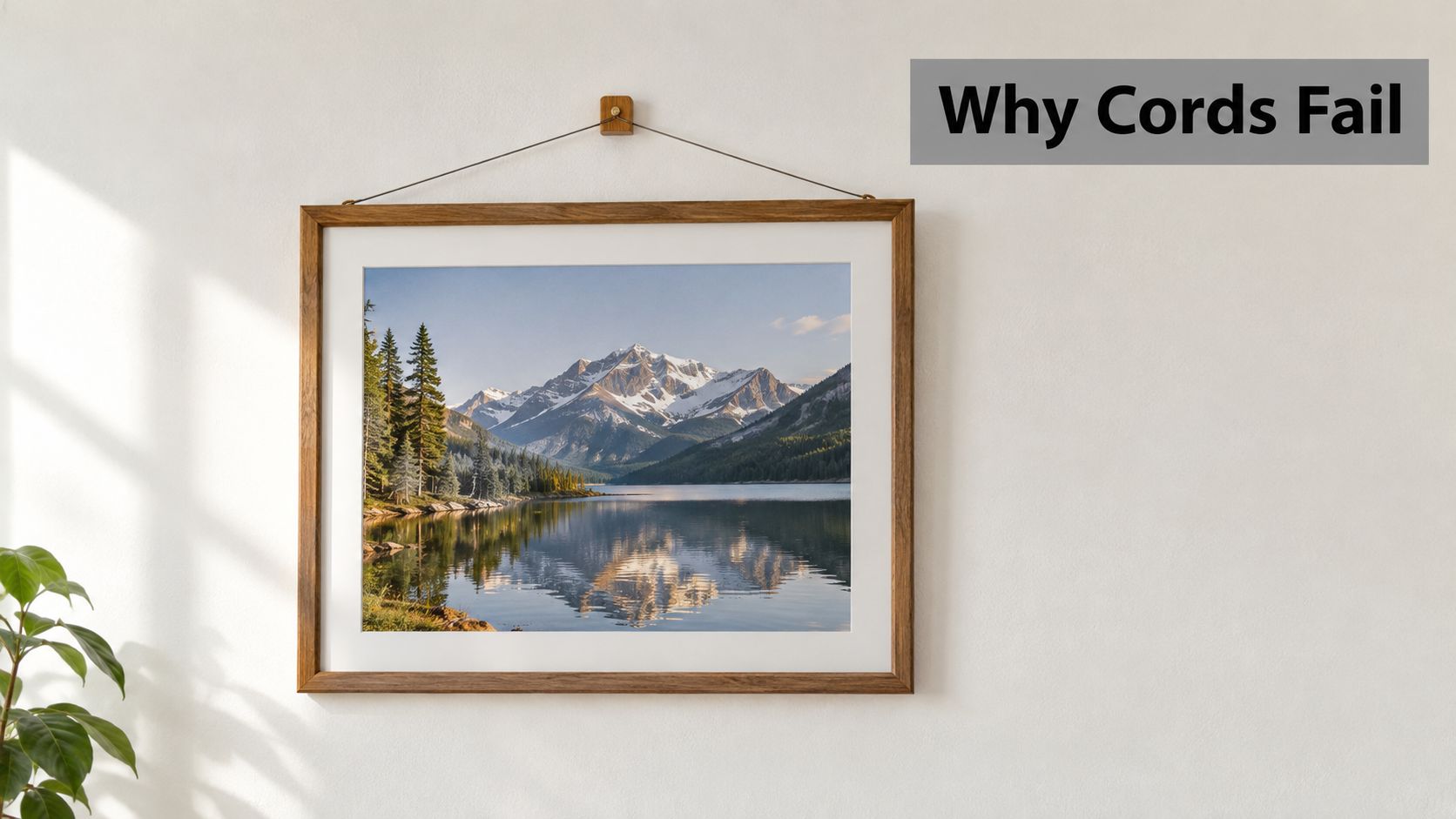
The complete assembly carries the load
The cord transfers force between the frame and the wall. It cannot compensate for a weak frame joint, loose screw, damaged hook, or anchor installed in unsupported plasterboard. A sound installation therefore includes the cord, frame hardware, wall hardware, fasteners, substrate, and hanging geometry. The weakest component sets the practical limit.
A 2.0 mm nylon cord rated at 15 lb per cord can still fail at the D-ring screw if the frame member splits. The cord's breaking strength or listed load is not automatically its safe working load, especially where knots, sharp bends, ageing, or repeated movement reduce capacity. Tension also changes with geometry. A cord pulled tight between widely separated attachment points places different forces on the frame than a slack cord forming a shallow triangle.
Cheap, unknown wire is a false economy. Check the manufacturer's rating, allow a sensible safety margin, and inspect every attachment before lifting the artwork. If the termination is unfamiliar, use a tested method for tying picture hanging wire correctly, then examine the frame-side hardware again before the piece reaches the wall.
Choosing Between Nylon and Steel Cords
A small, lightweight frame can hang neatly on nylon cord for years. Put the same cord behind a heavy mirror or a wide frame, and stretch can let the top edge tilt forward while the attachment points carry increasing tension. Material choice is therefore a geometry and safety decision, not only an appearance decision.
Nylon or perlon cord is clean-looking, flexible, and easy to handle. It can disappear behind a small frame, making it useful for domestic displays and adjustable indoor systems. Its low visibility and easy adjustment come with trade-offs: nylon can age, stretch, and provide less stiffness when the frame is heavy or the span between D-rings is wide.
Steel cable is the dependable choice for heavier artwork, large frames, and installations that need minimal stretch. Plastic-coated braided stainless steel is easier on the hands than bare wire and helps limit abrasion and corrosion. It also holds its shape better under sustained tension, but it normally requires a secure loop, crimp, or approved termination rather than an ordinary knot.
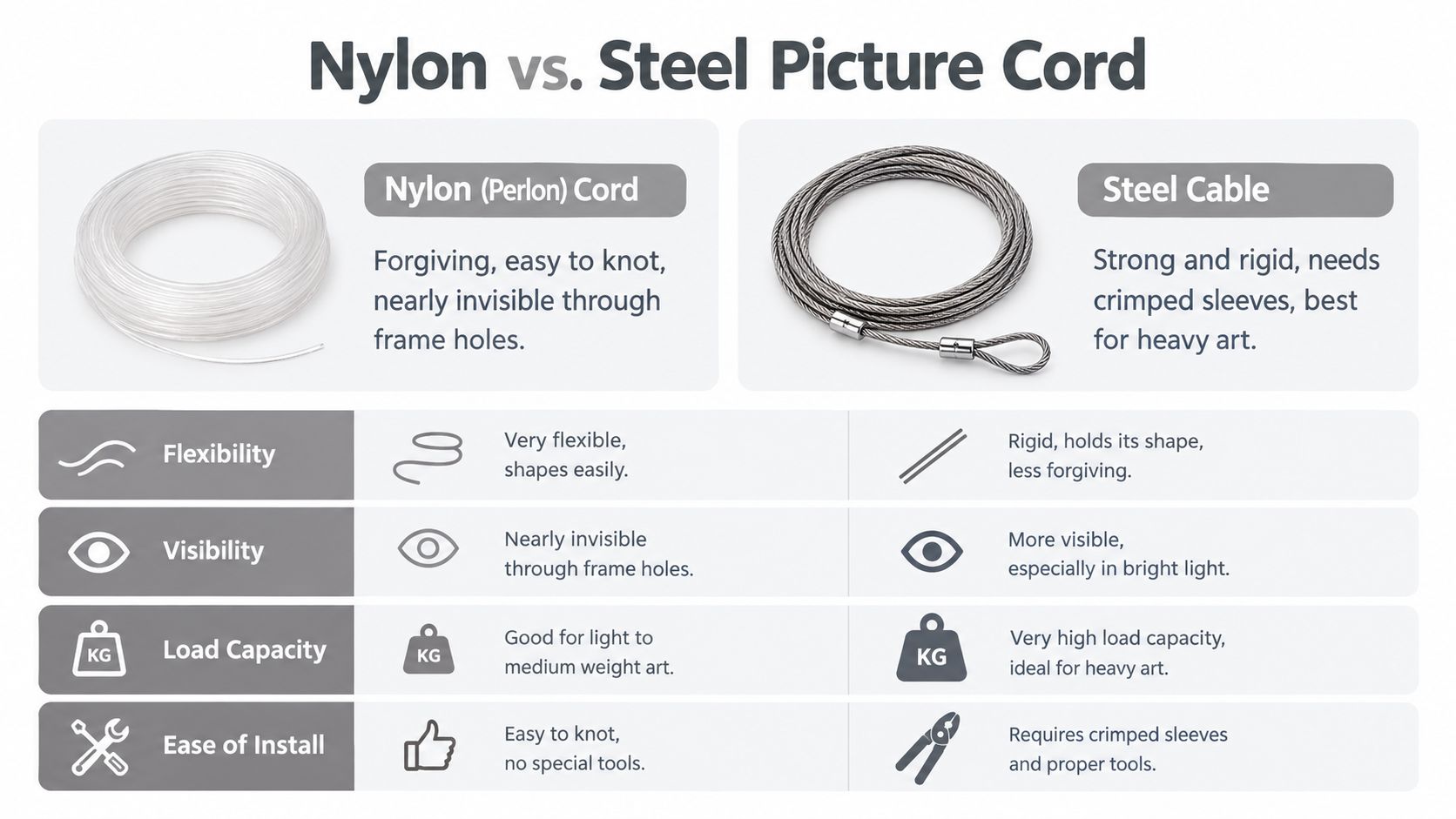
Where each material earns its place
Material | Strengths | Limitations | Suitable use |
|---|---|---|---|
Nylon or perlon | Flexible, discreet, simple to handle | Can age and may be less suitable where stiffness and high capacity matter | Lightweight framed art and adjustable indoor systems |
Plastic-coated steel | Strong for its diameter, resistant to stretch, durable | Less forgiving to handle and needs careful termination | Heavier frames, mirrors, and demanding installations |
Use nylon for a small watercolor or lightweight frame when low visibility and easy adjustment matter. Choose steel when the frame is heavy, the span between D-rings is wide enough for nylon stretch to affect the angle, or the artwork's value justifies reducing movement. A cord's listed breaking strength is not its safe working load. Knots, bends, ageing, and sustained tension reduce the margin available in the completed installation. Review the manufacturer cable specifications and match the product to the frame hardware, wall anchor, and hanging geometry.
Neither material repairs a weak wall anchor, split frame member, or poorly secured D-ring. The entire assembly must support the load.
Understanding Weight Ratings and Safety Factors
The most dangerous label on picture hanging cord is often the one that looks reassuring. A breaking load describes an idealized threshold at which a component fails under specified conditions. It isn't the load you should routinely suspend from that component.
Engineering guidance for non-lifting applications commonly reduces breaking strength to roughly one-third to one-fifth in practical use, allowing for shock, vibration, fatigue, imperfect knots, and uneven loading, as explained in this technical discussion of picture-wire capacity. A nominal 100-pound wire may therefore provide an approximate practical working range of only 20 to 33 pounds, before considering weak frame joints or wall anchors. The exact working load depends on the product and the completed installation.
Geometry can multiply the force
The wire's shape matters as much as its material. When the two sides of the wire rise steeply from the frame attachments to the wall hook, each side carries a manageable share of the load. As the wire approaches a horizontal line, tension rises sharply because the wire must pull inward as well as upward.
One published hanging analysis reports forces at wire and anchor points reaching up to 14 times the artwork's weight when geometry becomes unfavorable. That isn't a reason to distrust wire. It's a reason to stop treating a central hook and a taut-looking line as a complete engineering solution.
Keeping the two sides of the wire at least approximately 60 degrees above horizontal substantially reduces this amplification. In practical terms, don't mount the D-rings too low and then pull the wire almost straight across the back of the frame. That arrangement places high inward force on the rings and frame members.
Practical rule: Choose a cord by its working load, then check the geometry, frame attachments, wall anchors, and fasteners as separate load-bearing components.
For heavy or valuable work, use two independent wall hangers or a cleat-based system. Confirm that the anchor suits the substrate, and test the complete assembly before releasing the artwork. If the wall material is uncertain, this guide to drywall load capacity can help you identify why the wall itself may be the weak link.
Attaching Hardware to the Frame
The strongest picture hanging cord is useless if it's attached to the wrong part of the frame. Mount the hardware into the structural left and right frame members, never into cardboard, paper backing, or a loose dust cover. For a conventional framed work, position two sound D-rings or mirror hangers roughly one-quarter to one-third of the frame height down from the top, using the frame material and hardware size as your guide.
A reliable frame-side method
Inspect the frame members. Look for sound wood or properly engineered structural sections. Avoid split wood, crumbly composite material, and joints that already move under light pressure.
Install two D-rings or mirror hangers. Place them at matching heights on the left and right sides. Use screws appropriate for the frame material, and don't overtighten until the material crushes.
Use coated braided stainless-steel wire. Feed the wire through both rings, leaving enough tail to create a secure termination. Coating reduces abrasion and corrosion, while braiding provides a more controlled, durable cable.
Create a return loop. Pass each tail back through the wire after it has gone through the ring. Twist it several times so the termination can't pull through under load.
Keep the ends away from the artwork. Trim or fold the tails so they can't scratch the backing, canvas, or glazing.
The Smithsonian recommends double-strand wire between side eye screws and securing the ends so they can't contact or damage the artwork. A double strand also distributes the load more reliably than a single strand, but it doesn't excuse poor geometry or undersized hardware.
Watch the installation technique before working on a valuable frame:
Don't rely on a decorative cord, a simple overhand knot, or hardware attached only to backing. Those shortcuts may look tidy until the frame shifts and the termination is asked to carry a load it was never designed to support.
Measuring Length and Setting Tension
Correct tension keeps the frame close to the wall without making the cord difficult to install. Start by laying the frame face down on a clean, padded surface. Measure the distance between the two D-rings, then form the wire so its highest point will sit at the intended wall hook while leaving only enough slack to engage the hook comfortably.
The wire should be firm, not drum-tight. Excessive tension adds unnecessary force to the rings and frame members before the artwork is even hung. Too much slack creates a low apex, which can make the top edge drop, pull the frame away from the wall, and encourage rocking whenever someone brushes past it.
Set the apex before drilling
Hold the assembled wire at the back of the frame and lift it from the center as if it were resting on the wall hook. Check three things:
Top-edge position: The apex should support the frame without allowing the top edge to sag below the hook line.
Wall clearance: The frame should remain reasonably close to the wall rather than leaning forward.
Level behavior: Both D-rings must sit at matching heights, and the wire should rise evenly on both sides.
If the frame tilts forward, don't just pull the wire tighter. First check whether the D-rings are too low, whether the wall hook is poorly shaped for the wire, or whether the frame needs lower bumpers to steady it. Reworking the geometry is safer than loading the installation with additional tension.
Before hanging, place the frame against the wall and mark the intended hook position with painter's tape. Lift it onto the hook, check the level, and test the frame gently for movement. A proper setup should feel controlled and predictable, with no slipping termination, loose hardware, or sudden shift when the frame settles.
Hardware Recommendations for Heavy Art and Mirrors
Heavy art and mirrors change the installation standard. A small framed print may tolerate a simple cord-and-hook arrangement, but a large mirror or deep artwork can place serious force on the frame, wire, wall anchor, and hook at the same time. A single central wall hook also concentrates the consequences of any failure into one point.
For substantial pieces, choose two independent wall hangers or a cleat-based system. A cleat spreads the load across a longer section of wall and keeps the frame seated against the surface. Two properly positioned hooks provide redundancy and reduce the tendency of a wide frame to twist or slide.
Match the hardware to the building
Anchor into a stud whenever the layout allows. For masonry, use an appropriately drilled and rated fixing. Plaster and unsupported sheetrock shouldn't be treated as equivalent to a structural wall, and a drywall anchor must be selected for the actual substrate rather than its appearance.
Commercial rail systems are useful when you need adjustable positioning or several pieces along one wall. Published system limits include 20 kg per metre for several rails, 30 kg per metre for one wall-mounted rail, 50 kg per metre for a reinforced version, and 200 kg per metre for a heavy-duty track, according to Artiteq's hanging-system guidance. Those are system specifications, not automatic permissions to load any rail without checking its installation and fasteners.
A rail can be strong while the screws holding it to the wall are weak. Always treat the substrate and fixings as part of the rated system.
If you're sourcing oversized work, Where can I buy large scale art prints? is a useful starting point for understanding the scale and construction of pieces that may require more than ordinary picture wire. Once a frame becomes deep, heavy, or valuable, review the installation method before ordering the wall hardware. This heavy-duty mirror hanging plate guide provides another practical reference for installations where standard D-rings aren't enough.
Final Checks and Long-Term Maintenance
A secure installation deserves a final inspection before you walk away. Confirm that the wall hook or cleat is fully seated, the anchor hasn't shifted, and the frame hardware is still tight against sound frame material. Check the cord for fraying, kinks, corrosion, flattened sections, or damaged coating.
Run through this short audit:
Frame: D-rings or mirror hangers are fixed to structural members and sit at matching heights.
Termination: Wire tails are looped and twisted securely, with no exposed ends touching the artwork.
Geometry: The wire rises cleanly to the hook, and the frame doesn't lean or rock.
Wall: The fixing matches the substrate and shows no movement under a careful test.
Environment: The piece isn't exposed to avoidable heat, persistent humidity, or direct ultraviolet light.
Synthetic perlon can age, although deterioration in normal indoor climates is extremely slow, taking over 20 years according to one major hanging-system reference. Higher temperature, humidity, or ultraviolet exposure may justify precautionary replacement after 10 years, while steel wire is described as effectively long-lasting under ordinary conditions. These timeframes apply to the cord material, not to the hook, rail, screw, frame, or wall anchor.
Inspect the complete installation periodically, especially after moving furniture, repainting, remodeling, or noticing a change in the frame's level. A few minutes spent checking tension, corrosion, loosened screws, and wall movement can prevent a preventable fall.
For valuable, oversized, or difficult-to-place artwork, Colorado Art Services provides professional picture hanging, mirror mounting, heavy-piece installation, and art layout across the Denver Metro area and Front Range. Visit Colorado Art Services to arrange a careful installation that accounts for your artwork, frame, wall conditions, and long-term safety.
Comments