


Picture Hanging Chain Types Gauges and Safe Use Guide
You're standing in front of a wall with a framed piece in your hands, trying to make two decisions at once. You want it safe, and you want it to look right. That's usually the moment when picture hanging chain stops being a small hardware choice and starts feeling like part of the whole display.
I see this often with homeowners who've inherited an older frame, bought a vintage mirror, or moved into a house with picture rails near the ceiling. The chain looks simple. A few links, a hook, maybe a rail. But once you start asking basic questions, things get murky fast. Is one chain enough? Does a thicker chain always mean safer? Can the chain be part of the room's design instead of something to hide?
Those are the right questions. Chain isn't just decoration. It's a load-transfer part of a hanging system. The rail, the hook, the connection at the frame, and the wall or molding above it all share the job. If one part is weaker than the rest, that part controls what the system can safely hold.
There's also a style decision hiding inside the safety decision. Some people want the chain to disappear. Others want it to read like jewelry for the frame. That design choice changes what finish, proportion, and hardware make sense.
Introduction to Picture Hanging Chain and Why It Matters
A lot of people first meet picture hanging chain by accident. They move into an older home, notice a strip of molding near the ceiling, and wonder why it's there. Or they buy a brass-framed piece at an antique market and realize the original chain is part of its character.
That setup has real history behind it. Picture rails emerged in the early 19th century and became especially common in the Victorian era, from 1837 to 1901, allowing artwork to hang from molding with cord, chain, or wire instead of adding new holes every time a picture moved. The method stayed popular into the 1920s and 1930s in Colonial Revival, Craftsman, and Bungalow homes, then declined sharply after World War II as drywall and faster, lower-cost construction changed interior finishing methods (English Chain Direct on picture rail hooks and chains).
That history still matters in practical ways. If your house has plaster walls, decorative wallpaper, historic trim, or a true picture rail, chain may be the most natural solution both visually and structurally. In a gallery or office, chain can also help you adjust displays without peppering walls with fresh holes.
Why homeowners get tripped up
The confusion usually comes from thinking the chain alone answers the safety question. It doesn't.
Core idea: A hanging system is only as strong as its weakest part.
That weakest part might be the hook at the top, the D-ring on the frame, the rail itself, or the wall anchor behind everything. A handsome brass chain doesn't fix a poor attachment point.
Why the look matters too
Chain also changes how the art feels in a room. A slim dark chain can nearly disappear against a shadowy wall. A warm brass chain can echo frame details, sconces, or cabinet hardware. In some rooms, showing the suspension looks intentional and elegant. In others, a less visible method will suit the artwork better.
If you understand both sides, the mechanics and the visual role, you can choose with confidence instead of guessing.
What Picture Hanging Chain Is and How It Works
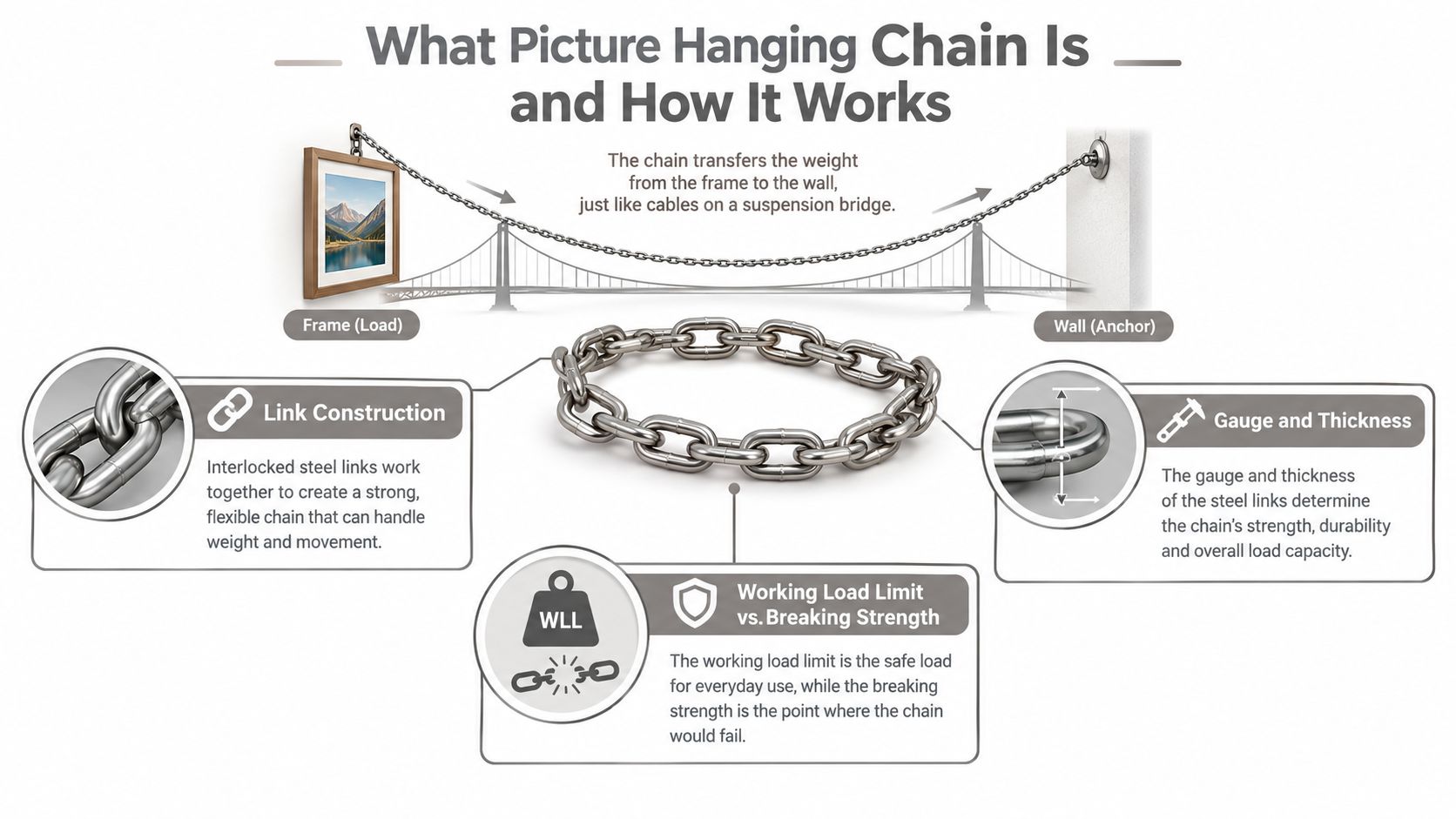
At its simplest, picture hanging chain is a series of metal links that carries the weight of a frame from one point to another. One end connects to the artwork, usually through D-rings, eyelets, or similar hardware. The other end connects to a wall hook, a rail hook, or another hanging point above.
Think of it the way you'd think about a suspension bridge in miniature. The bridge deck carries the load, but the cables move that load to the towers and anchors. A picture hanging chain does the same thing on a smaller scale. The frame has weight. The chain transfers that weight upward. The top connection passes it into the rail, hook, or wall.
What the links and gauge really tell you
People often use gauge as shorthand for strength, but gauge also affects appearance. A finer chain looks delicate and formal. A heavier chain reads more industrial or more substantial, depending on the finish and frame.
Link shape matters too. Short links usually look tidier and can feel more precise for framed art. Longer links can look rustic or decorative but may not suit every frame style. If the chain is visible, the eye notices proportion immediately. A tiny chain on a large heavy frame can look underdressed. A bulky chain on a small watercolor can overwhelm it.
If you're used to stainless cable rather than chain, a good visual comparison is the way architectural cable systems balance thickness, span, and appearance. Ultra Modern Rails has a useful primer on 1/8 cable for coastal railings that helps illustrate how a slender suspension element can still be a structural component, not just a visual accent.
Why sag changes the forces
A hanging chain doesn't always pull straight down. If it forms a deep V between two frame points and a top hook, the tension in the chain rises beyond the artwork's simple weight. That's one reason installers pay attention to geometry, not just material.
This idea connects to a very old physics problem. Christiaan Huygens coined the term catenary in 1690 for the curve of a freely hanging chain, correcting the earlier belief that the curve was a parabola. That shape became important in engineering because it describes how a uniform chain hangs under gravity (The Craftsman Blog on picture rail history and catenary context).
When a chain hangs with more spread and more sag, each side works harder than many people expect.
One chain is never the whole answer
A safe choice comes from reading the chain as one piece in a larger assembly:
At the frame: D-rings, eye screws, or side hardware have to be secure.
At the top: Wall hooks or rail hooks need equal or greater capacity than the chain.
At the surface: The rail, molding, anchor, or wall structure has to carry the load.
In use: Adjustment, movement, and accidental bumps can change how the load behaves.
That's why experienced installers don't ask only, “How much is the chain rated for?” They ask, “What is every part in this path doing?”
Types Gauges Finishes and Weight Capacities Explained
Walk into a hardware store or browse online, and chain choices can look deceptively similar. The links may all seem close in size at first glance. In use, though, different chain types behave differently and create very different visual effects.
Common chain styles
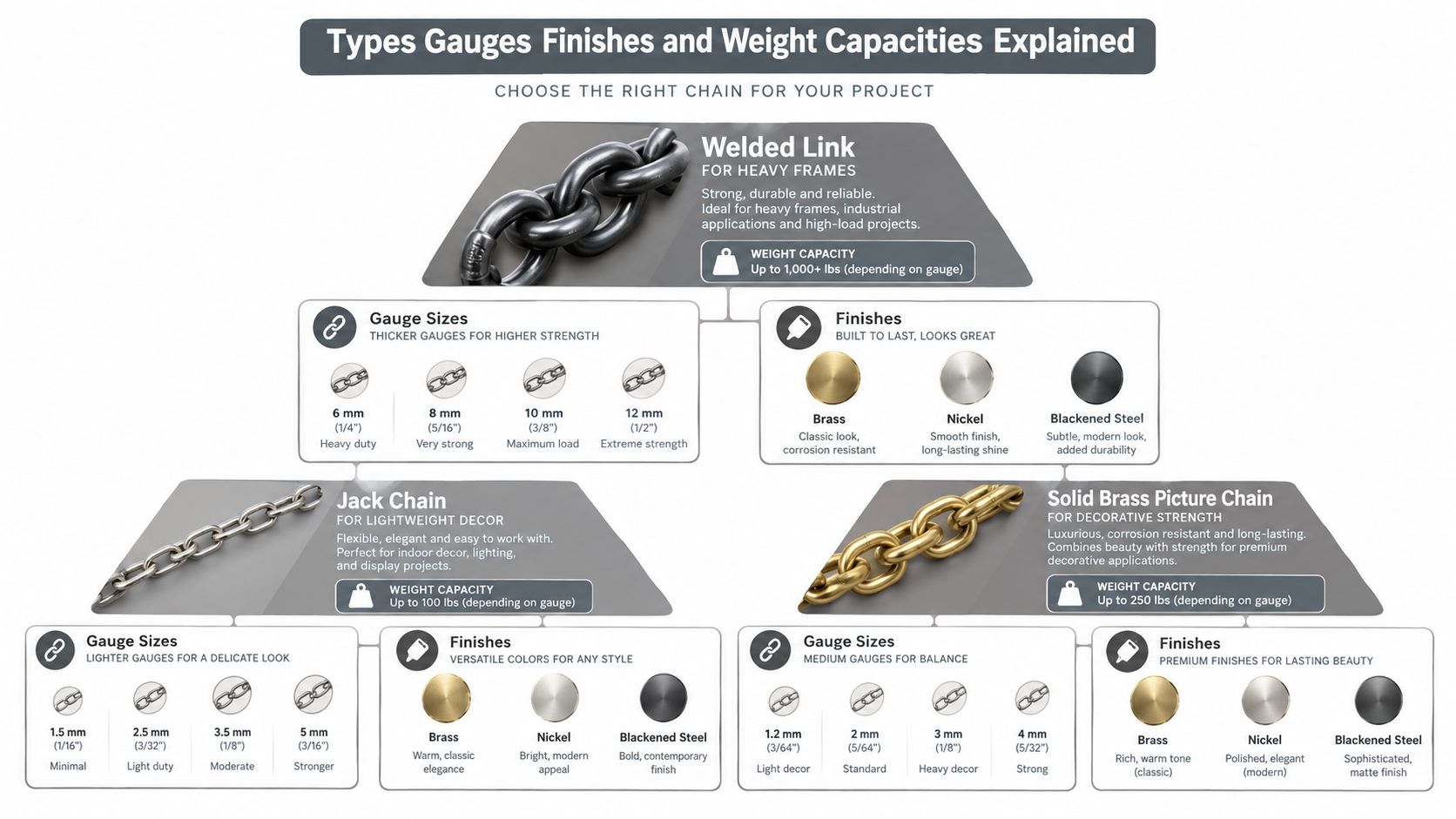
Jack chain is often the light-duty option people recognize from lamps, tags, or simple hanging decor. For artwork, it may suit very small or lightweight pieces when the rest of the hardware is equally light, but it usually isn't the first choice for anything valuable or substantial.
Welded link chain tends to feel more structural. The links are more clearly built for load transfer, and the overall look can suit industrial, modern, or utilitarian interiors. It can also be a better fit where the chain is visible and needs to look intentional rather than ornamental.
Solid brass picture chain sits in a different category. It's often chosen because it looks finished and traditional, especially with antique brass frames, gilt frames, or rail systems in older homes. One independent hardware listing for solid-brass picture chain gives a maximum working load limit of 23 lbs (solid-brass picture chain listing). That's a useful reminder that decorative-looking chain can still have a defined working limit, and that limit may place it in the light to medium range rather than the heavy-mirror category.
Gauge affects both strength and proportion
Gauge is where safety and appearance overlap.
A thicker gauge generally looks stronger because it usually is part of a stronger family of products, but it also changes the visual balance. On a slim metal frame, a heavy chain may feel clumsy. On a broad carved frame, a very fine chain can look nervous, like it's trying to do a bigger job than it was made for.
I usually suggest treating gauge like you'd treat the width of a mat or the scale of a lamp. It should fit the object and the room, not just the load.
Selection rule: Choose a chain that fits the frame visually, then verify that the full system rating still exceeds the real demand.
Finish choices and where they work
Finish does more than match metal colors. It changes whether the chain blends in or reads as a design feature.
Brass: Warm, traditional, often right for historic interiors, oil paintings, and vintage mirrors.
Nickel or silver tone: Cleaner and cooler, often easier in modern offices or minimalist rooms.
Blackened steel or dark finish: More graphic, often good when you want the hardware to frame the art without adding shine.
Recent design coverage points to a 2026 trend projection in which visible suspension becomes part of the room's look instead of something hidden (Galaxus on visible suspension as design). That lines up with what many designers already do in galleries, studios, and high-end residential spaces.
The rating that matters
A lot of product pages answer the wrong question. They give one number and leave out the context.
One independent guide notes that published ratings are often per pair of chains, and that heavier-duty picture rail chain can range from 88 lb to 660 lb per pair depending on gauge (Collier Webb picture rail chain guide PDF). That's a huge spread.
Don't ask only what the chain can hold. Ask what the whole assembly can hold, and whether the rating is for one chain or a pair.
How Picture Hanging Chain Compares to Other Hanging Methods
A common homeowner mistake happens right at the comparison stage. They look at one number on the chain package and assume they have their answer. In practice, hanging method is a system choice. The rail or wall anchor above, the hook in the middle, the frame hardware below, and the amount of movement you can tolerate all matter just as much as the chain itself.
That is why chain should be compared a little differently from wire, cable, cord, or cleats. Chain is often chosen for two jobs at once. It carries weight, and it stays visible as part of the room.
Picture Hanging Chain vs Alternative Suspension Methods
Method | What usually limits it first | Visibility | Best For |
|---|---|---|---|
Picture hanging chain | Often the full system: rail, hook, chain, and frame hardware | Usually visible | Decorative hanging, picture rails, historic interiors |
Picture wire | Commonly the wall hook or frame attachment points | Mostly hidden behind frame | Standard framed art where the hardware should not show |
Stainless steel cable | Often the rail system and cable hardware together. One professional system example lists about 45 lbs (AS Hanging support guidance) | Low to moderate visibility | Modern rail systems, cleaner look, light to medium pieces |
Nylon cord | Usually the cord and hook combination. One professional system example lists about 15 lbs | Low visibility | Lightweight displays and flexible rail arrangements |
Cleat or French cleat | Usually the wall fasteners and how well the cleat is installed | Hidden once installed | Heavy mirrors, large framed works, flat-to-wall mounting |
A simple way to compare these methods is to picture a bucket chain. The bucket does not care which link looked strongest in the store. It hangs from the weakest part of the whole run. Art hanging works the same way.
When chain makes more sense
Chain works well when you want the suspension to be part of the presentation. In an older home with a real picture rail, chain can look natural instead of improvised. In a room with antiques, oil paintings, or a tall mirror, the visible metal can echo the trim, lighting, or frame finish.
It also helps in spaces where art changes places from time to time. Rail-based hanging lets you adjust height and position with less patching than repeated direct wall mounting. If you are comparing systems room by room, this guide to an artwork hanging system shows how installers match the method to the wall, art, and layout.
When another method fits better
Wire usually wins when you want the hardware to disappear. Cable often suits cleaner, more modern rooms where a thin vertical line looks intentional but less decorative than chain. A cleat is often the steadier choice for large mirrors or broad frames that need to sit close to the wall and resist shifting.
That visible-design question matters more than many buyers expect. Chain can look beautiful and still be the wrong method if the piece needs a flush fit, extra lateral stability, or support that spreads across a wide frame.
Quick decision cues
Choose chain when the hanging hardware should be seen and the full system rating supports the piece.
Choose wire when you want a familiar, mostly hidden method for standard framed art.
Choose cable when you want a slimmer, more architectural line.
Choose cord only for lighter pieces where low visibility matters more than strength.
Choose a cleat when a heavy object needs firm, close-to-wall support.
The best comparison question is simple. Which method gives you the right look, while keeping the whole hanging system rated safely from top support to frame?
Proper Installation With Hooks Wire and Picture Rails
Installation mistakes usually happen before the chain goes up. People focus on the links and ignore the support above or the frame hardware below. Good hanging starts with a quiet checklist.
Start at the wall or rail
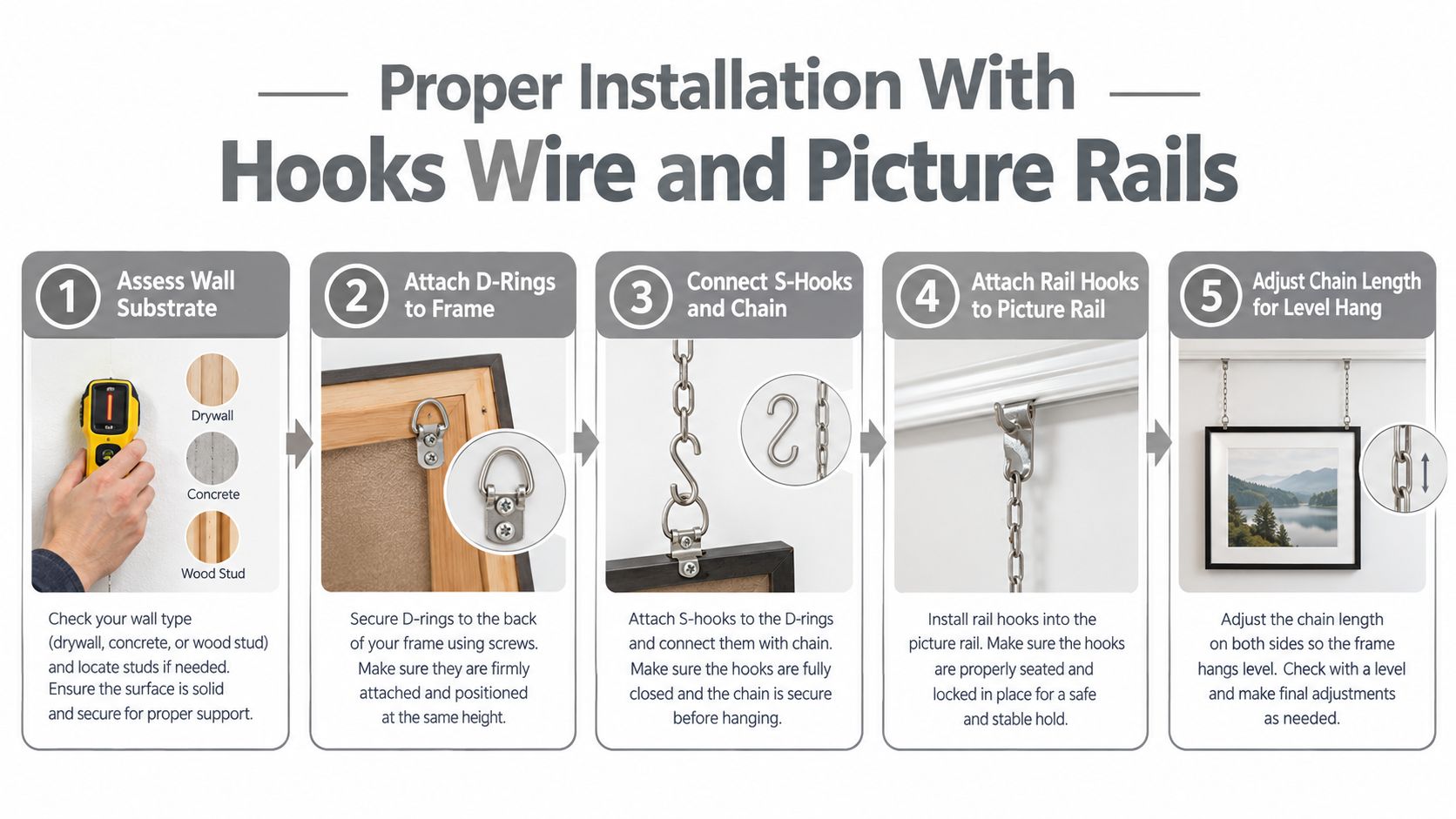
Look first at what will carry the load. Is it a historic picture rail, a modern rail system, a direct wall hook, or an anchor in drywall or plaster? If the support surface is uncertain, stop there and sort it out before choosing chain length or finish.
In older homes, the rail may be original and visually perfect for chain, but the condition of surrounding trim still matters. In modern spaces, a dedicated rail system may be cleaner and easier to adjust over time. If you're comparing options, this overview of picture rail installation helps show how rail-based setups are planned.
Attach the frame hardware correctly
Most framed art should have two secure side attachment points, usually D-rings or similar hardware. Those points should be installed evenly so the chain shares the load properly.
A common beginner mistake is relying on one central hanger at the back of the frame. That may work for some light objects, but it often creates more swing, less control, and a less level result.
Two side connection points usually give you a calmer, more controllable hang than a single centered point.
Set the chain and top hooks
Once the frame hardware is set, connect the chain with appropriate hooks or connectors. Then hang the top end from the wall hook or picture rail hook. The goal is a balanced line, not a dramatic droop.
Installers slow down and watch the geometry. The deeper the V shape, the more tension develops along each side. That's one reason an arrangement that “looks fine” can still be asking too much of its components.
A visual walkthrough helps here:
Practical setup sequence
Check the support first: Confirm the rail, wall hook, or anchor is suitable for the intended piece.
Install matching side hardware: Place D-rings evenly so the frame hangs predictably.
Use compatible connectors: S-hooks, rail hooks, and attachment points should fit the chain cleanly without forcing the links.
Shorten for control: A slightly shorter chain often gives a tidier, steadier presentation than an overly long one.
Level and test: Step back, then gently test for movement before leaving the piece in place.
For complex layouts, high placements, heavy mirrors, or grouped displays, some homeowners use a professional installer such as Colorado Art Services because the work often involves wall assessment, layout planning, and safer hardware matching, not just hanging one piece.
Safety Maintenance and Long Term Care for Hanging Systems
A picture may hang for years, then fail because one small part slowly loosened. That is why long-term care starts with one simple idea. The system is only as strong as its weakest link.

Chain often gets all the attention because it is visible. Yet the chain is only one part carrying the load. The rail or wall hook above, the connectors in the middle, the frame hardware below, and the wall or trim behind them all share the job. If one part is weaker, worn, or poorly matched, that part sets the limit.
A good rule is to leave a healthy safety cushion instead of loading any piece close to its stated capacity. As noted earlier, hanging systems also carry more tension when the suspension line forms a deep V. A setup that looks neat from across the room can still place extra strain on hooks and attachment points. That is one reason installers inspect the whole path of the load, not just the chain itself.
What to inspect regularly
Use the same routine you would use for a ladder or a handrail. Give it a quick check now and then, and a closer check after moving furniture, repainting, cleaning, or rehanging the piece.
Check the chain links: Look for bending, thinning, rust, worn plating, or any link that no longer matches the others.
Check connection points: S-hooks, quick links, rail hooks, and frame rings should sit straight and should not look spread open or twisted.
Check the support above: Rails should stay tight, wall hooks should not shift, and wood trim should not show cracking or pull-out.
Check the wall itself: Drywall, plaster, and masonry age differently. If the installation uses anchors, this anchor selection guide for different wall types helps explain what can loosen over time.
Check for movement: If the picture starts tilting, swinging more easily, or sitting lower than before, treat that as a warning sign.
Small changes matter.
Clean for function and appearance
Visible chain has two jobs. It holds the piece, and it contributes to the look of the room.
Dust, kitchen moisture, and bathroom humidity can dull finishes or encourage corrosion. Wipe the chain and exposed hardware with a soft dry cloth first. If the finish allows more cleaning, use the mildest method recommended for that metal and avoid soaking joints or connectors. Harsh cleaners can strip color, leave residue, or speed up wear.
Finish choice affects maintenance too. Bright brass shows fingerprints sooner. Black finishes can collect pale drywall dust. Stainless steel usually asks for less visual upkeep. The goal is consistency. The chain, hooks, and nearby hardware should still look like they belong together.
Know when to replace parts
Hardware rarely fails all at once. It usually gives signals first. A stretched link, a hook that no longer closes neatly, or a wall anchor that turns in place is enough reason to stop using the setup until you correct it.
Replace worn parts with components that match both the load path and the visual style. That keeps the display safe and keeps the suspension looking intentional, rather than patched together over time.
Choosing the Right Picture Hanging Chain for Your Space
The right choice usually becomes clear when you answer three questions. How heavy is the piece, what is carrying the load, and do you want the chain to be seen?
For a small framed print in a traditional room, a fine decorative chain may be exactly right. For a heavier framed work, the chain might still suit the look, but only if the rail, hooks, and frame hardware all support that decision. For a large mirror, a less decorative and more direct mounting method may make more sense even if chain appeals visually.
Match the chain to the setting
A homeowner may want warmth and character. A gallery may need flexibility. An office may want clean lines and easy adjustment. A designer may want the suspension to act like a visible accent.
If the artwork itself carries cultural or symbolic significance, the display method should support that tone. For example, someone hanging religious or South Asian artwork may want a setup that feels respectful and visually coherent with the piece. In that context, a resource like HD Asian Art explains Hindu deities can help inform the curatorial side of placement while you make hardware decisions.
A practical decision path
Use decorative chain when the suspension should contribute to the room.
Use a stronger or less visible system when the object is large, valuable, or better held close to the wall.
Choose finish deliberately so the hardware either blends with the frame or speaks clearly as part of the display.
Stop treating the chain as a single answer if the rail, hook, or wall condition raises doubts.
A good hanging result feels calm. The piece sits where it belongs, the hardware makes visual sense, and nobody in the room wonders if it's secure.
Colorado Art Services provides professional picture hanging, art installation, mirror mounting, and display planning for homes, offices, and galleries across the Denver area and Front Range. If you're working with picture rails, visible chain, heavy framed pieces, or tricky wall conditions, their team can help match the hardware and placement to the piece and the space. Visit Colorado Art Services to learn more.
Comments