


Large Picture Frame Dimensions: A Practical Sizing Guide
You've found the print you want to display, but the frame shelf turns a straightforward purchase into a measurement problem. The artwork may be labeled 24 × 36 inches, while the frame listing refers to the opening, the moulding adds to the outside footprint, and a mat can make the finished package larger still. On a wide wall, those differences affect balance. On a narrow stairway or above furniture, they affect whether the piece can be installed safely at all.
Large picture frame dimensions make sense once you separate the artwork size, the frame's inner opening, and the finished outer package. The practical decision is rarely just “Which frame is biggest?” It's “Which standard size fits the art, suits the wall, leaves room for a mat, and can be handled without forcing an unsuitable stock frame?”
What Counts as a Large Picture Frame
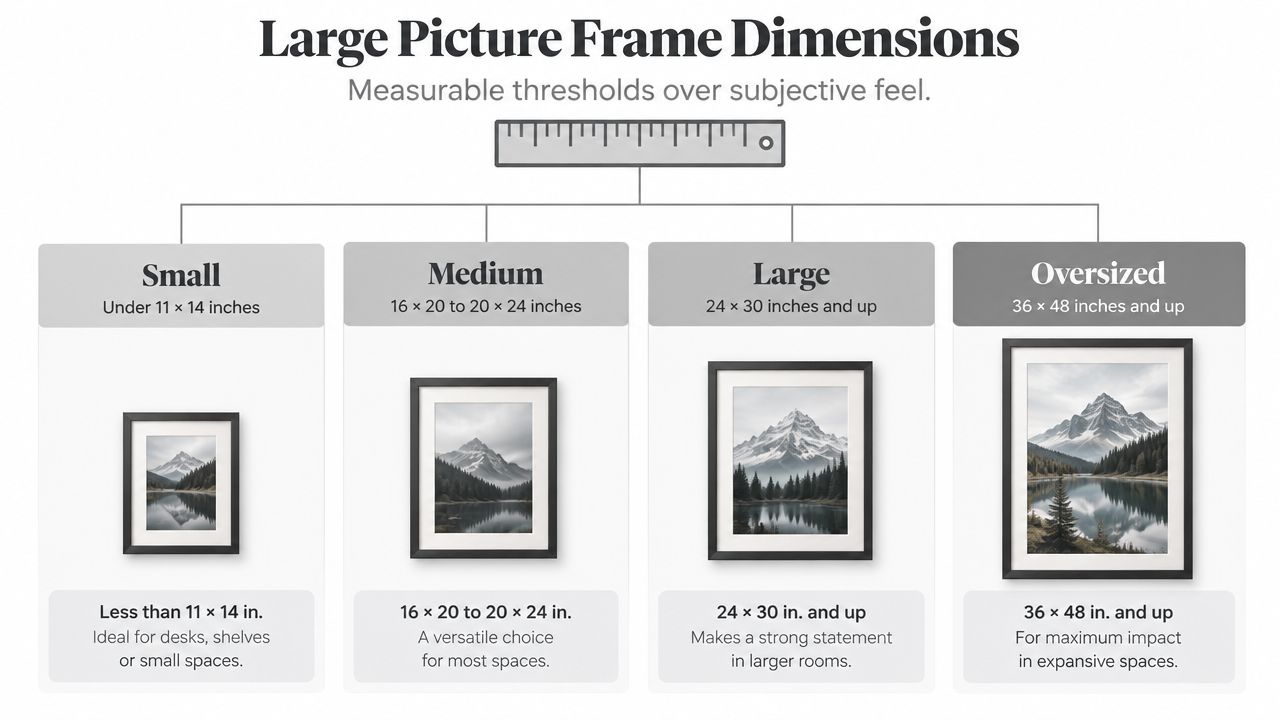
A frame can look oversized on a narrow wall yet feel modest above a deep sofa. Use the artwork size and the finished package to set a practical category. Frames under 11 × 14 inches generally fall into the small range, 16 × 20 through 20 × 24 inches into the medium range, and 24 × 30 inches and above into the large range. Formats from 36 × 48 inches and above enter oversized territory, where handling, wall structure, and glazing become part of the decision.
A 24 × 36 inch poster is a substantial piece in many rooms and a common retail format for posters and statement art common large frame sizes. The listed size usually identifies the artwork or poster the frame accepts. It does not necessarily describe the complete outside measurement.
Three measurements prevent most mistakes
Inner opening: The usable area for the artwork, or the space enclosed by a mat opening.
Outer package: The full wall footprint, including moulding, mat, glazing, backing, and spacers.
Visible image area: The part of the print left visible after the mat covers its edges.
Standard formats also provide room to adjust presentation. An 8 × 10 print in an 11 × 14 frame leaves space for a mat, while keeping the finished size manageable for a home, office, or gallery. The same approach helps bridge the gap between a ready-made frame and a custom order when the artwork does not match a stock opening.
Measure the artwork before choosing the frame. Confirm whether the image will be cropped, floated, or covered by a mat, then measure the wall area available for the outer package. Tools such as AI interior design Vizcraft let you mock up a 24 × 36 frame on a photo of your wall before ordering, which can reveal scale problems early. Use the visualization as a planning aid, then verify clearances, stud locations, hanging hardware, and the actual frame measurements before installation.
Standard Large Frame Dimensions in Inches and Centimeters
Retail frame ranges concentrate on repeatable formats, which makes them useful starting points before custom fabrication enters the discussion. Common U.S. sizes include 16 × 20, 18 × 24, 24 × 36, 27 × 39, 27 × 40, and 30 × 40 inches large frame size references. 24 × 36 inches suits many posters, photographs, and statement pieces, while 27 × 40 is a familiar theatrical one-sheet format. For poster-specific purchasing context, use this poster frame size guidance.
Metric sizing follows a related but separate system. ISO paper sizes provide a dependable reference for international prints: A3 is 29.7 × 42 cm, A2 is 42 × 59.4 cm, and A1 is 59.4 × 84.1 cm. A1 measures about 23.4 × 33.1 inches, so an A-series print may need a different frame or a mat when paired with an inch-based format. The ISO paper and frame sizing reference helps compare the two systems.
Inches (in) | Centimeters (cm) | Typical Availability | Common Use |
|---|---|---|---|
24 × 30 | About 60 × 75 | Often available, finish dependent | Portraits, art prints, office graphics |
24 × 36 | About 60 × 90 | Common off the shelf | Posters, photography, statement wall art |
27 × 40 | About 69 × 102 | Available in poster ranges | Theatrical one-sheets |
30 × 40 | About 75 × 100 | Available in selected ranges | Fine-art prints, canvases, corporate graphics |
32 × 40 | About 80 × 100 | More often special order | Large photography and presentation work |
36 × 48 | About 90 × 120 | Select stock, often ordered | Oversized art and feature walls |
40 × 60 | About 100 × 150 | Usually special order | Panoramic displays and very large graphics |
These conversions guide shopping, but they do not define the finished frame. Confirm whether a listing describes the art size or the outside size. A mat changes the required opening, and a broad moulding increases the wall footprint. That distinction often determines whether a ready-made frame works or whether the project should move to custom fabrication. It also affects wall placement, because the visible artwork can be correctly sized while the completed frame still occupies more space than expected.
Aspect Ratios and Frame-to-Art Conversions
Aspect ratio determines whether a print fits cleanly, needs a crop, or should sit inside a mat. A frame labeled 24 × 36 has a 2:3 ratio, which works naturally with many photographic and poster formats. A 30 × 40 frame has a 3:4 ratio, while 16 × 20 and 24 × 30 follow 4:5, also expressed as 8:10.
The ISO A-series uses a different proportion. A2 and A1 prints are close to one another in shape, but neither is an exact match for every inch-based poster frame. That difference may be small visually, yet it becomes obvious when you try to center an unmounted print inside a stock frame.
Frame Size (in) | Aspect Ratio | 16:9 Image (in) | 4:5 Image (in) | ISO Paper |
|---|---|---|---|---|
24 × 30 | 4:5 | Requires matting or crop | 24 × 30 | Near A-series use, not exact |
24 × 36 | 2:3 | About 22.4 × 40 when matched by height | About 24 × 30 when matched by width | A1 is about 23.4 × 33.1 |
30 × 40 | 3:4 | Requires crop or mat | 30 × 37.5 or 24 × 30 | Near A-series use, not exact |
36 × 48 | 3:4 | Requires crop or mat | 36 × 45 | Larger than A1 |
40 × 60 | 2:3 | Requires crop or mat | 40 × 50 | Larger than A1 |
The 16:9 example illustrates why the mat is often the better solution. A 16:9 image scaled to roughly 22.4 × 40 inches preserves its ratio, but it won't fill a 24 × 36 opening without cropping or visible side areas. A mat can preserve the full image while creating a deliberate presentation.
A practical odd-size adjustment
Suppose a print measures 22 × 34 inches and you want to use a 24 × 36 frame. The frame leaves only a small amount of room around the print, so first check the frame's actual opening and rabbet. If the print is smaller than the opening, center it with equal borders. If the art is larger, don't force it under the frame lip. Trim only when the composition allows it, otherwise order a custom mat or frame.
Matting Allowances and Outer Package Sizing
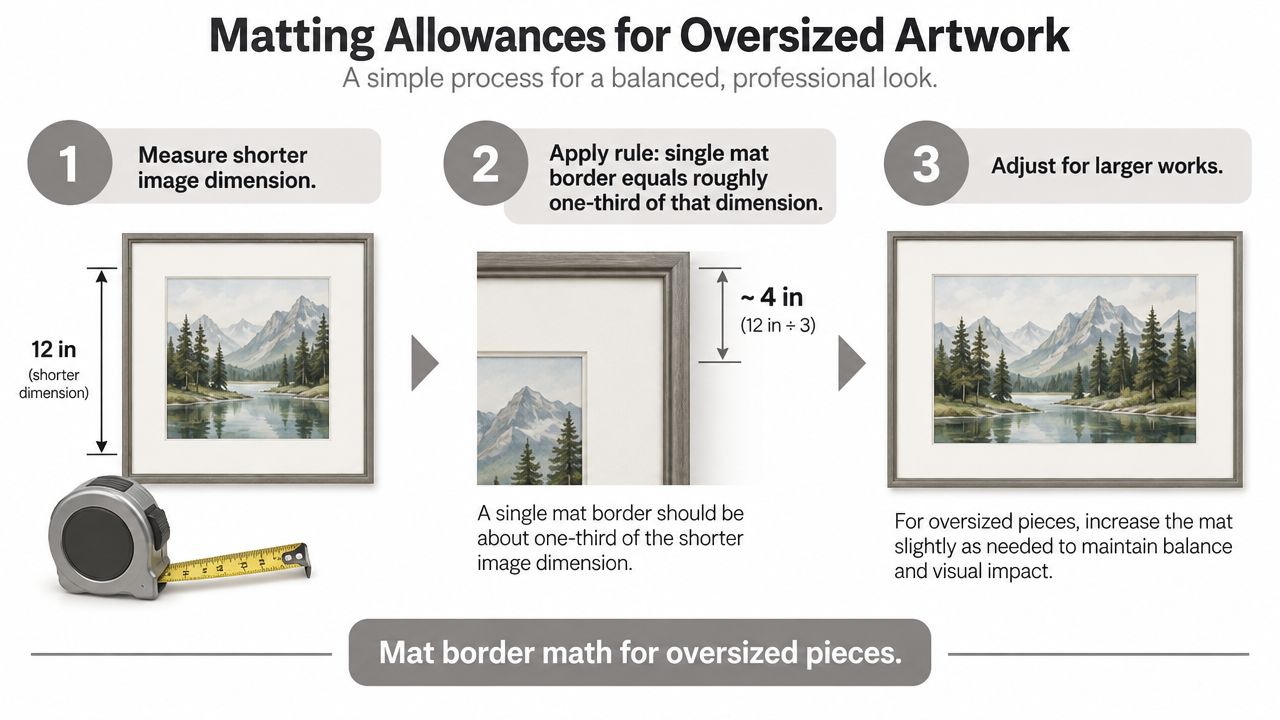
A mat changes both the appearance and the dimensions of a large frame. For a single mat, a useful starting principle is to make the visible border roughly one-third of the shorter image dimension, then adjust by eye for the room, moulding, and artwork. Larger pieces generally need proportional scaling rather than a narrow border copied from a small photograph.
For a 24 × 36 inch poster, framing guidance commonly recommends mat borders of about 3 to 4 inches, creating an outer package around 30 × 42 to 32 × 44 inches before any additional structural differences poster mat and outer sizing. A smaller 2-inch border around a 24 × 36 print produces a 28 × 40 presentation, while a 30 × 40 print with the same border becomes 34 × 44.
Measure the complete stack
A mat isn't the only allowance. The frame must also hold the glazing, artwork, backing, and sometimes spacers. Leave a small clearance behind the rabbet so the glazing doesn't press directly against the print. Large pieces are especially unforgiving because broad glazing can bow, shift, or transmit pressure if the stack is packed too tightly.
Practical rule: Measure the framed package from the back as well as the front. The rabbet depth, backing, and hanging hardware can matter as much as the visible moulding.
Double and triple mats add visual separation, but they also increase thickness and weight. Spacers create a deeper air gap for photographs, textiles, or dimensional work, yet they make the package project farther from the wall. Before sending an oversized piece to storage or transport, record the full finished dimensions and depth. Large artwork storage guidance is useful when the frame needs to be protected between locations.
Custom Fabrication Versus Ready-Made Limits
Ready-made frames work best when the artwork matches a format that manufacturers produce repeatedly. The familiar search sizes include 24 × 36, 30 × 40, 36 × 48, and 40 × 60 inches, although availability depends heavily on the finish, glazing, and retailer. Once the artwork falls outside the supplier's normal production range, adapting it into a smaller frame usually creates a worse result than commissioning the correct size.
A manufacturer's limit may be physical rather than aesthetic. One supplier cited in industry coverage lists its largest completed frame at 27 × 41 inches, which shows why “large” has no universal meaning across manufacturers manufacturer limits and large-frame constraints. Shipping, glazing size, corner joinery, and safe handling can all move a project from stock inventory into custom fabrication.
Factor | Ready-Made | Custom Fabrication |
|---|---|---|
Dimensions | Fixed formats and selected finishes | Cut to the artwork and installation |
Availability | Immediate when stocked | Requires production scheduling |
Mat opening | Often pre-cut | Sized to the image and visual balance |
Glazing | Limited by the product range | Selected for weight, protection, and scale |
Shipping | Easier for compact packages | More vulnerable as size and weight increase |
Best fit | Standard posters and repeat formats | Odd sizes, oversized work, deep or valuable pieces |
Custom work costs more to produce because the shop must account for material waste, stronger joinery, specialized glazing, and labor. It also avoids the hidden cost of trimming an important image, accepting uneven borders, or replacing a damaged frame after a difficult shipment. For an overview of production considerations, Thompson frame construction provides useful context.
Matching Frame Dimensions to Wall and Artwork Size
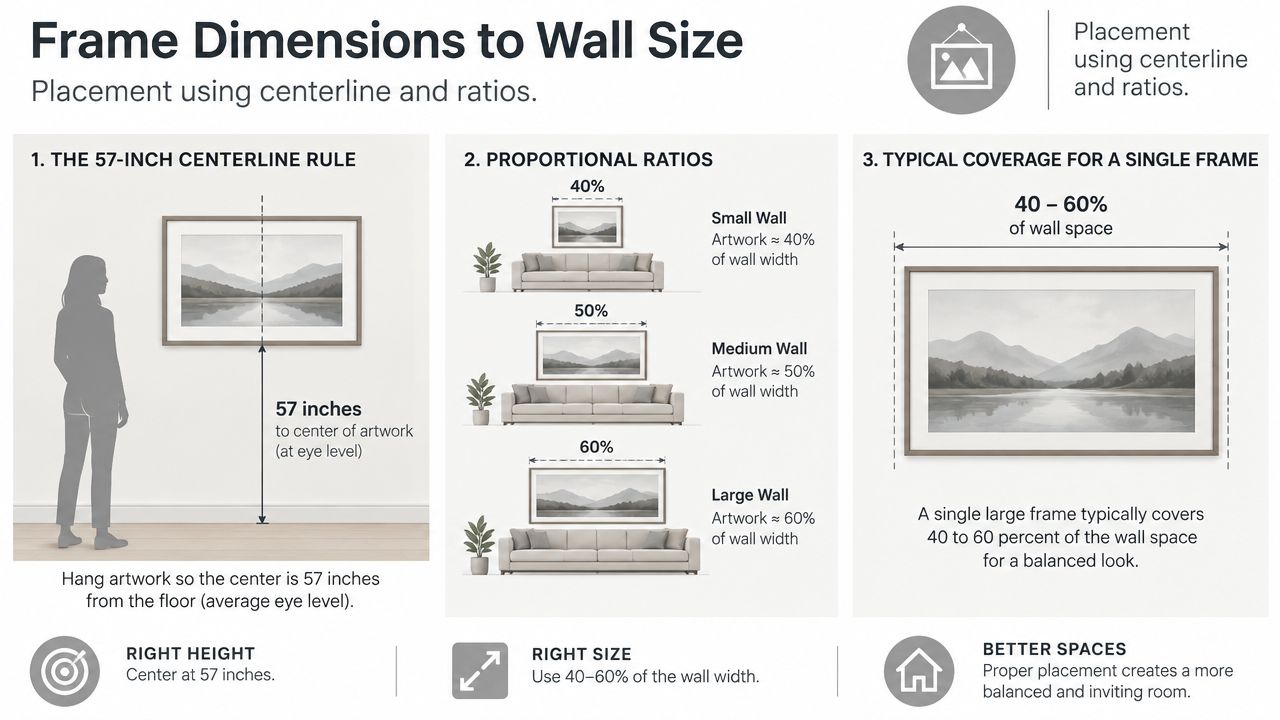
A frame can be the correct size for the art and still be wrong for the wall. Installers usually evaluate the furniture below, the open wall area, sightlines, trim, lighting, and the finished outer package. The popular centerline reference places the center of the artwork at 57 inches from the floor, adjusted when the room, furniture, or viewer profile demands a different height.
Above a sofa, console, or credenza, a single large frame should relate to the furniture rather than float independently. A practical target is for the framed piece to cover 40 to 60 percent of the furniture width, while a gallery arrangement can extend across 70 to 80 percent of the available furniture or wall run. Those proportions keep a large frame from looking either lost or crowded.
Check the wall before choosing the format
An 8-foot ceiling generally has less tolerance for a tall, deep frame than a taller room. 9- and 10-foot walls can accommodate pieces around 72 inches and taller more comfortably, provided the top and bottom clearances are deliberate. The measurement isn't a design law. It's a warning against selecting a vertical frame whose outer package nearly touches the ceiling or door casing.
Use a paper or cardboard template at the exact outer size, not merely the art size. Mark the top of furniture, nearby switches, door trim, light fixtures, and any studs or masonry that affect the hardware. A frame that extends 2 to 4 inches beyond the art because of the moulding can improve breathing room, but it can also collide with a narrow passage if you don't map the package first.
The placement method is easier to judge when you can see the complete composition rather than holding a tape measure against a blank wall.
Frame Face Width and Conservation Choices at Scale
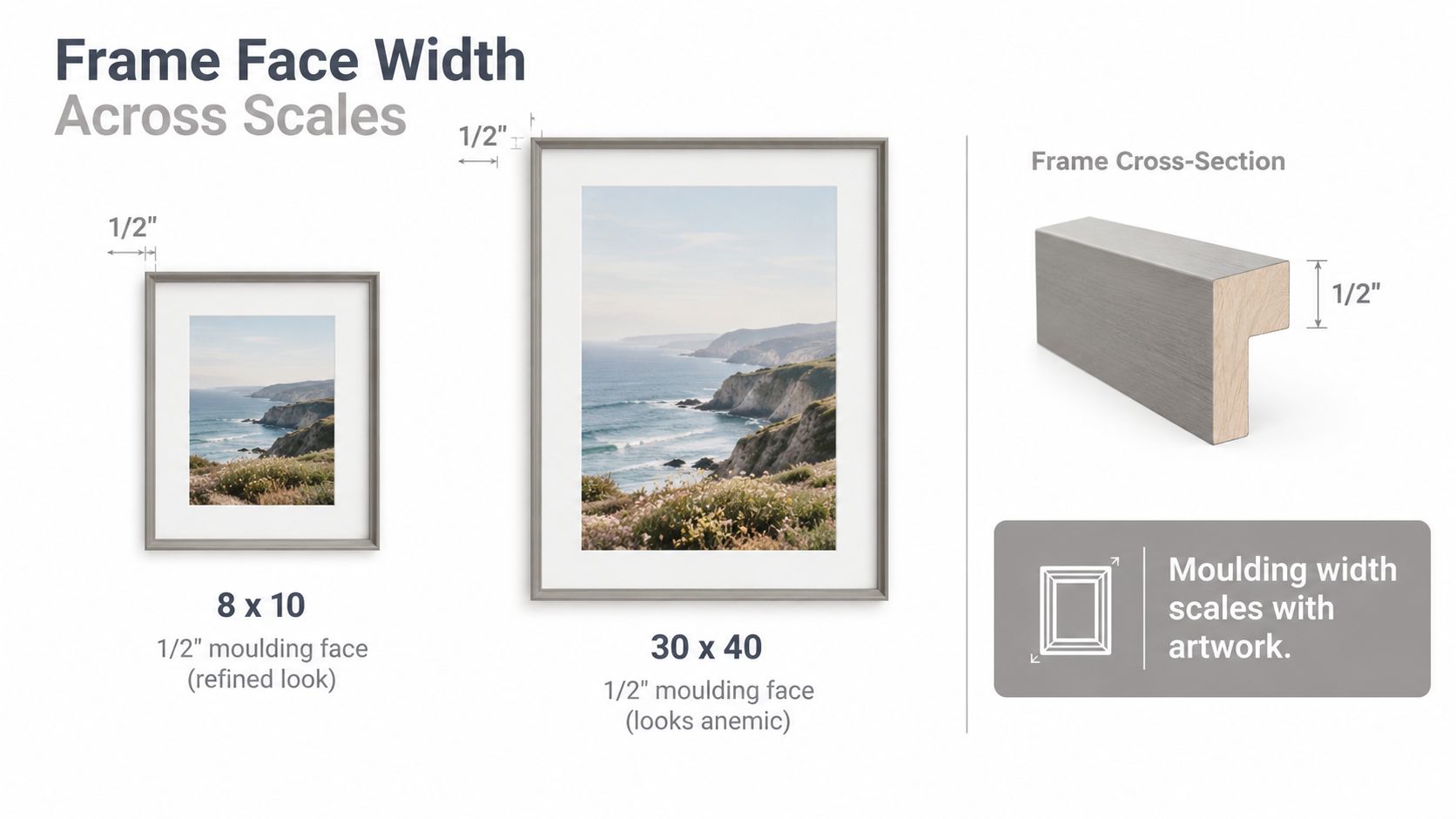
A narrow moulding that looks refined around an 8 × 10 image can look underbuilt around a 30 × 40 work. At larger dimensions, the face width must carry enough visual weight to contain the artwork without making the wall feel dominated by a border. The right choice also depends on the profile's material, depth, finish, and the amount of mat visible around the image.
Gallery-standard practice commonly keeps frame faces between three-quarters and one inch for works up to 30 × 40 inches, which explains why a half-inch profile can appear slight at that scale. Use that range as a starting point rather than a fixed rule. Dark metal, deep walnut, and pale minimal profiles create different visual weight at the same nominal width.
Scale the moulding with the longest side
Start with the longest dimension. At 24 inches, a restrained face can suit dense artwork or a contemporary room. At 36 inches, a narrow profile needs deliberate support from the mat, glazing, and hanging hardware. At 48 inches, a frame usually needs greater structural and visual presence, especially when the piece stands alone on a broad wall.
Larger work also raises the cost and handling consequences of conservation choices:
Glazing: UV-filtering glazing helps limit exposure-related risk. Museum glass improves optical clarity, with greater cost and weight.
Acrylic: Acrylic lowers total hanging weight on very large pieces and is less likely to shatter during handling, though it can scratch.
Spacers: Deep objects need a defined air gap so the glazing stays clear of the surface.
Backing: Oversized work requires rigid, properly supported backing that will not flex during installation.
At large sizes, the frame becomes a structural assembly with its own weight, joinery, and handling requirements.
The mat-to-face relationship can change the whole package. A broad mat beside a hairline moulding may make the frame recede, while heavy moulding around a tight opening can make the artwork feel compressed. Wood profiles require attention to face width, depth, and rabbet dimensions. These details are covered in large picture frame wood guidance, particularly when a ready-made profile approaches custom-fabrication territory.
Quick Reference Charts for Common Large Sizes
Use the artwork measurement as the starting point, then confirm the frame's actual opening and outer package with the supplier. The figures below are planning references for standard presentations. A custom mat, wide moulding, double mat, or spacer will increase the finished size.
Art Size (inches) | Standard Frame Outer (inches) | Suggested Face Width (inches) | Typical Mat Border (inches) |
|---|---|---|---|
16 × 20 | Larger than art size | Proportional, restrained to medium | Moderate border |
18 × 24 | Larger than art size | Medium profile | Moderate border |
24 × 36 | About 30 × 42 to 32 × 44 with a broad mat | About ¾ to 1 | About 3 to 4 |
30 × 40 | About 34 × 44 or larger with a 2-inch mat | Medium to substantial | About 2 or more |
36 × 48 | Larger than art size, often custom planned | Substantial profile | Proportional to the wall |
40 × 60 | Larger than art size, commonly special order | Substantial and structurally suitable | Proportional to the wall |
A poster may need a different treatment from fine art even when the dimensions match. Posters often sit directly in a standard opening, while a photographic print may benefit from a mat, spacers, and conservation glazing.
Art Size (inches) | Standard Frame Outer (inches) | Suggested Face Width (inches) | Typical Mat Border (inches) |
|---|---|---|---|
24 × 36 poster | Larger than art size | Medium to substantial | Optional, about 3 to 4 when used |
27 × 40 theatrical poster | Larger than art size | Medium to substantial | Optional or proportional |
44 × 60 graphic | Larger than art size, usually custom planned | Substantial profile | Proportional to the wall and image |
For room planning, match the outer package to the furniture and the remaining wall. A narrow console may suit a single moderate large frame, while a long sofa can take a wider composition or a group whose combined span is carefully balanced. Templates are more reliable than visualizing from the art dimensions alone.
Frequently Asked Questions About Large Picture Frame Dimensions
Does the listed frame size equal the visible opening?
Usually, the label refers to the artwork size the frame is designed to hold. The actual visible opening can be smaller because the frame lip or mat overlaps the edges, and the outside footprint is larger because of the moulding.
Should I measure to the mat opening or artwork edge?
Measure the artwork edge first, including any part that must remain visible. Then specify the desired mat opening separately. The mat opening should overlap the print enough to hold it securely without hiding important image content.
Can I trim an oversized poster into a stock frame?
Only if the composition has safe trim space and the paper can be cut cleanly. If trimming removes typography, a border, or a designed edge, use a larger frame or custom mat instead.
How deep should the rabbet be for a canvas?
The rabbet must accommodate the canvas profile, any backing, and the required clearance. Measure the complete depth of the mounted canvas rather than relying on the nominal artwork dimensions.
Do frames over 40 × 60 need reinforced corners?
Large frames often need stronger joinery and more careful handling, but the correct construction depends on the moulding, glazing, backing, and transport conditions. Ask the framer how the corners and hanging points are engineered for the finished package.
When should I order custom framing?
Order custom work as soon as the artwork size, mat design, glazing, and installation location are known. Production and shipping become less forgiving as dimensions grow, so waiting until the installation date can leave too little time for fabrication or correction.
Colorado Art Services measures and installs large-format artwork, handles heavy-piece mounting, and plans placements around wall conditions, furniture, lighting, and finished frame dimensions. Visit Colorado Art Services to arrange professional picture hanging, art installation, or secure storage for a large framed piece.
Comments