


How to Store Framed Artwork Safely: A Practical Guide
The frame goes behind the guest bed because it's out of the way and the room feels normal. In the afternoon it's 22°C and 51% relative humidity, and every time you walk past with a laundry basket nothing seems wrong. What you're not seeing is the 5am reading, when the slab cools the air and the humidity climbs into the high 60s, then drops back by noon when the air conditioning kicks on. Six weeks of that and the print has a wave in it that no amount of re-clamping will flatten.
That's how framed art usually fails. Not from a fall, but from the room and from what happens inside the frame when the room changes. Good storage comes down to three things: the air, the enclosure, and how the piece is supported. Everything below is about those three.
Climate Targets for Framed Art Storage
Check the same corner at 4pm and again before dawn. Outdoor temperature, the concrete slab, the dryer, the HVAC schedule, and how many people are home all move the air. A room can sit in a comfortable band all afternoon and still swing hard overnight while nobody is in it.
The set points depend on what is in the frame. The Canadian Conservation Institute's environmental guidance for paintings puts canvas and wood paintings at 40% to 60% relative humidity, with 50% RH the figure international lending practice usually centers on, and a temperature band of 16°C to 25°C (61°F to 77°F). The same guidance cites the Library of Congress on framed photographs, which get a narrower window: 30% to 40% RH, held at or below about 21°C (70°F).
A photograph and a painting on wood do not want the same air. I set the target from the object's condition, not from one number meant to cover every frame on the rack.
Artwork type | Relative humidity | Temperature | Guidance source |
|---|---|---|---|
Paintings on canvas or wood | 40%-60% RH, 50% commonly used for lending | 16°C-25°C (61°F-77°F) | Canadian Conservation Institute |
Framed photographs | 30%-40% RH | At or below about 21°C (70°F) | Library of Congress |
Any framed work, day to day | A steady reading inside the band that fits that object | A room that does not heat and cool hard through the day | The artwork's condition, read from a multi-day trace |
Above 60% RH, warping and mold become realistic outcomes. Below roughly 30%, paper curls and emulsion flakes as materials give up moisture. A frame is a stack: paper, board, wood, glass, and metal hardware, and each layer takes on and gives off moisture at a different rate. That mismatch is what cracks, cups, and cockles a piece. A fast swing does more harm than a steady reading that sits a few points off the lending figure.
The rule I'd write on the box: a stable 44% RH protects most framed work better than a room that averages 50% but bounces between 38% and 62% every day.
Log the room before you trust it
Buy a calibrated thermo-hygrometer and leave a logging unit in the space for two weeks before anything goes in. Cheap dial gauges drift, and they read the wall they hang on. Then read the trace for steadiness. A sharp rise and fall between night and afternoon means the space is not ready, however good it feels on a Tuesday.
Skip attics, leak-prone basements, exterior walls, radiators, and supply vents. A midday reading that looks perfect does not cancel a cold slab or a duct six feet away. Keep the area as dark as practical. Sun through a south-facing window fades pigments; a dark room does not.
A room that settles at 45% to 55% without fighting the building is easier to hold steady than one forced to a precise 50%. Before you oversize equipment to pin a whole room at one figure, see why 50% humidity targets waste energy. For sensor placement and what a normal weekly trace looks like, humidity monitoring for stored art is the longer treatment.
How to Wrap and Protect Each Frame
A dusty frame that goes into storage comes out scratched, and the scratch usually isn't from the move. It's from grit ground into the glazing by the wrapping. The order of these steps matters as much as the materials.
Clean the glazing dry. A microfiber cloth, no spray bottle. Liquid wicks under the frame lip and stains the mat, and sprays leave a film that traps grit. Dust is abrasive, so remove it before anything presses against the surface.
Check that the glazing is fixed to the frame. Framing tape, points, or a properly seated rabbet. Loose glass shifts in a rack, chips at the corner, and opens a gap that lets dust and moisture straight into the package.
Seal the back. The Canadian Conservation Institute's guide to framing a painting recommends combining front glazing with a sealed backing board to cut dust, pollutants, mechanical hazards, and sudden shifts in temperature and humidity. On canvas, an airtight backing plus a sealed 4 mm matboard buffer or a contained silica-gel pack moderates short-term humidity change inside the frame. Skipping that buffer is a common omission on stretched canvas.
Wrap in acid-free tissue or archival paper. Ordinary plastic wrap is the mistake people make because it looks protective. It traps moisture against the frame and backing, which is exactly the condition mold needs.
Sandwich the piece between two rigid sheets. Corrugated plastic or archival board, taped at the edges. This is what stops a rack divider or a neighboring frame from pressing on the glazing later.
Manage the hanging hardware. Fold the wire back, tape it, or pad it with foam so it can't press into the frame face or the piece beside it. Remove protruding hardware when the frame allows.
Label the outside only. Accession number, client name, date, and an arrow showing which way is up. Never on the frame, never on the artwork, never on the wrapping in marker that can bleed through in humidity.
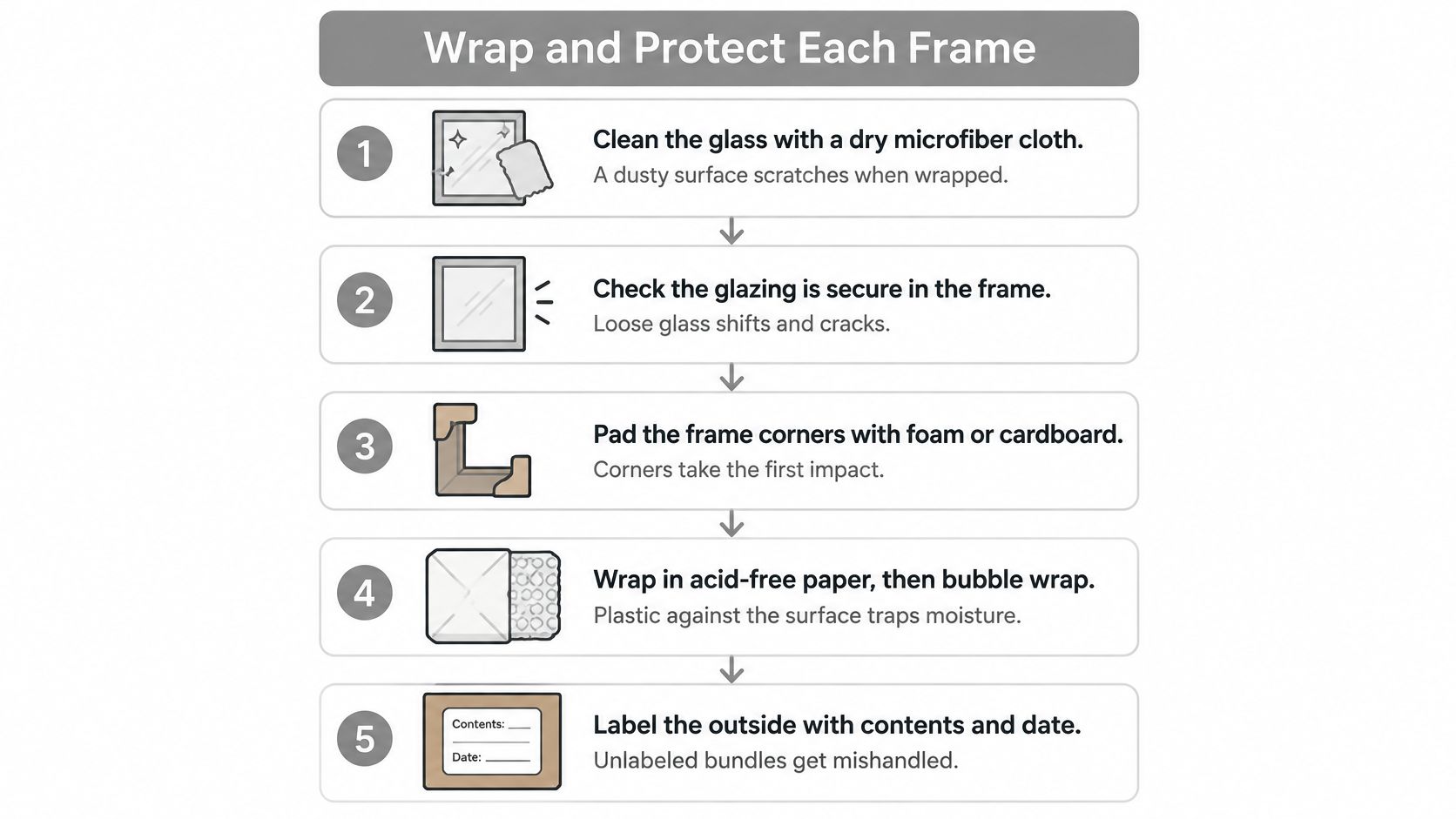
A finished package is boring by design. It's enclosed, it's dust-free, the corners are padded, and you can read what's inside without unwrapping it. If you're also planning to move pieces rather than park them, this guide to packing artwork safely for a move covers the transport side, and this rundown of protective packing materials for artwork explains which foams and boards are safe against a gilded or painted surface.
Vertical Storage, Racks and Spacing
Vertical is the default for good reason. It's how racks, dividers, and gravity work together, and it keeps weight off the face of the piece.
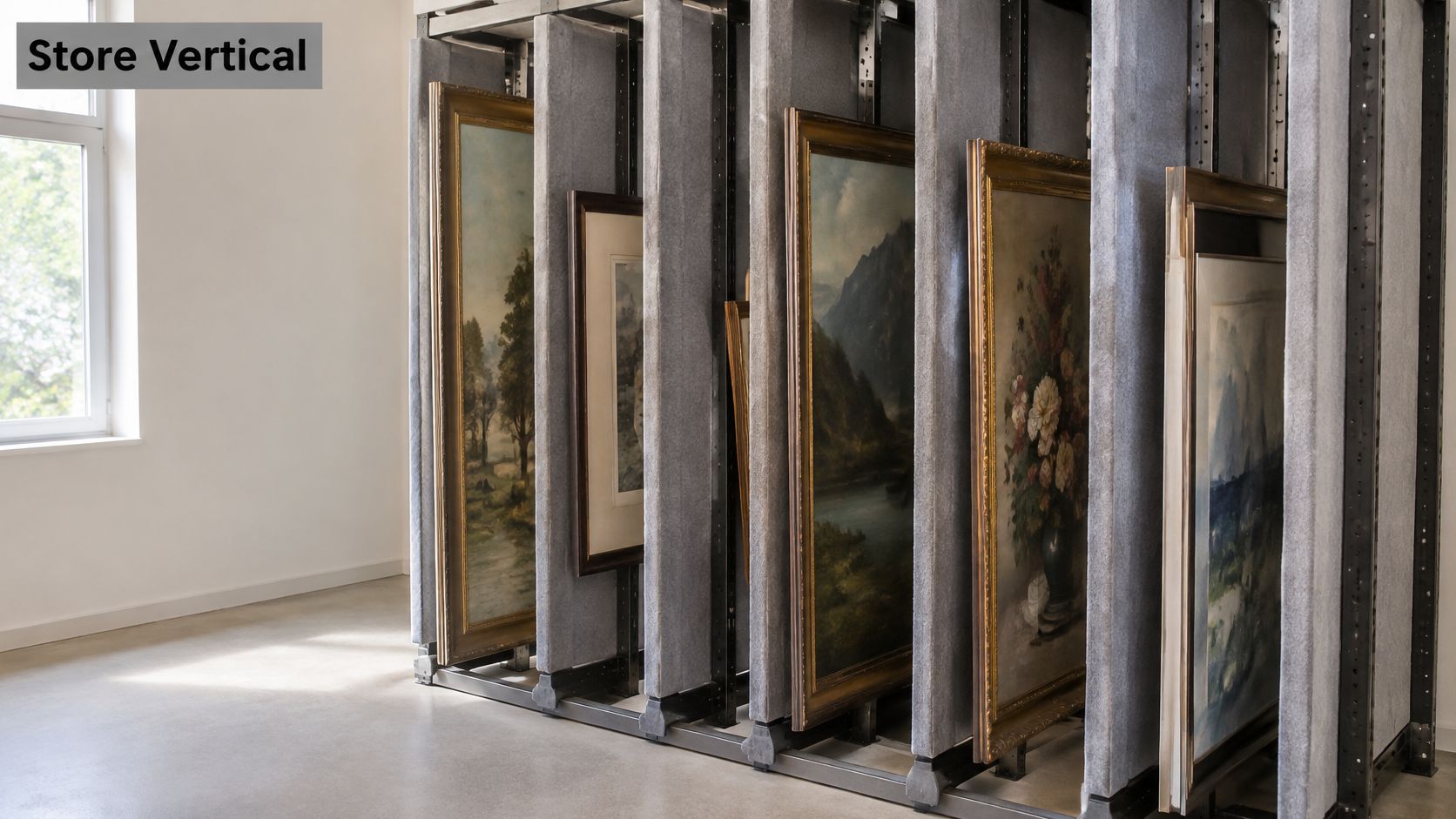
The Canadian Conservation Institute's basic care guidance for paintings lays out the arrangement: clean protective sleeve or breathable wrapping, one piece per bay, and rigid dividers so glazing, frame ornament, and hanging hardware can't reach the work next door. Support the frame through its own structure and the rack, not through stretcher bars or a strainer. A 24 x 36 inch canvas in a rack with 2-inch dividers should slide in and out without touching anything on either side. If it rubs, the bay is too tight.
Keep frames off the floor on a raised, level platform, which handles leaks, dust, and the dropped-tool problem in one move. Leave a visible gap between the rack and any exterior wall, and keep bays away from radiators, vents, and windows.
Three habits undo more framed work than bad climate does:
Stacking face to face without spacers. Surfaces touch, ornament digs into the piece behind, and hardware takes the load.
Leaning against a bare wall. The bottom edge carries the whole frame against a hard, often damp surface.
Laying one frame on top of another. Weight lands on glazing and on the top rail of the frame below.
Add ordinary plastic wrap to that list, since it traps moisture. If you're buying rather than building, this comparison of art painting storage racks covers which rack types earn their footprint. Then do one check today: pull a frame halfway out of its bay and watch whether anything else moves, sags, or scrapes.
When Horizontal Storage or a Condition Check Is Needed
Vertical storage is the sane default, not a universal law. Museums Galleries Scotland recommends vertical storage with ventilation behind the frame, then specifically advises horizontal storage, raised off the floor with airflow, when a paint layer is unstable. Orientation follows condition, and condition is something you assess before the piece moves, not after.
Condition | Orientation | First action |
|---|---|---|
Stable paint, rigid frame, normal glazing | Vertical in padded rack | Wrap, separate, and label |
Flaking or lifting paint layer | Horizontal on raised, padded support | Conservator assessment before moving |
Warped stretcher or bowed panel | Horizontal, fully supported | Assess before moving; never force flat |
Heavy, oversized, or old frame | Vertical in rack, two-person handling | Check hanging hardware and frame joins |
Visible mold, foxing, or water staining | Isolated from other works | Professional condition check first |
What each condition actually calls for
Flaking or lifting paint is the exception you'll meet most often on older work, and it's the one that punishes handling. Lift a canvas with a loose paint layer and vibration alone can shed flakes into the bottom of the frame. That piece goes horizontal on a padded, raised support, and a conservator looks at it before anyone carries it anywhere.
A warped stretcher or bowed panel doesn't get clamped flat. Forcing it back introduces stress at the corners and can crack a join that was holding. Support it fully in the position it wants to sit, then get it assessed.
When to stop: active flaking, visible mold, or a frame that has lost a join is a call-a-conservator moment, not a storage problem you can solve with better wrapping.
Heavy and oversized frames need two people, every time, and the hanging hardware deserves a look before storage. Worn wire, a bent D-ring, or a loose corner join tells you the piece has been carrying load it wasn't built for. Support the frame through its hardware or a proper rack so joints aren't taking the stress, both in the bay and in transit. And if you can't articulate why a piece is stable, treat it as an exception until someone with conservation training has seen it. That's a short conversation compared with a restoration bill.
Stopping Condensation and Mold on Stored Frames
A frame in a basement can have wet glass while a spot check on the wall reads 20°C and looks fine. That mismatch confuses people into buying a dehumidifier when the problem is placement.
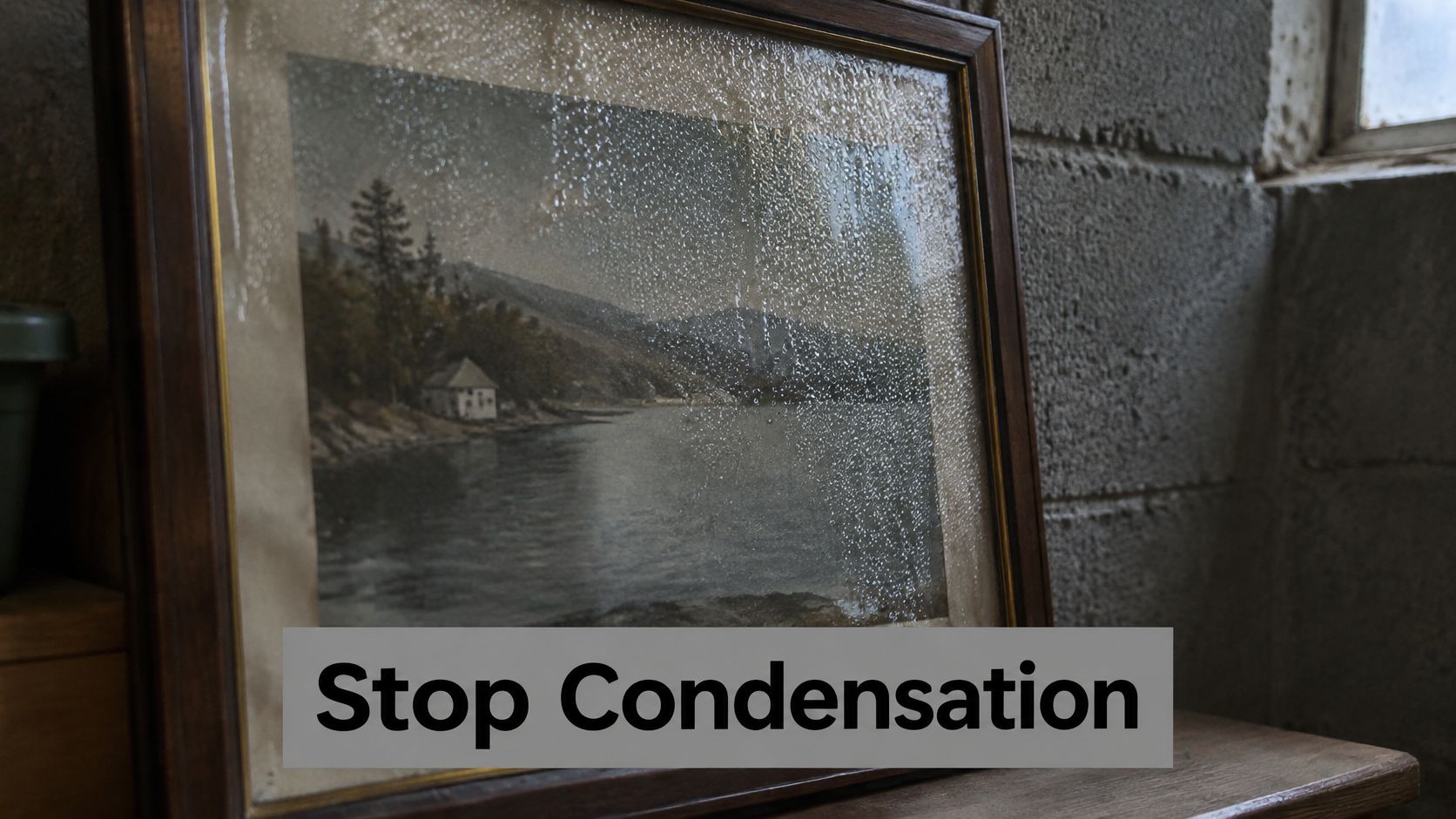
Why the glass is wet when the gauge looks fine
Every frame builds its own microclimate. The Western Australian Museum's conservation manual describes the mechanism: glazing runs colder than the air around it when a frame sits against concrete or an exterior wall, so moisture from warmer room air condenses on the inside face. Unmatted paper can then adhere permanently to glass or acrylic. A frame near an HVAC vent, a plumbing run, or a door that opens to a temperature swing gets the same treatment on a schedule.
Move pieces off concrete floors and away from exterior walls, plumbing, radiators, and vents. Cold surfaces plus warm air equal condensation, and a shelf on a slab is the worst offender.
Leave a visible air gap behind every frame. Tight packing is where mold gets its start, and Museums Galleries Scotland warns that it commonly develops at relative humidity around 65% or higher.
Mat works on paper, or leave a spacer gap. That's what keeps a sheet from bonding to glazing in a humid week.
Specify acid-free backing and reversible adhesives on paper and textiles, so future treatment stays possible.
Inspect glazing, backing, and airflow before buying equipment. Most fogging comes down to a placement problem wearing a humidity costume.
An uncontrolled room can average into a number that looks safe while still wetting frames. A 2024 study of Salford Museum environments found storage relative humidity ranging from 41% to 75% with no control, a 34-percentage-point spread (Building Research and Information). An average of 58% sounds fine and tells you nothing about the week the frames had.
Once mold is established on wood or frames, the cleanup matters as much as the cause, and these wood mold tips from Eagle Restoration are a sensible reference for what's treatable at home and what isn't. Fix placement and the enclosure first. If the glass is wet while your logger sits inside the target band, the room isn't the problem.
Inspecting and Handling Stored Frames Each Season
A storage room nobody checks is a guess. The routine that works is small and repeatable.
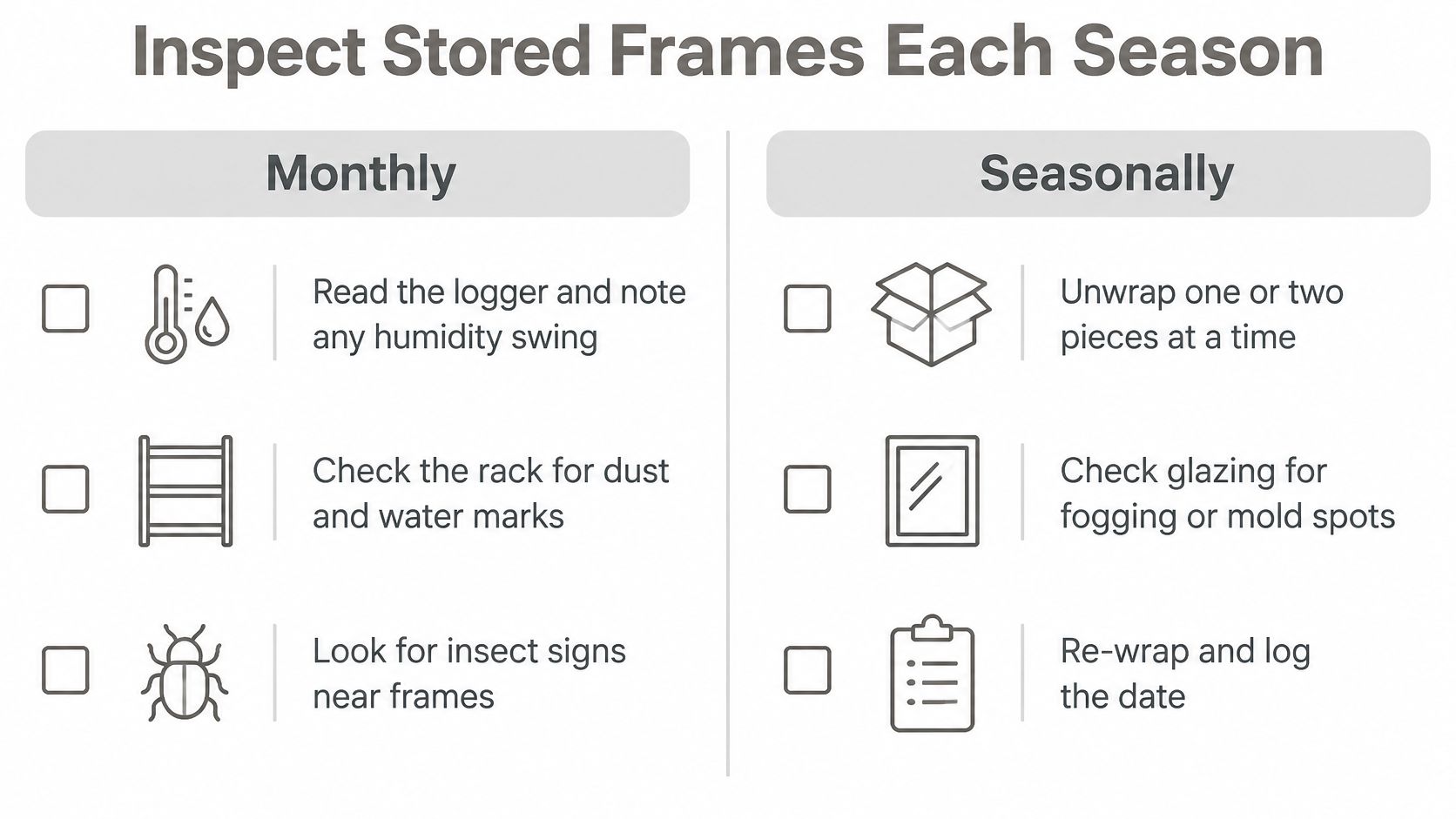
Monthly: read the logger, note any swing against the previous month, and look along the rack for dust lines, water marks, or insect activity near the frame edges. Seasonally: unwrap one or two pieces at a time and check the glazing for fogging or condensation, the mat for foxing, and the hardware for corrosion or looseness. Rewrap with fresh acid-free material and log the date.
Handling rules are short. Two people for anything large. Lift by the frame edges, never by the glazing or the top rail alone. Carry pieces upright and keep hands off the glass. Support the hanging hardware whenever you move a frame, so the wire doesn't carry the load through the stretcher.
The mistake to avoid: opening wrappings on a humid day. Moist air gets into the package, you close it up, and you've built a small greenhouse.
Keep a log with the date, the reading, and anything you changed, so a slow trend shows up before damage does. Copy this to a phone note and run it: read the logger; check the rack for dust and water marks; look for insect signs; unwrap one piece; check glazing and mat; rewrap and log.
Decide Whether to Store It Yourself or Hire Storage
A spare room that stays a little warm, and barely moves, will often protect a framed print better than a basement held to a textbook target that heats and cools every time the system cycles. Stability matters more than a perfect average you cannot hold. I would keep a small, sound print at home in that steady room: wrapped, raised off the floor, logger running. I would not park a flaking surface or a heavy frame there just because yesterday's reading looked fine.
Situation | Store it yourself | Hire storage help |
|---|---|---|
Small, stable prints in a steady room | Suitable with wrapping and a logger | Not needed |
Large, heavy, or many pieces | Hard to handle safely | Recommended for crating and transport |
Valuable or flaking works | Risky without assessment | Recommended with condition check |
Room with daily temperature or humidity swings | Hard to control | Climate-controlled storage |
Short move or relocation | Manageable for a few frames | Pickup and delivery |
How you set the frame depends on its condition, not on one storage rule. A stable work can stay vertical on a home rack. Lifting paint, a weak joint, or glass that already shows a water line calls for a condition check before you choose vertical or flat, and often before you choose the room.
The split is handling plus the room, not the price tag alone. If you cannot lift the piece without stressing the joints, or the space swings through a full day, it belongs somewhere with controlled temperature, packing done properly, and two people on the lift. Colorado Art Services runs a specialized art storage warehouse with controlled temperature, pickup, professional packing, meticulous crating, and transportation, and offers a free estimate. That space can hold sizable canvases and delicate ceramics as well as ordinary frames, with surveillance cameras and alarms as part of the security.
Four checks settle it. Measure the largest frame so you know the lift. Log the room for two weeks and watch the daily swing, not only the average. Read the table: a row that lands under hire storage is a reason to ask. Skip the estimate when the pieces are small and stable and the room holds steady.
Colorado Art Services stores work for private collectors, corporate clients, and art institutions across Denver and the Front Range. If you'd rather not gamble a frame on a room that swings overnight, the climate-controlled warehouse can hold it instead, with pickup and crating for pieces too large or too delicate for a basement. Visit Colorado Art Services for a free estimate on storage, packing, or installation.
Comments