


How to Display Canvas Paintings Like a Professional
- 1 day ago
- 4 min read

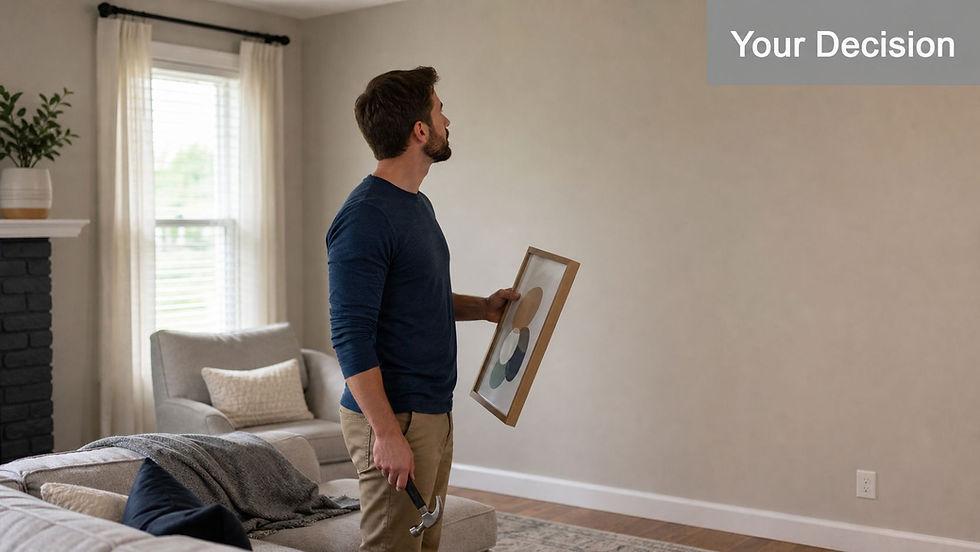
You’re standing in a room with a canvas in your hands, wondering why the placement already feels wrong before the first hole is drilled. That is where many hanging mistakes begin—not with the hardware, but with the assumption that eye level alone will solve everything.
Learning how to display canvas paintings involves more than choosing an empty wall. The artwork must relate to the furniture, lighting, traffic flow, wall material, and intended viewing position. With a little planning, you can create a display that feels balanced, secure, and naturally connected to the room.
Start With the Room, Not the Wall
Before reaching for a hammer, identify the furniture that anchors the room. A sofa, bed, mantel, sideboard, or bookcase provides a centerline that the artwork should follow.
As a general guideline, artwork displayed above furniture should be approximately one-half to two-thirds the width of the furniture below it. This helps the canvas feel connected to the room instead of floating in an unrelated section of the wall.
Create a paper template that matches the canvas dimensions and tape it to the wall. Then examine it from the doorway, sofa, dining table, and other places where people naturally view the room. This allows you to test the size, height, and balance without making unnecessary holes.
Also consider nearby doors and walking paths. A canvas placed too close to a door swing, narrow hallway, or busy seating area can become vulnerable to bumps and damage.
If you cannot explain how the artwork relates to the furniture, the placement probably is not ready.
Measure From the Center
For most framed or gallery-wrapped canvas paintings, begin by placing the center of the artwork approximately 57–60 inches from the floor. This creates a comfortable eye-level position for most standing viewers.
When hanging artwork above furniture, leave approximately 8–12 inches between the bottom of the canvas and the top of the sofa, mantel, or console. Too little space can make the display feel crowded, while too much can cause the artwork to look disconnected.
Use painter’s tape to outline the canvas and mark its center. Confirm your marks with a spirit level before drilling. Always evaluate the placement from both seated and standing positions.
Rooms such as stairwells and hallways may require adjustments. A stairwell arrangement should generally follow the direction of the stairs, while hallway artwork should be positioned for people viewing it as they walk through the space.
For more placement guidance, review our eye-level art hanging guide.
Choose Hardware for the Canvas and Wall
The correct hardware depends on the canvas’s weight, construction, and wall material. A lightweight canvas on sound drywall may only require a picture hook, but larger pieces and specialty walls need stronger solutions.
Common hanging options include:
Sawtooth hangers: Best for lightweight, smaller canvases.
D-rings and wire: A dependable option for medium-sized artwork.
Wall anchors: Useful when a stud is unavailable and the canvas requires additional support.
French cleats: Ideal for oversized or heavy canvases because they distribute weight across a wider area.
Masonry fasteners: Required for many brick or concrete installations.
When using D-rings and picture wire, attach the hardware securely to the stretcher bars. Avoid making the wire too tight or allowing so much slack that the canvas hangs unpredictably.
Never select hardware based only on what is already in your toolbox. A fastener designed for drywall may not work properly in plaster, brick, tile, or concrete. Our picture-hanging hardware guide offers a closer comparison of popular options.
Secure hardware is not a finishing detail—it is what prevents the display from becoming a repair project.
Plan Gallery Walls on the Floor
Gallery walls look best when their spacing and overall shape feel intentional. Before placing anything on the wall, arrange the canvases on the floor within a taped boundary matching the available wall space.
Choose a layout that complements the room:
Grid layouts work well with similarly sized canvases and matching frames.
Salon-style groupings accommodate different sizes but require a strong anchor piece.
Linear arrangements are effective in hallways and above long furniture.
Stair-step layouts follow the architecture of stairwells naturally.
Keep the spacing between pieces consistent. When using canvases of different sizes, begin with the largest piece and position the smaller works around it. A shared frame color, canvas style, or visual theme can help connect the collection.
For additional ideas, explore our guide to the best way to hang a gallery wall.
Use Lighting to Finish the Display
Even perfectly positioned artwork can look flat under poor lighting. Picture lights, adjustable track heads, and wall-washing fixtures can all work, provided they illuminate the canvas without creating glare.
Avoid aiming strong light directly at glossy or varnished artwork. A softer angle can reveal texture while reducing reflections. Warm lighting tends to soften colors, while cooler lighting can make whites and contrasting colors appear sharper.
Natural light also matters. Avoid placing valuable canvas paintings in direct sunlight, which can cause fading and material damage over time. If another location is unavailable, consider curtains, shades, or UV-filtering window treatments.
Protect the Canvas From Environmental Damage
Not every attractive wall is suitable for artwork. Before hanging a canvas, check for:
Prolonged direct sunlight
Heat from radiators, fireplaces, or vents
Moisture and humidity fluctuations
Door swings and narrow walking paths
Chair backs, bags, and other bump hazards
Kitchen grease, steam, or splashes
Bathrooms, kitchens, stair landings, and busy corridors often present the greatest risks. If you want artwork in one of these spaces, select the wall with the most stable temperature, least moisture, and lowest chance of accidental contact.
Felt bumpers placed on the lower corners can prevent the canvas from shifting and protect the wall from scratches. Labeling the back of each piece can also simplify future moves, maintenance, and collection changes.
When to Call a Professional
A small or medium canvas on drywall is often a manageable DIY project. Professional installation is recommended when the project involves:
Oversized or unusually heavy artwork
Brick, plaster, tile, or concrete walls
High ceilings or stairwells
Multiple-piece gallery layouts
Valuable or fragile artwork
Commercial or public spaces
Uncertain wall conditions
A professional installer can assess the wall, select appropriate hardware, create templates, align the artwork with a laser level, and adjust the layout based on how the room actually looks.
If you are located in the Denver Metro area or along the Front Range, Colorado Art Services provides residential and commercial art installation with careful attention to placement, hardware, wall conditions, and the long-term safety of your collection.


Comments