


Commercial Art Display: A Practical Guide for Every Space
A blank lobby wall can look like a small design problem until the first delivery arrives. The artwork is heavier than expected, the wall contains unknown services, the glass catches every ceiling reflection, and the facilities manager asks how it will be removed when the lease ends. A retail team faces a similar decision when a mural needs to change with a product launch, while a gallery crew may be preparing an entire exhibition under a tight installation schedule.
Commercial art display means presenting artwork, graphics, signage, or objects in a space used for business, public access, leasing, hospitality, retail, or sales. It isn't merely residential decoration moved into a larger room. Commercial spaces bring heavier foot traffic, longer viewing distances, stricter accessibility and fire requirements, rotating inventory, security concerns, and accountability to a property manager, facilities team, insurer, or brand owner.
The artwork is only the visible part of the project. The less visible work includes selecting suitable glazing, identifying wall construction, planning sightlines, controlling glare, documenting condition, coordinating access, and creating a maintenance plan. Picking the art is often the first 20 percent of the job. The remaining work is engineering, lighting, installation, and upkeep.
What a Commercial Art Display Actually Is
Walk into a corporate lobby and you'll usually find one of three conditions: a blank wall waiting for a statement piece, a collection installed without a clear visual order, or artwork that looks fine in photographs but disappears from the visitor's actual path. Retail stores face a different pressure. Their walls need to support merchandise, seasonal changes, and brand messaging without becoming permanent obstacles. Galleries operate on a more exacting schedule, with condition reports, crates, labels, lighting adjustments, and carefully measured sightlines.
In each setting, the display is a working system. It combines the object, its frame or mount, the wall or structure behind it, the lighting, the visitor route, and the operational rules that govern access. A framed print above a reception desk, a sculptural piece in a hotel corridor, and a rotating gallery installation all qualify, but they don't share the same technical requirements.
The commercial difference
Residential hanging often assumes a stable occupant, limited traffic, and a wall that can be patched later. Commercial installation has to account for people carrying bags, cleaning equipment, carts, doors, furniture changes, and visitors who may not know where the artwork begins and the circulation path ends.
A facilities team also needs answers that a homeowner may never request:
Can the piece be removed without damaging the wall?
Will the hardware resist tampering or vibration?
Does the glazing create a dangerous reflection near a doorway?
Can staff rotate the display without calling a contractor every time?
Does the installation preserve access routes and required clearances?
Who records condition before the work is moved?
That operational layer changes the buying decision. A beautiful, fragile piece may be appropriate for a controlled boardroom but unsuitable for a busy corridor. A modular rail system may cost more at installation yet reduce patching and downtime when a tenant refreshes the space.
Practical rule: Choose the display infrastructure at the same time as the artwork. A piece that can't be safely lit, secured, serviced, or relocated isn't a complete commercial solution.
How Commercial Art Display Became an Industry
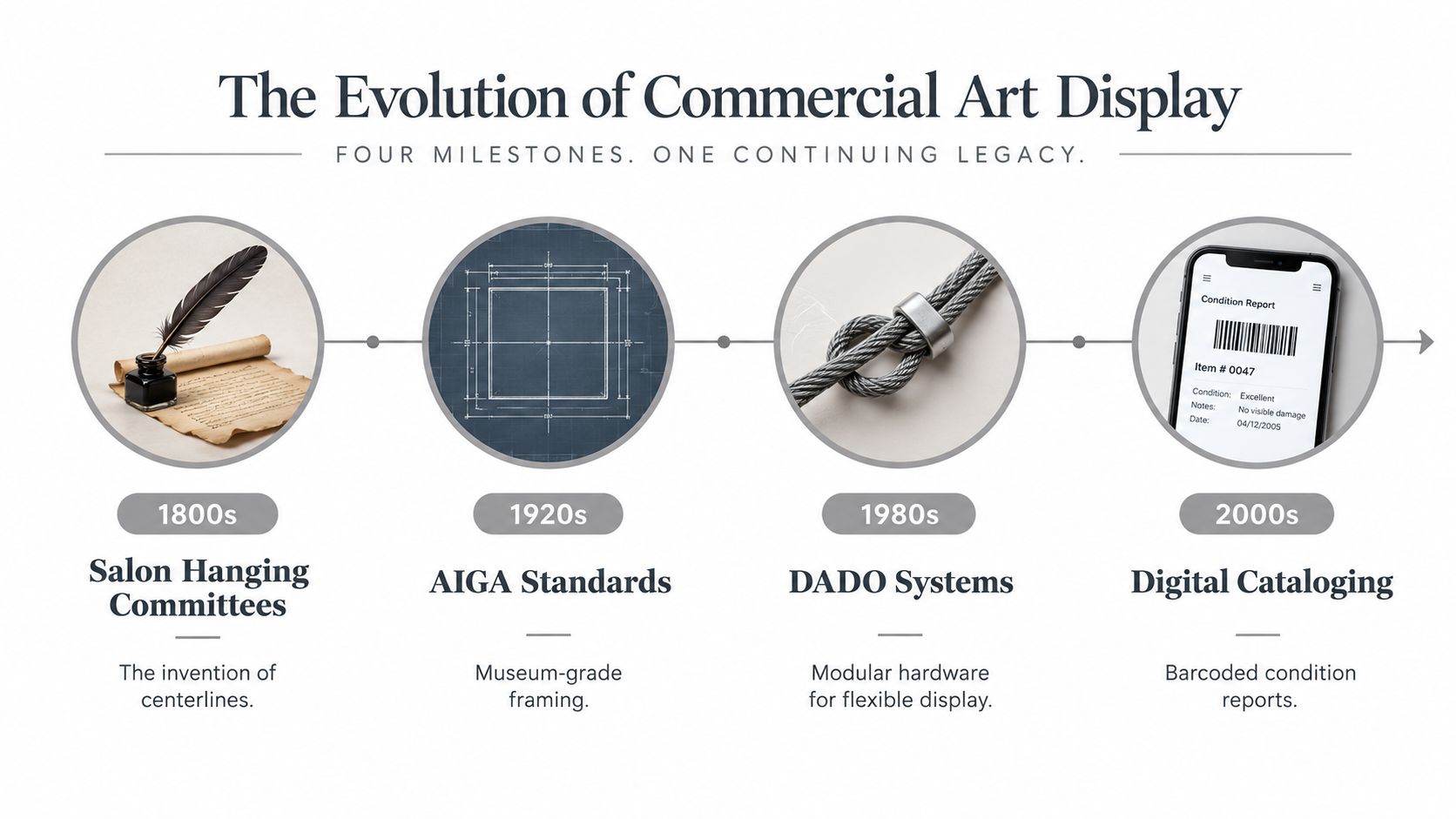
Commercial art display grew from the point where art stopped being viewed only in private collections and became organized for public audiences and commercial exchange. Earlier display practices shifted toward public viewing near the end of the eighteenth century. By the nineteenth century, galleries and salons had become established venues where works were shown for sale, combining curation, audience access, and revenue in one format. The historical overview of exhibition design traces this wider development through public exhibitions and the 1851 Great Exhibition in London, housed in the Crystal Palace.
The salon made hanging a practical discipline. Committees had to decide which works belonged together, how densely they could be arranged, and how viewers would read a wall from a distance. Centerlines, sightlines, picture rails, and consistent spacing weren't abstract design preferences. They were answers to crowded rooms, valuable objects, limited wall area, and audiences moving through a shared space.
From exhibition halls to working buildings
Large exhibitions also required systems for transporting, lighting, labeling, protecting, and selling work. The Liverpool exhibition record referenced in historical scholarship describes events where around 900 works were shown, while galleries commonly supported exhibitions through admission charges and sales commissions. That scale matters because it shows that display was already an organized commercial operation, not an occasional act of decoration. The same historical source documents how exhibition systems blended presentation, audience management, and revenue.
Museums later refined these practices through more controlled rails, cases, mounts, and lighting. Corporate offices, hotels, retailers, and public buildings adapted the principles for branding and placemaking. The modern installer still deals with the same basic problems, even when the building is a workplace rather than a salon: how to move the object, distribute its weight, protect its surface, control the light, document its condition, and make future changes without starting over.
Today's commercial art display may include modular rails, digital labels, projection, interactive elements, or a large lobby commission. The tools have changed, but the professional standard has a clear lineage. Good display makes the artwork visible while keeping the building, visitor, and object safe.
Where Commercial Art Displays Live and Why Each Space Is Different
The same framed work can succeed in one commercial environment and fail in another. A lobby is read while people are standing, walking, waiting, and looking toward reception. An office is experienced repeatedly by staff who may need visual calm rather than a constant focal point. Retail changes faster, while a gallery can devote more control to light, humidity, security, and visitor movement.
A recent study of exhibition activity recorded 905 museum exhibitions and 351 gallery exhibitions in 2022, with an average of 8 exhibitions per museum and 14 per gallery. The study also reported that exhibition attendees represented about 15% of museum visitors and roughly 25% of gallery attendance. These figures show how display programming remains central to organized cultural and commercial operations, even as exhibition totals have changed from earlier periods. See the exhibition activity research for the full context.
Environment | Primary Goal | Typical Lux | Common Mistake |
|---|---|---|---|
Corporate lobby | Create a durable focal point that reads from the approach | Set by material sensitivity and glare conditions | Choosing a piece that works close up but disappears across the lobby |
Office | Support identity and atmosphere without disrupting work | Set by the artwork, glazing, and task-light spill | Allowing overhead reflections to compete with the image |
Retail | Make the wall adaptable to merchandise and campaigns | Set by object sensitivity and the store's lighting scheme | Installing a fixed layout that requires patching for every change |
Hospitality | Establish mood while tolerating frequent turnover | Set by material sensitivity and ambient mood | Using irreplaceable originals where replacement editions would work better |
Gallery or museum | Present work accurately while protecting it | Conservation limits and controlled exposure | Treating every material as if it can tolerate the same light |
Match the display to the visitor's behavior
In a lobby, a single large work often performs better than a cluster of small pieces because visitors approach from a distance and rarely stop for extended inspection. Use a substantial frame, protected corners, and hardware that can tolerate nearby traffic. Don't place a delicate, low-contrast work where cleaning carts and visitor bags pass within inches of it.
Retail walls benefit from picture rails, slatwall-compatible hardware, or ceiling-hung cable systems when the brand expects frequent change. The installation should leave room for product fixtures, signage, and seasonal resets. A permanent mural can be effective, but it should be treated as architecture, with access, repair, and lease-end removal considered before commissioning.
Galleries and museums need tighter control. Paper, textiles, and photographs are commonly limited to about 50 lux, oil paintings are often displayed at 150 to 200 lux, and durable materials such as sculpture, stone, ceramics, and metal may reach around 300 lux, according to conservation guidance from the Canadian Conservation and Art Handling Association. The material, not the room's preference for brightness, sets the starting point.
Design and Layout Principles That Hold Up in Any Space
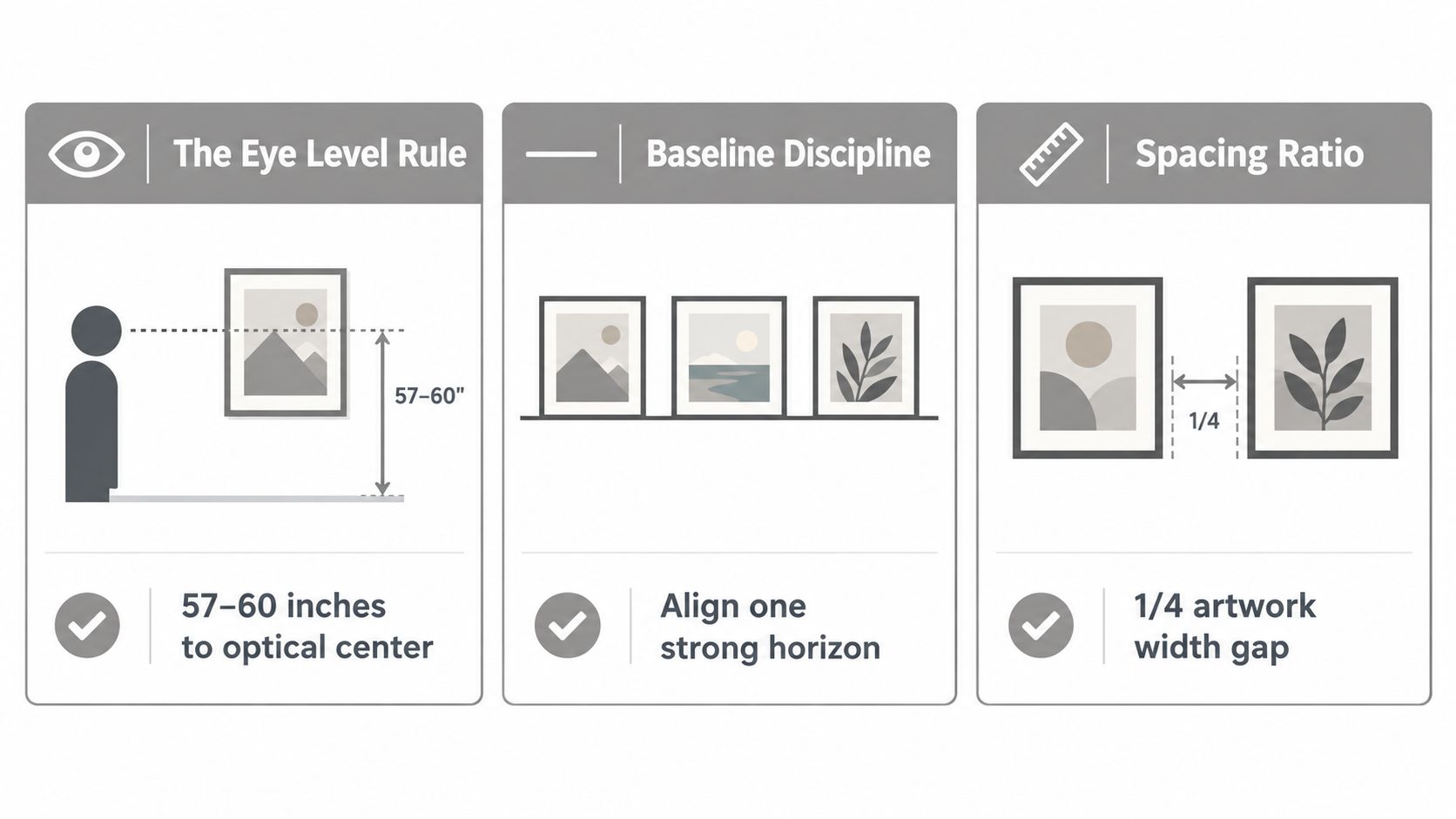
Good layout starts with the viewer's eyes, not the top edge of the frame. For a single work, place the optical center around the normal standing sightline, then adjust for furniture, circulation, and the audience's posture. In a boardroom, seated viewers may need a lower centerline. In a lobby, the approach path may matter more than a nearby sofa.
Groups need a governing line. Align the optical centers, lower edges, or upper edges only when that choice serves the composition, but don't let every frame float independently. A clean baseline gives a mixed collection order, while a grid makes variation in size feel intentional.
Choose density deliberately
A single-hero wall needs breathing room. Give one strong work enough surrounding space to read as an object, rather than crowding it with furniture, signs, and smaller frames. This approach works well in reception areas and executive spaces where the artwork carries brand or hospitality value.
A salon wall does the opposite. It uses deliberate density, a shared theme, related framing, or a consistent color relationship to make many works read as one installation. The arrangement can follow a grid, a diagonal progression, or a carefully irregular field, but the pattern should be established before anyone drills.
Spacing should reflect both the work and the viewing distance. Related pieces can sit closer together, while distinct works need more separation to avoid visual competition. A useful on-site test is to lay the frames on kraft paper or cardboard, photograph the proposed arrangement, and inspect it from the main standing and seated positions.
Let architecture edit the plan
Door swings, sprinklers, columns, outlets, baseboards, furniture, and security devices all impose limits. Don't force a symmetrical grid across an obstruction and then compensate with awkward gaps. Break the composition at the architectural boundary, or move the entire grouping so the interruption looks intentional.
The final layout should be checked in the actual light, not only in a floor plan. Tape the frame footprints to the wall, walk the visitor route, and photograph the result from the entrance, the waiting area, and the primary work position. That simple test catches poor scale and obstructed sightlines before the first hole is drilled.
Mounting and Hanging Systems Worth Knowing
Treat the wall as structure, not as a blank surface. The correct anchor depends on whether the substrate is drywall, masonry, concrete, wood paneling, a partition system, or a wall with concealed services. A light frame may need only a suitable hook, while a heavy glazed work or sculpture can transfer a serious load into the wall and its supporting structure.
Adhesive products and single nails have a limited role. They can suit lightweight, low-risk frames on appropriate finished surfaces, but they aren't a substitute for rated hardware. For medium loads, installers may use threaded drywall anchors or snap-toggle systems where the wall construction allows them. Substantial pieces should be fixed into studs or structural backing with appropriate screws, cleats, or rated hangers.
Weight Range | Wall Type | Recommended Hardware | Typical Use |
|---|---|---|---|
Light | Suitable finished drywall or panel | Proper picture hook or compatible adhesive system | Small framed prints in controlled areas |
Moderate | Drywall with usable cavity or backing | Threaded anchor, snap-toggle, or rated hanger | Office and hospitality artwork |
Heavy | Stud, wood backing, masonry, or concrete | Structural screws, cleat, rated D-rings, or engineered anchor | Large framed works and mirrors |
Frequently rotated | Sound wall or ceiling structure | Picture rail, cable system, or ceiling track | Retail, gallery, and lobby programs |
High risk or oversized | Verified structural support | Engineered cleat, rated rigging, security hardware | Large-format, valuable, or public-facing pieces |
Use systems that support change
Picture rails and ceiling-mounted tracks make sense where the wall will be reconfigured. They let a team move hanging points without repeatedly patching and repainting the surface. Cable systems also help when the display needs vertical adjustment, but the cable, hook, and termination must be rated for the actual load and installed according to the manufacturer's instructions.
Security hardware has a place in public corridors, retail environments, and open lobbies. Security hangers, T-screws, D-rings, and anti-theft cable can reduce casual removal, but they don't correct an inadequate wall anchor. Adhesive mounting products may be useful for small components or temporary positioning, and facilities teams can review specialized industrial mounting tape dispensers when the application suits tape rather than mechanical support.
For practical planning, compare the wall, load, access, and rotation schedule with commercial hanging services before selecting hardware.
Stop and escalate: A piece that is unusually heavy, wide, fragile, high, or positioned above people shouldn't be installed by guesswork. Confirm the substrate, load path, hardware rating, and fall consequences first.
Lighting as a Hierarchy, Not Just a Fixture
Lighting should be specified as a conservation decision before it becomes a styling decision. Light damage accumulates, and a work can fade or degrade even when each individual viewing period seems harmless. The conservation lighting guidance identifies common starting limits of about 50 lux for highly sensitive paper, textiles, and photographs, 150 to 200 lux for moderately sensitive oil paintings, and around 300 lux for durable sculpture, stone, ceramics, and metal.
Those levels aren't a universal recipe. Exposure duration, material condition, glazing, daylight, ultraviolet exposure, and the work's importance all affect the specification. A sensitive drawing in a bright lobby needs a different plan from a metal sculpture in a shaded atrium.
Build visual hierarchy
The artwork should be brighter than its surroundings without turning the room into a dark tunnel. Gallery-lighting research citing CIE guidance recommends keeping the background at roughly one-third to one-fifth of the artwork's surface brightness, a relationship that helps reduce glare adaptation and supports stable visual perception. The CIE-based lighting discussion also emphasizes controlled color temperature and high color rendering.

Track fixtures with adjustable heads suit rotating exhibitions because the beam can be redirected without replacing the whole lighting system. Fixed picture lights can work for smaller executive or hospitality pieces, but they often create hot spots and reflections when installed without testing. LED wall washers are effective for broad lobby surfaces when their spread, cutoff, and distance from the wall are selected carefully.
High color rendering matters because a bright fixture that shifts reds, blues, or neutrals can misrepresent the work. Use dimming, UV control, suitable glazing, and shielding from direct daylight where required. Check reflected glare from the visitor's approach, not just from the installer's position.
Lighting test: View the work at the time of day when the building is busiest. A display that looks balanced in an empty room may fail once windows, screens, polished floors, and overhead fixtures are active.
Safety, Maintenance, and Budgeting as One Conversation
A commercial display budget isn't complete when the installer leaves. Safety checks, cleaning, relamping, condition monitoring, wall repairs, and future removal all create costs. Treating them as separate decisions often produces the familiar pattern of a cheap installation followed by expensive fixes when a frame loosens, a wall is damaged, or a renovation requires emergency de-installation.
Start with a written asset list. Record the artwork, frame, glazing, location, mounting method, condition, and responsible contact. Then connect each item to a practical maintenance action.
Safety: Verify load-rated anchors, security cleats, glazing where impact risk is present, seismic restraint where applicable, and clear access around the work.
Cleaning: Dust frames and accessible surfaces with methods appropriate to the material. Don't spray cleaner onto glazing or artwork.
Lighting: Check aiming, glare, dimming, and exposure conditions after furniture or daylight changes.
Condition: Photograph works before movement and record chips, frame separation, scratches, or glazing damage.
Change management: Keep spare hardware, layout files, condition records, and removal instructions with the facilities documentation.
Budget for the building's real cycle
A maintenance schedule should follow the building's use. Busy public areas need more frequent visual checks than a controlled office, while rotating displays require condition review at every change. Relamping and control-system servicing belong in facilities planning, even when LED equipment reduces the urgency associated with older lamp types.
Space Type | Annual Maintenance (% of install cost) | Primary Cost Drivers |
|---|---|---|
Corporate office | Establish after the initial condition and access review | Reconfiguration, cleaning, lighting checks, and tenant changes |
Public lobby | Establish after traffic and security review | Contact risk, glazing, security hardware, and access coordination |
Retail | Establish after the rotation schedule is known | Frequent moves, wall repairs, campaign changes, and storage |
Hospitality | Establish after turnover and housekeeping review | Cleaning, replacement editions, guest contact, and room refreshes |
Gallery or museum | Establish through the collection care plan | Condition reporting, controlled lighting, packing, and specialist handling |
Include a reserve for emergency removal during construction, leaks, relocations, or lease transitions. Secure storage can also prevent rushed decisions when a display must come down. Facilities teams evaluating that requirement can review art storage planning as part of the broader installation scope.
The cheapest mounting method isn't necessarily the cheapest project. Compare the initial hardware, labor, wall repair, future rotation, insurance requirements, and downtime before approving the work.
When and How to Hire a Professional Art Installer
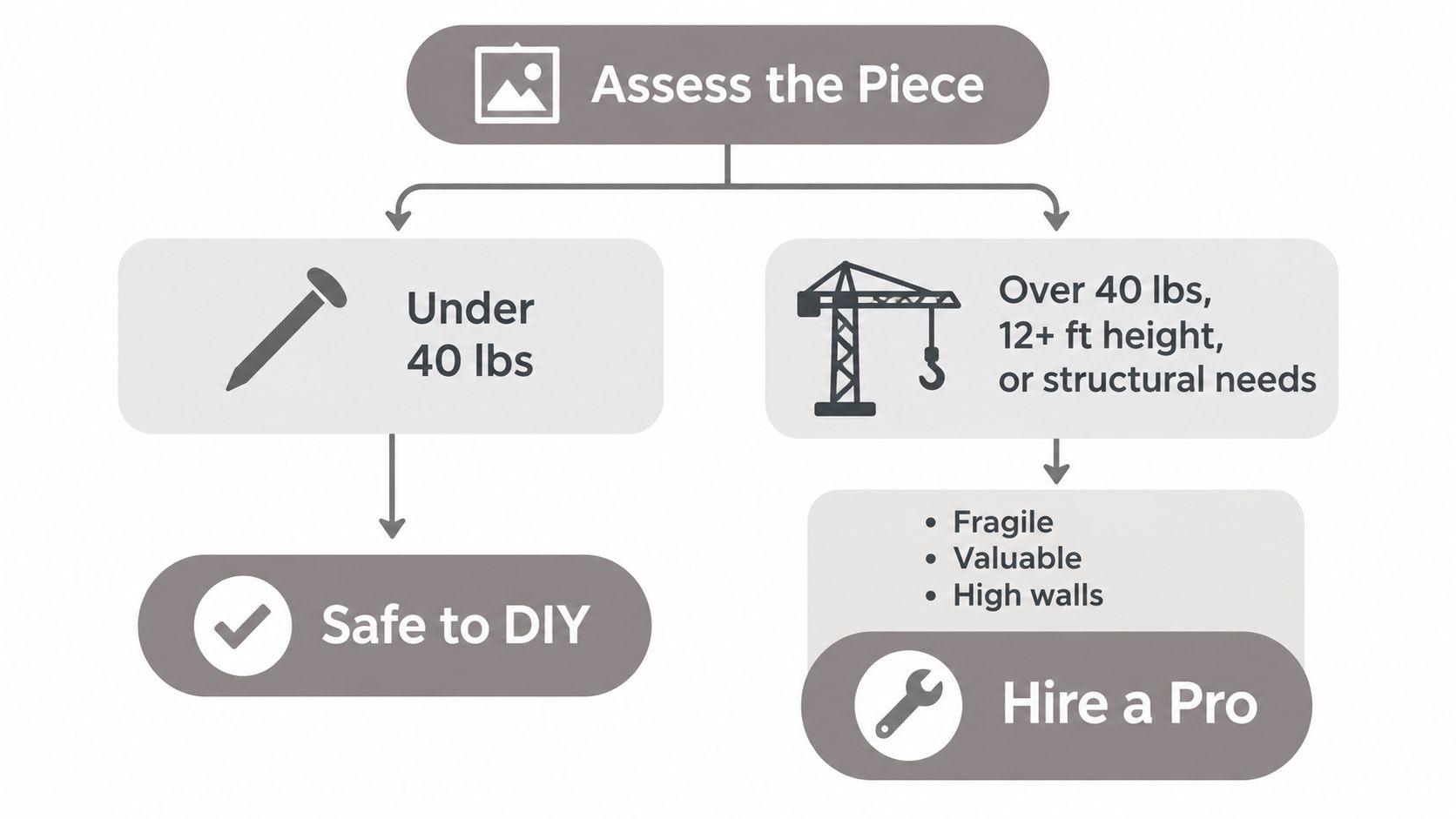
DIY installation is reasonable only when the risk is clearly low. Stop and bring in a qualified installer when the work is over 40 pounds, positioned above 12 feet, dependent on structural anchors, fitted with security hardware, unusually fragile, or located where a fall could injure people. Public spaces also introduce accessibility and circulation requirements that deserve a site-specific review.
Ask the installer for practical evidence, not just a portfolio:
Insurance documentation: Request current certificates and confirm that the scope matches the work.
Wall experience: Ask whether the team has worked with the building's actual wall types, not only standard drywall.
Rigging knowledge: Confirm experience with cleats, tracks, lifts, cable systems, large-format work, and sculpture when relevant.
Written scope: Require locations, hardware, access needs, condition documentation, exclusions, and post-install responsibilities.
Damage response: Ask who handles damage, how it is documented, and what happens if the wall or artwork is affected.
References: Seek comparable commercial projects with similar height, traffic, materials, and rotation demands.
Use a defined project sequence
A reliable installation begins with a site survey. The installer confirms wall construction, access, ceiling height, furniture, lighting, circulation, and the proposed layout. The team then reviews the artwork's condition, creates a placement or hanging plan, and identifies any required lifts, protection, permits, security measures, or after-hours access.
For a complex project, a mockup or taped layout can resolve scale and sightline disagreements before hardware arrives. Installation follows only after the client, designer, facilities contact, and building representative agree on the plan. The closeout should include photographs, final locations, hardware notes, condition records, and instructions for future removal or rotation.
A regional team such as the one described through Colorado Art Services' professional staff may support corporate, healthcare, hospitality, gallery, storage, moving, and heavy-piece requirements as one coordinated service. The value of that approach is operational continuity. The same project record can guide placement, handling, later movement, and maintenance instead of leaving each phase to a different unbriefed vendor.
Commercial art display works best when the wall can change safely, the lighting can be adjusted without harming the work, and the facilities team knows what is installed and why. Before buying the next piece, document the space, test the sightline, confirm the wall, and decide how the display will be maintained after opening day.
Colorado Art Services handles commercial art installation, gallery layouts, heavy-piece mounting, high-placement work, local art moving, and secure storage across the Denver Metro area and Front Range. Visit Colorado Art Services to discuss a display plan that accounts for placement, wall conditions, lighting, rotation, and long-term care.
Comments