


Art Installation Denver: A Complete Local Guide
For a Denver art installation, the core service bundle is assessment, layout, mounting, lighting coordination, and optional storage or delivery. Denver's public-art framework reserves 1% of qualifying city capital construction budgets for artwork, a useful reminder that serious installation starts with planning, not decoration.
You may be standing in a living room with a valuable sculpture waiting in its crate, or in a commercial space where an opening date is approaching and nothing is on the walls. In both cases, the question isn't only where the artwork looks good. The key questions are whether the wall can carry it, whether the lighting will damage or distort it, whether the delivery route works, and whether Denver requires another review before installation begins.
A competent Denver installer solves those questions before drilling, lifting, or aiming a fixture. The difference between a clean install and a costly one usually appears in the survey, the hardware schedule, and the access plan long before the crew arrives.
What Art Installation in Denver Actually Covers
A homeowner in Wash Park receives a 300-pound bronze sculpture from a Santa Fe gallery. Across town, a corporate client in RiNo needs twelve framed prints installed on a brick wall before a product launch. Both clients need art installation Denver services, but they don't need the same crew, equipment, or risk controls.
The Wash Park project begins with object handling and structural planning. The installer needs the sculpture's exact mass, dimensions, center of gravity, base design, delivery route, floor protection, and final position. The RiNo project may be lighter, but the brick substrate, repeated spacing, brand-sensitive layout, and deadline create their own technical demands.
The work starts with a site survey
A professional assessment documents:
The wall or floor substrate: Drywall, plaster, masonry, metal studs, engineered blocking, and finished architectural surfaces all require different fastening methods.
The artwork: Weight, frame construction, hanging points, projection from the wall, glazing, fragility, and center of gravity determine the hardware and handling plan.
The room: Ceiling height, doors, stairs, elevators, corridors, furniture, sprinklers, outlets, existing lights, and visitor circulation affect placement and access.
The viewing experience: Sightlines, seated and standing heights, grouping, negative space, glare, and label placement should be resolved before mounting.
Heavy or high-placement work should be treated as a structural-load and lateral-stability problem, not as ordinary picture hanging. Denver's structural provisions require walls that contribute resistance to be connected to supported floors, roofs, and lateral-support members, with connections designed for prescribed horizontal forces under ASCE 7. That rule doesn't automatically govern every decorative anchor, but it captures the engineering principle installers should follow. Denver's 2021 structural provisions show why substrate, load direction, embedment, edge distance, and lateral movement matter.
The service continues after the piece is mounted
The crew selects cleats, brackets, anchors, restraints, lifts, blankets, and protective materials suited to the site. They coordinate with electricians or lighting designers when picture lights, track heads, or museum-style fixtures need adjustment. They level and secure each piece, inspect the finished layout, remove packaging, clean the work area, and explain care or maintenance requirements.
Practical rule: If a quote doesn't mention the wall condition, artwork weight, access route, and lighting interaction, it isn't a complete installation plan.
The installer isn't there to improvise around surprises. The installer is there to prevent those surprises from becoming wall damage, artwork damage, missed deadlines, or a display that looks wrong once the room is occupied.
Residential, Commercial, and Gallery Services Compared
The right service tier depends less on the number of artworks than on the consequences of getting one decision wrong. A private collector, a gallery director, and a facilities manager may all ask for “hanging,” but their handling, documentation, scheduling, and liability requirements differ sharply.
Residential installation prioritizes fit and finish
A Cherry Creek condo gallery wall may involve framed photography, a mirror, and a few smaller works arranged around furniture and architectural features. The installer measures the wall, confirms the frames, creates a layout, protects floors and furnishings, and uses hardware appropriate to the building's substrate.
Residential work can also include heavy mirrors, sculpture, a television-over-fireplace arrangement, high placements, and art moving between rooms. A single piece may be straightforward if the wall and access are known. It becomes a different job when the piece is oversized, the wall is historic plaster, or the building requires elevator reservations and loading-dock coordination.
Gallery work adds custody and turnover pressure
A Santa Fe Drive gallery preparing for an opening needs more than accurately spaced hooks. The project may involve receiving crates, checking condition before handling, holding works securely, coordinating a room-by-room installation sequence, aiming lights, removing packing materials, and completing a tight turnover before visitors arrive.
Gallery and exhibition crews need clear documentation. A condition report can distinguish pre-existing damage from handling damage. A packing list can prevent a work from being misplaced. A lighting plan can keep staff from changing exposure conditions after installation without realizing the effect on sensitive materials.
The Denver Art Museum's long operating history illustrates the scale of professional exhibition demands. The museum traces its origins to the Denver Artists' Club, founded in 1893, became the Denver Art Museum in 1923, and holds more than 70,000 works across 12 permanent collections, according to its institutional history. Large collections require disciplined object placement, circulation planning, lighting, security, and conservation, not improvised hanging.
Commercial projects involve more stakeholders
A downtown Denver hotel lobby may include wall panels, sculpture, mirrors, signage-adjacent artwork, and pieces installed above active guest circulation. The installer may need to coordinate with a general contractor, property manager, designer, electrician, security team, and building engineer. Off-hours access, insurance certificates, lift use, freight elevators, union requirements, and phased handover can all affect the work.
Corporate offices, restaurants, healthcare facilities, and hospitality sites also need a repeatable installation record. That record should identify locations, hardware, substrate, inspection notes, and maintenance considerations. The more public the space, the less acceptable it is to treat a finished installation as a one-time visual gesture.
The Typical Denver Installation Process and Timeline
A professional project follows a sequence because each step removes a different kind of risk. Clients who skip discovery usually pay for the missing information later, through revised hardware, return visits, access changes, or rushed decisions.
1. Discovery and site documentation
The first conversation establishes the project type, location, artwork list, target date, access restrictions, and desired finish. A site walk then confirms measurements, wall construction, ceiling height, lighting, floor protection, delivery routes, and any building rules.
Provide artwork specifications early. Weight, dimensions, frame depth, hanging hardware, crate size, and fragility affect the quote more than a room label such as “lobby” or “gallery wall.”
2. Written scope and scheduling
The estimate should separate labor, hardware, lifts or rigging, lighting coordination, delivery, storage, crating, and outside trades. A vague line such as “install artwork” doesn't tell you what happens if the wall is masonry, the piece needs a secondary restraint, or the crew must return after an electrician adjusts the lighting.
Book around the event that matters. A gallery opening, listing photography, executive visit, or corporate launch needs a completed walkthrough before the public deadline, not an installation that ends when the last screw goes in.
3. Preparation and crew dispatch
Before arrival, the installer procures hardware, confirms access, protects floors and furniture, verifies the artwork list, and coordinates any lift or electrical requirements. For multi-room work, a room sequence prevents the crew from repeatedly moving crates and equipment through finished areas.
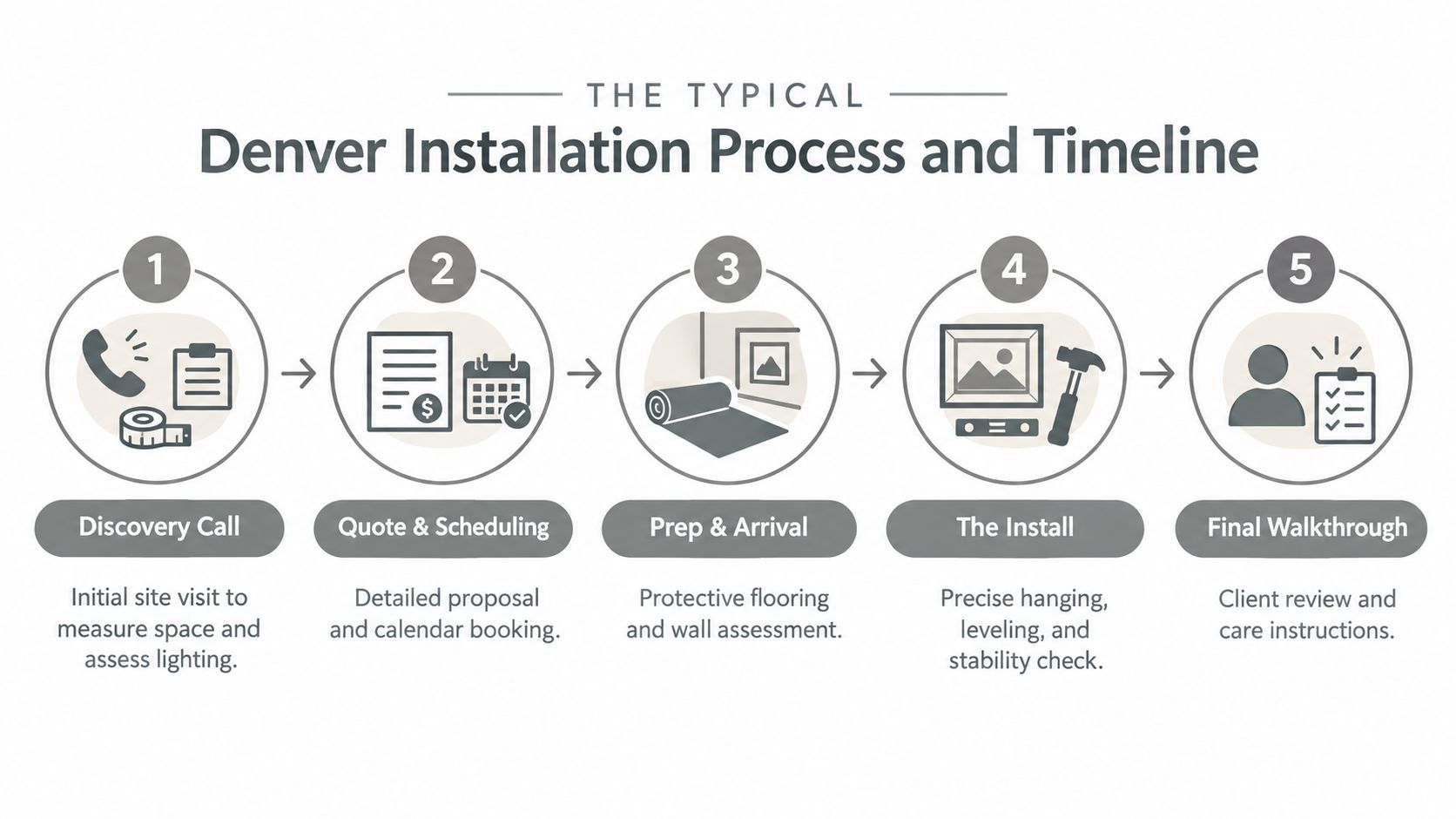
4. Installation and stability checks
The crew marks the layout, checks each mounting point, installs the selected hardware, lifts or carries the piece into position, and verifies level, alignment, clearances, and stability. Heavy sculptures and projecting objects need special attention to overturning, pull-out, vibration, and accidental contact.
A small residential placement may be completed in one visit. A hotel or corporate rollout can require multiple coordinated visits, especially when furniture, lighting, construction, or building access changes during the project.
The team should end with a walkthrough, care briefing, and sign-off. This is when the client confirms sightlines, spacing, lighting, labels, and any outstanding work.
Cost Factors That Shape a Denver Art Installation Quote
Installation pricing follows risk and labor, not just the number of pieces. Two projects with the same piece count can produce very different quotes if one involves drywall at standing height and the other involves masonry, a lift, fragile glazing, restricted access, or a heavy sculpture.
The main variables are:
Piece count and repetition: A grid of identical frames can be efficient once the layout is approved. Mixed sizes, unusual hardware, and changing sightlines slow the work.
Weight and dimensions: Large or heavy objects may require rated cleats, secondary restraints, extra handlers, lifting equipment, or engineered review.
Substrate: Brick, plaster, concrete, metal studs, and ordinary drywall each change drilling, anchoring, dust control, and repair risk.
Height and access: Stairwells, atriums, mezzanines, hotel lobbies, and high ceilings may require lifts, rigging, barricades, or off-hours work.
Lighting coordination: Adjusting existing track heads is different from supplying fixtures, relocating power, or coordinating an electrician.
Handling and logistics: Crating, pickup, delivery, temporary holding, storage, and return visits can be bundled or quoted separately.
Use the Denver art installation cost guide to prepare better questions, but insist on a project-specific scope rather than relying on a generic price label.
Project Type | Typical Piece Count | Cost Range (USD) |
|---|---|---|
Single residential hanging | One piece | Quote depends on weight, substrate, and access |
Mid-size commercial lobby | Multiple pieces | Quote depends on layout, height, scheduling, and documentation |
Heavy sculpture install with rigging | One or more large pieces | Quote depends on engineering, equipment, handling, and restraints |
The table is intentionally qualitative because a responsible quote needs site information. A provider who gives a firm figure without seeing the wall, confirming the artwork specifications, or discussing access is guessing.
Ask whether the estimate includes travel within the metro area, protective materials, hardware, lighting aim, disposal of packing, insurance documentation, storage, and a final walkthrough. Those exclusions are where an apparently inexpensive proposal can become expensive.
The cheapest quote is often the one that leaves the most decisions for the client to discover on installation day.
Safety, Substrates, and Lighting Decisions Behind a Clean Install
A clean installation begins with knowing what sits behind the finish. Drywall may conceal studs or blocking. Plaster may be sound, cracked, historic, or attached to a fragile lath system. Brick can be strong but uneven, while metal studs may need a different fastening strategy than the surface suggests.
Match hardware to the wall and the load
An installer should identify the substrate before selecting anchors. Light objects may use appropriate wall anchors, while heavier framed works often benefit from a rated cleat or French cleat tied into reliable structure. A projecting mirror or sculpture creates more than a downward load. It can produce pull-out and overturning forces when someone brushes against it or when vibration affects the mounting point.
In Denver's older homes, including bungalows and Capitol Hill properties, plaster deserves careful treatment. Drilling too aggressively can create cracks or loosen surrounding material. The installation plan should account for the wall's condition, not just its nominal material.
The installation record should identify anchor type, locations, substrate condition, rated capacity where applicable, inspection notes, and access constraints. That documentation helps the next technician avoid replacing a suitable system with a weaker shortcut.
Treat lighting as part of conservation
Room brightness isn't an adequate specification for artwork. Conservation guidance recommends approximately 50 lux maximum for highly light-sensitive works such as paper, photographs, textiles, and dyed materials, about 150 lux for moderately sensitive oil paintings, wood, and leather, and up to 300 lux for relatively stable stone, ceramic, glass, and metal objects. The Canadian Conservation Institute guidance on light exposure also recommends gallery-quality lamps with CRI above 90, Duv between -0.003 and +0.003, and R9 above 50.
Light damage is cumulative and irreversible. The installer should measure illuminance at the artwork surface, eliminate direct sunlight, control fixtures with dimming or occupancy settings where appropriate, and rotate sensitive works instead of leaving them permanently exposed.

Test the chosen lamps in place. Fixture aiming, beam spread, glazing reflections, wall color, and viewer position can change glare and measured lux even when the lamp's nominal output stays the same. The art installation lighting resource can help frame that conversation before the mounting plan is finalized.
Denver Permits, Public Art Rules, and the Compliance Gap
A private interior installation is usually a property-management and construction question. An exterior mural, sidewalk-facing sculpture, sign-adjacent artwork, or project on public land can become a zoning, right-of-way, transportation, accessibility, or agency-review question.
Denver's Public Art Program provides the city's framework for commissioning and installing artwork in civic spaces. It began in 1988 through Executive Order 92 under Mayor Federico Peña and became part of Denver's municipal code in 1991. The policy reserves 1% of the construction budget for qualifying city capital-improvement projects with design and construction costs of at least $1 million, provided the project includes finished space for human occupancy and is available for public view. The Denver Public Art Program reported more than $40 million invested, over 300 newly installed works, and a broader collection exceeding 400 original works by 2019.
Those figures matter to private clients because they show that Denver treats installation as part of civic construction, transportation, architecture, and urban development. The city has an established ecosystem for commissioning, fabricating, reviewing, installing, and maintaining public work.
Identify the project category before fabrication
Denver reviews new murals and other artwork through Arts & Venues before zoning determines whether a zoning permit is required. Work extending over a sidewalk, street, or alley may require a right-of-way permit. Projects in parks, recreation centers, streets, sidewalks, trails, and other public spaces can trigger separate agency reviews, and displayed work must remain structurally sound for the duration of its display.
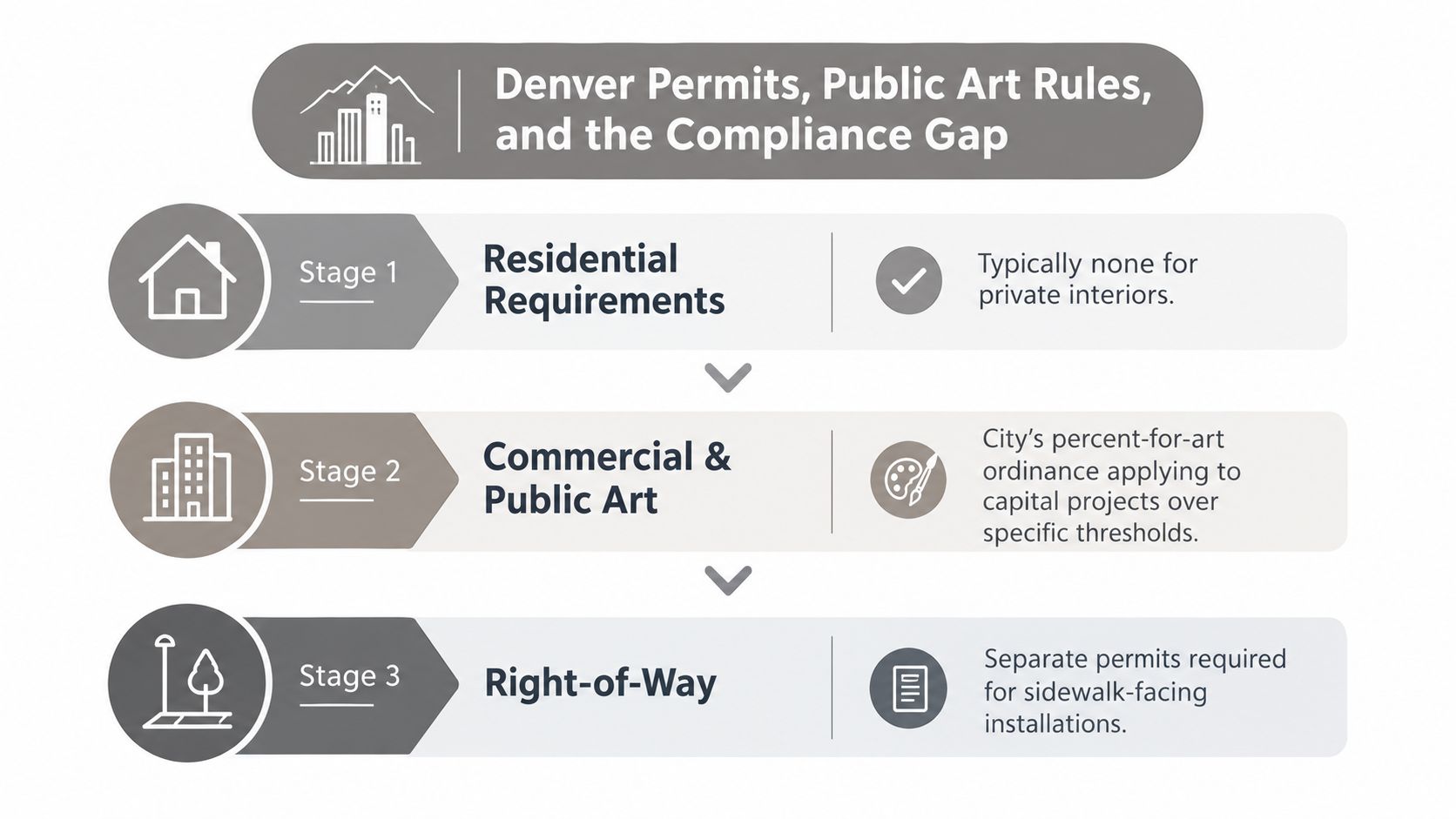
For a homeowner hanging a framed work inside a private room, formal public-art review usually isn't the issue. For a commercial lobby, hospitality venue, exterior wall, or artwork near a public route, the installer should ask who owns the land, who controls the façade, whether the object resembles signage, whether it projects into public space, and whether historic-district review applies.
The practical question is simple: What approvals, lead times, insurance, access plans, and structural documentation does this installation require? Installers who raise that question early protect the client from fabricating an object that cannot be installed as designed.
How to Choose the Right Denver Art Installation Provider
Don't choose an installer from photographs alone. A polished portfolio can show attractive results without proving that the provider can assess an old plaster wall, document a heavy-piece hang, protect art in transit, or coordinate with a commercial building.
Use this screening checklist before booking:
Request insurance documentation. Confirm coverage for artwork in transit, handling, and potential damage to walls, floors, finishes, and furnishings. General liability language alone may not answer the questions your insurer or property manager will ask.
Ask for the hardware plan. The provider should be able to explain how they approach plaster, brick, concrete, steel, metal studs, and drywall. “We use standard anchors” isn't a meaningful answer for a heavy or projecting object.
Confirm who takes measurements. Client-supplied dimensions can be wrong, especially when frames, cleats, crates, or irregular sculpture bases are involved. The installer should verify the site and the object specifications.
Check relevant local experience. Ask for references from a gallery, architect, designer, facilities manager, or property manager. Commercial work should include examples with access controls, documentation, and coordinated trades.
The Colorado art installation service overview is useful as a comparison point when evaluating the scope a provider may offer, including residential, commercial, heavy-piece, sculpture, mirror, and high-placement work.
Red flags that should disqualify a provider
Vague pricing: The quote doesn't separate hardware, access equipment, delivery, lighting, storage, or return visits.
No site visit: The provider prices a heavy, high, or unusual installation from photographs alone.
Unclear subcontracting: The company can't identify who will handle the artwork or operate access equipment.
No substrate discussion: The installer never asks whether the wall is plaster, brick, masonry, drywall, or metal framing.
No local reference: The provider avoids naming relevant commercial or gallery work.
For projects above roughly $1,500, obtain three bids and at least one local reference. That threshold is a practical buying rule, not a market statistic. On a heavy-piece installation, the lowest bid is almost never the best bid if it excludes the survey, correct hardware, insurance, access planning, or a stability check.
Booking Your Denver Art Installation and What Comes Next
Prepare the information that lets an installer price the actual job. Send room dimensions, clear wall photographs, artwork dimensions and weights, ceiling heights, frame depths, preferred placement, delivery details, and the date the space must be ready.
Also include constraints that can stop an otherwise workable plan. Mention HOA rules, building-management requirements, freight-elevator reservations, loading restrictions, historic finishes, engineering requirements, public access, and any planned furniture or lighting changes. If the piece is still with a gallery or shipper, provide crate dimensions and handling instructions.
What the first conversation should produce
A useful first call is a focused scoping conversation. It should establish whether the work is residential, commercial, gallery, exterior, or public-facing; whether storage or delivery is needed; whether a site assessment is appropriate; and which decisions require an electrician, engineer, property manager, or permitting agency.
A free on-site assessment may be available across Denver and nearby communities, including Aurora, Lakewood, Centennial, Englewood, Littleton, Thornton, Westminster, Broomfield, and the Boulder County border. Confirm service coverage and timing when you book, especially for projects involving oversized art or multiple locations.
Expect the quote window and scheduling lead time to depend on scope, artwork availability, access, and equipment. A single interior piece can move quickly when specifications are complete. A gallery, hotel, or public-facing installation needs more planning because fabrication, delivery, lighting, documentation, and approvals may run in parallel.
Colorado Art Services handles residential, gallery, and commercial installation work, including placement, layout, sculpture and mirror hanging, heavy-piece mounting, delivery, and storage. You shouldn't need one vendor for hanging and another for every handling step, but the proposal should still state exactly what the crew will and won't provide.
Send the artwork list and site photographs before the consultation. Then ask for a written scope that addresses substrate, hardware, lighting, access, insurance, delivery, storage, and the final walkthrough.
Colorado Art Services provides residential, gallery, and commercial art installation across the Denver Metro area, with support for layout, heavy-piece mounting, sculpture, mirrors, high placements, delivery, and storage. Visit Colorado Art Services to book a consultation and turn your artwork list, wall conditions, and deadline into a clear installation plan.
Comments