


Where to Hang Large Artwork: A Practical Placement Guide

You found the wall, bought the oversized canvas, and held it in place—but something still feels off. In many homes, the problem is not the artwork. It is treating a large piece like a small picture and positioning it from the frame’s top edge instead of its visual center.
The right placement begins with a museum-style center height, then adjusts for the furniture, lighting, and architecture around it.
Start With the Artwork’s Center
A reliable starting point is to place the artwork’s vertical center about 57 to 60 inches from the finished floor. Measure to the center—not the top of the frame. Height errors become especially obvious on large pieces.
Treat this as a foundation rather than an absolute. In a dining room, consider the seated sightline. In a hallway, check how the piece appears as someone approaches. Above a sofa or headboard, it should connect visually with the furniture instead of floating above it.
Establish the artwork’s center first, then adjust for the room.
Measure the Hanging Point Correctly
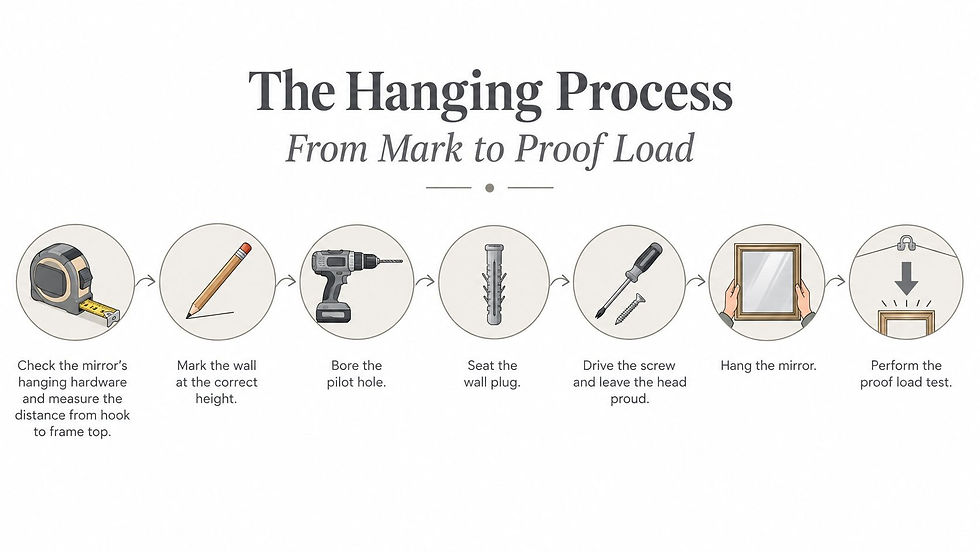
The wall mark should show where the hook, screw, or cleat will carry the artwork. Use this process:
Choose the center height. Begin with 57 inches or another height that fits the room’s sightlines.
Measure the artwork’s height. Divide that number by two.
Measure the hardware drop. Measure from the top of the frame to the loaded wire, D-ring, or cleat mounting point.
Calculate the wall mark. Subtract half the artwork’s height from the desired center height, then add the hardware drop.
For example, a 36-inch-tall piece has an 18-inch midpoint. If its center will sit at 57 inches and the hanging wire rests 3 inches below the frame’s top, the hardware mark should be:
57 − 18 + 3 = 42 inches from the floor
Measure hanging wire while pulling it taut. For two D-rings, measure the exact distance between them and use a level to transfer both points. Before drilling, outline the frame with painter’s tape and view it from the seating area, doorway, and walking path.
Choose the Best Wall
Correct height cannot fix the wrong wall. A strong location should:
Be visible when someone enters or sits in the room
Have a sofa, console, mantel, or headboard that visually supports the artwork
Avoid strong glare from windows and light fixtures
Stay clear of doors, chairs, coat hooks, and busy walkways
Avoid competing with a television, mirror, or other dominant feature
The wall above a sofa is often a natural focal point. Dining rooms require comfortable seated views, while entryways and hallways require extra attention to glare, traffic, and clearance. If the most obvious wall creates practical problems, choose a secondary wall.
Balance Artwork With Furniture
When artwork hangs above furniture, the two elements should read as one composition. A helpful starting point is to choose artwork approximately two-thirds the width of the furniture below it.
The gap above a sofa, console, table, or headboard will usually fall between 4 and 12 inches, depending on the size of the piece and the room. The goal is connection without crowding.
Do not raise artwork simply because the ceiling is high. Keep it near a comfortable viewing height and use a larger piece or intentional grouping when more wall coverage is needed. Oversized work also needs enough viewing distance for the eye to absorb the full composition.
Use Safe Hardware for the Wall and Weight
Drywall, plaster, brick, and concrete require different mounting systems. Identify the wall surface and weigh the complete framed artwork before choosing fasteners.
Attach heavy pieces to studs whenever practical. Otherwise, use anchors designed for the wall and load, with a generous safety margin. French cleats and two-point systems can distribute weight and prevent shifting.
Professional installation is the safer choice when artwork is:
Oversized, unusually heavy, or valuable
Mounted above a stairway, fireplace, bed, or busy seating area
Installed high on a wall
Going into plaster, masonry, tile, or another challenging surface
Intended for a public or commercial space
Check Lighting Before Installation
Review the wall in daylight and evening light. Direct sun may create glare or affect sensitive materials. For artwork under glass, keep fixtures outside the direct reflection path. For canvas, use an even wash instead of a harsh beam.
Final Placement Checklist
Before drilling, confirm:
The artwork’s center is near a comfortable eye-level height.
The piece feels connected to nearby furniture.
Its size carries enough visual weight for the wall.
Seated and standing viewers have comfortable sightlines.
The mounting system matches the wall and artwork weight.
Windows and fixtures will not create distracting glare.
The hardware marks—and the finished frame—are level.
If the artwork feels too high, lower it instead of tilting the frame. If it looks too small, consider a larger piece, a coordinated grouping, or a wall with tighter boundaries.
Professional Art Installation in Colorado
DIY installation can work for lighter artwork on a familiar wall. Large, heavy, high, or valuable pieces require greater care.
Colorado Art Services provides professional art placement and installation for homes, offices, galleries, and commercial spaces throughout the Denver Metro area and Colorado’s Front Range. Our team can evaluate the wall, calculate the correct mounting points, select appropriate hardware, and install your artwork securely and level.


Comments