


10 Hanging Artwork Ideas for Every Room
The most popular advice about hanging artwork is also the least useful: center the frame and put a nail in the wall. A frame can be perfectly centered and still look wrong if the room is tall, the furniture is low, the viewing distance is long, or the artwork needs to be changed regularly. Good placement starts with the space, sight lines, wall condition, artwork weight, and future use, not with a ruler alone.
These ten hanging artwork ideas solve different installation problems. Some create repeatable order for a large collection. Others make room for an evolving display, a heavy sculpture, a high stairwell, a corporate art program, or a collaboration with an artist. Across all of them, the practical sequence stays consistent: mock up the layout before drilling, establish a visual anchor, check lighting and viewing paths, and match the hardware to both the artwork and the wall.
For a single residential placement, careful preparation may be enough. Projects involving heavy pieces, high access, multiple rooms, art moving, or museum-quality handling may benefit from a specialist. Colorado Art Services provides precise residential and commercial art installation across the Denver Metro area and Front Range, including picture hanging, sculpture mounting, large-format layouts, and art storage.
1. Gallery Wall Grid Layout
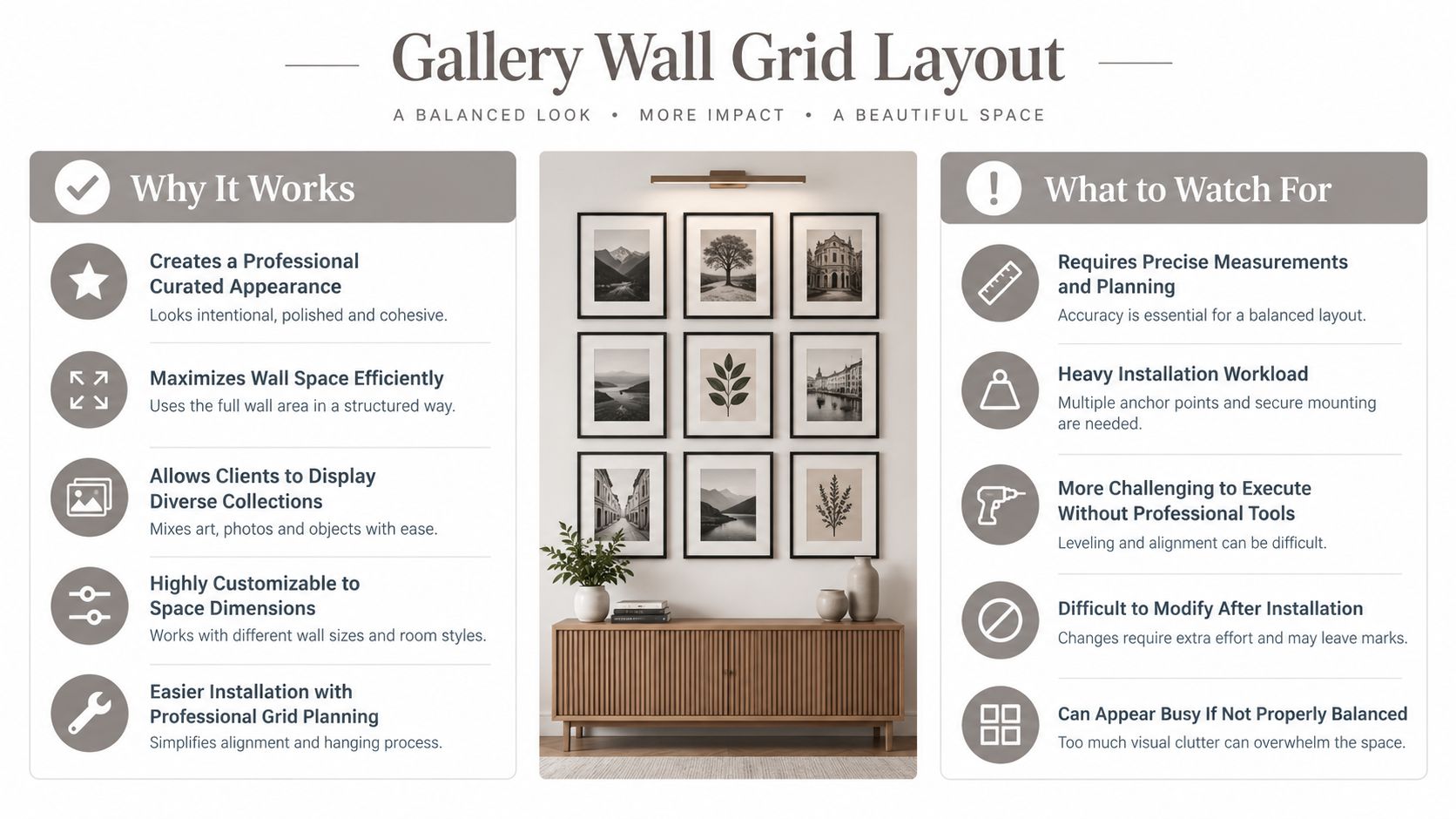
A grid works when your collection needs order, rhythm, and repeatable alignment. Matching frames or closely related artwork can turn a blank living-room wall, LoDo loft, corporate lobby, or gallery corridor into one coherent architectural feature. The strength of the format is consistency. The weakness is that even a small measuring error becomes obvious across the whole arrangement.
Build the composition on the floor first. Use paper templates or painter's tape to test the outside dimensions, then mark a centerline and work outward with a laser level. A chalk grid can help on a large wall, but don't rely on visual judgment alone once several rows are involved.
Make the grid serviceable
Use two secure hanging points where the frame and hardware allow it, particularly in a busy hallway where movement can shift a piece. Museum installation guidance recommends sturdy D-rings with wire attached before delivery, with the D-rings positioned about one-quarter to one-third of the way down the frame. The same guidance emphasizes keeping the work close to the wall and checking approved load and size limits before installation, as museum installation guidelines show.
Practical rule: Treat the entire grid as one composition, but secure every individual frame as its own object.
Photograph the finished arrangement before removing anything. That record helps when a frame needs repair or the wall is repainted. For detailed planning, gallery wall installation guidance can help you assess spacing, alignment, and wall conditions before drilling.
2. Museum-Quality Single Statement Piece Installation
A single large painting or sculpture needs more than an empty wall. It needs a clear viewing zone, controlled light, suitable protection, and hardware that won't allow the work to tilt or pull away from the surface. This approach suits a major artwork in an entry, a contemporary piece in a Denver headquarters, or a private gallery in Boulder or Cherry Creek.
The familiar eye-level starting point is the 57-inch rule, which places the center of the artwork about 57 inches, or 145 cm, above the finished floor. Christie's hanging guidance notes that modern and contemporary works are typically hung at 1.55 metres to the middle of the picture, a museum and Christie's display convention. It isn't a law. Furniture, architectural features, the artwork's scale, and the intended viewing distance can justify a different position.
Protect the piece, not just the wall
Use conservation-minded glazing where appropriate, such as UV-filtering glass or acrylic, and keep sensitive work away from direct sun, heat sources, and damp areas. A statement piece should also have documented hardware and installation information, so future handlers know what was used and how the work was supported.
A professionally lit painting can read very differently from one under a ceiling fixture. Aim the light to reveal surface and color without creating glare, and leave enough clearance for maintenance. For gallery-style placement advice, see how to hang artwork in a gallery.
3. Heavy Sculpture and 3D Art Installation
A wall-mounted bronze, welded steel form, stone object, kinetic piece, or mixed-media construction doesn't behave like a framed print. Its weight may sit away from the wall, its center of gravity may be irregular, and vibration or movement can stress a single fixing point. The installation starts with the building, not the sculpture.
Inspect the wall construction and identify studs, masonry, or another suitable structural element. A moisture meter can help reveal wall conditions in vulnerable areas, while a structural assessment may be appropriate for a particularly heavy or projecting work. Don't assume that a large anchor in drywall is equivalent to a connection into structure.
Plan the complete handling route
Measure doorways, corridors, elevators, stair turns, and furniture clearances before delivery. A safe mount can still fail as a project if the piece cannot reach the wall without striking a corner. Use trained riggers and proper lifting equipment for objects that need more than careful hand placement.
For kinetic work, allow for the object's operating movement and consider vibration isolation where it suits the design. Take high-resolution photographs, preserve engineering notes and hardware specifications, and coordinate insurance documentation before installation. Wall-mounted sculpture installation guidance offers a useful reference for projects where appearance and structural security must be resolved together.
A public-art setting in Denver or a private sculpture display in Vail may look effortless when finished. That result usually depends on concealed preparation, distributed support, and a route planned before the artwork arrives.
The installation team should also test the work after mounting. Check for movement, wall deflection, contact points, and interference with doors or walking paths before considering the job complete.
4. Salon-Style Eclectic Mixed-Media Wall
A salon wall is useful when a collection has personality but doesn't share identical frames, dimensions, or media. Combine paintings, family photographs, mirrors, textiles, small objects, and prints around a visual relationship rather than forcing them into a rigid rectangle. This can suit an artist apartment in RiNo, a creative office in Fort Collins, or an eclectic residence in Highlands Ranch.
Start with one anchor piece, then add supporting works by color, subject, frame weight, or material. A dark frame beside a small mirror may balance a light canvas on the other side. A ceramic object can interrupt a field of rectangles, but only if its mounting method and projection are safe for the location.
Keep asymmetry from becoming disorder
Lay every piece on kraft paper or cardboard and trace its outline. Move the templates until the composition feels balanced from the room's main entrance and from the seating area. Painter's tape on the wall lets you test the arrangement without committing to holes.
Create a visual link: Repeat a color, finish, subject, or material so unrelated pieces still belong together.
Vary the scale deliberately: Place smaller works near larger anchors instead of spreading every piece evenly.
Respect negative space: A little room around a mirror or dimensional object helps it remain legible.
Record the final layout: Photograph the wall straight on and keep the image with the artwork inventory.
The right spacing depends on the wall, furniture, and object scale. A salon display can feel more relaxed than a grid, but it still needs a clear center of gravity and secure individual mounts.
5. Floating Shelf and Art Ledge Display
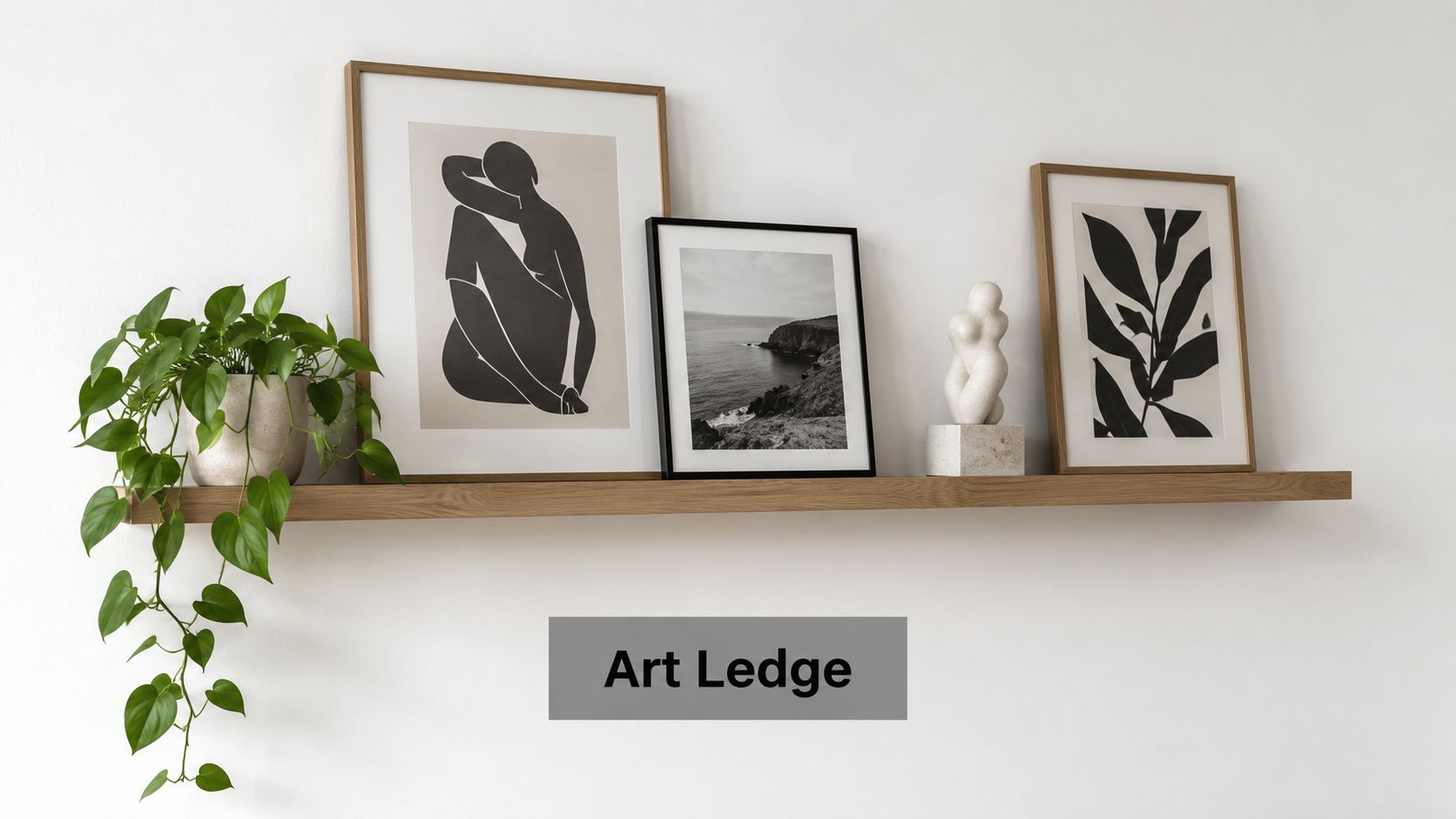
A picture ledge solves the problem of a collection that changes. Instead of drilling for every frame, install a shallow shelf and lean selected works, small sculptures, and objects against the wall. This works well in a rental apartment, home office, boutique retail space, or minimalist interior where the display needs to evolve without repeated wall damage.
The ledge still requires proper installation. Anchor it into studs where possible, or use a fixing system rated for the shelf, wall type, and intended load. Distribute objects along the length rather than concentrating heavy pieces at one end. Add discreet museum-quality adhesive putty or suitable stabilizers to reduce sliding and forward movement.
Design for rotation
Layer a larger frame behind a smaller one, then leave visible gaps so each piece can be read. A restrained ledge often looks more elegant than one packed edge to edge. Rotate seasonal prints or small works while keeping the anchor pieces in place.
The broader picture-hanging category includes rails, brackets, adhesive hooks, and gallery systems, with the market segmented by weight capacity and mounting format. One market estimate values the global picture hanger market at about USD 8.72 billion in 2023 and projects USD 14.60 billion by 2032, a 4.25% CAGR from 2024 to 2032, according to picture hanger market data. That growth reflects demand across homes, offices, galleries, and institutions, but it doesn't remove the need to match a system to the actual wall and artwork.
Check the shelf after rearranging, dust the objects, and keep fragile pieces away from exposed edges or areas where people brush past.
6. Corporate Branding and Commissioned Art Programs
A corporate art program needs consistency across more than one wall. A lobby, executive office, wellness room, conference area, and satellite location may each have different lighting and construction, yet the artwork should still support a recognizable environment. The practical solution is a documented program that connects acquisition, placement, maintenance, and rotation.
Begin with an artwork inventory containing dimensions, medium, condition, location, mounting method, and photographs. Add artist biographies or object descriptions where employee and visitor engagement matters. A local Colorado artist program may use commissioned work in a lobby, while a healthcare network may need quieter, clearly mounted pieces in patient-facing areas.
Build a repeatable process
Set display standards: Define acceptable hardware, glazing, sight lines, and access requirements.
Map the buildings: Record wall materials, studs, power, lighting, doors, and high-traffic zones.
Plan rotations: Schedule changes around maintenance and workplace operations rather than treating each move as an emergency.
Keep an archive: Store installation photographs, condition notes, invoices, and artist information together.
Invite useful feedback: Ask employees and facilities teams about visibility, accessibility, and practical problems.
A home office collection can use the same principle on a smaller scale. Choose home office wall art ideas for visual direction, then adapt the final layout to monitor placement, seating position, glare, and cable paths. A branded display should feel intentional, not like a series of unrelated purchases placed wherever an empty wall appeared.
7. Mirror Arrangements and Reflective Display Systems
Mirrors can function as artwork, spatial tools, and light modifiers. A single oversized mirror may anchor a narrow entry, while a cluster of smaller framed mirrors can add texture to a dining room, boutique, spa, or hospitality setting. The arrangement should respond to what the mirror reflects, not only to the wall it occupies.
Stand in the main viewing position and identify the useful reflection. A window, artwork, plant, or architectural feature can become part of the composition. Avoid creating an uncomfortable tunnel effect by placing mirrors directly opposite one another. Also check whether a mirror will reflect glare from a television, bright downlight, or unshaded window.
Secure reflective surfaces correctly
Mirror weight and frame construction vary widely. Use hardware designed for the object, confirm the wall can support it, and use two fixing points where appropriate to prevent rotation. A perfectly level mirror makes the surrounding room look more orderly, while a slight tilt can become noticeable because straight architectural lines appear in the reflection.
In a small Denver apartment, a carefully placed mirror may open the visual field without adding another framed image. In a restaurant or retail space, a cluster can reinforce the interior's material palette. The trade-off is maintenance. Fingerprints, dust, and edge damage show quickly, so leave enough access for cleaning and inspection.
Group mirrors by shape, frame finish, or scale, but don't make every element identical unless the room calls for a formal pattern. Reflection is the main subject, so keep the background visually useful.
8. Photography Exhibition and Series Installation
Photography works best when the installation supports the relationship between images. A travel series may need a clear sequence, architectural photographs may benefit from repeated framing, and a mixed collection may need consistent mats to keep different subjects from competing. The wall should help viewers understand the visual narrative.
Use acid-free mats, archival backing, and suitable UV protection for valuable prints. Keep frame profiles and mat colors consistent when the photographs belong to one series. If the work is intended for long-term display, protect it from direct sunlight and document the glazing and lighting specifications for future maintenance.
Give the sequence room to speak
Arrange photographs thematically or chronologically, then test the order from the distance where visitors will stand. Uniform spacing supports a calm exhibition feel. A more flexible arrangement can work for a home collection, but inconsistent gaps should look intentional rather than accidental.
Use focused LED lighting where possible and check for reflections across glazing before finalizing the angles. Add concise labels with titles, artist information, or location when the context improves the viewer's experience. A corporate photography wall may need a discreet sign system, while a private collection may need no text at all.
A photography installation in a Denver gallery and a travel series in a hotel corridor have different traffic patterns. In both cases, secure each frame, keep the lower edge clear of accidental contact, and make sure the lighting doesn't create more glare than illumination.
9. High-Placement and Architectural Integration
High walls, stairwells, cathedral ceilings, and spaces above doorways demand a different planning model. A piece that looks correctly scaled from the floor may feel lost when viewed from a landing or across a double-height lobby. High placement should be judged from every meaningful sight line, not from the ladder position alone.
Start by photographing the wall from the room, stairs, entry, and adjacent corridors. Mark the proposed location digitally or with a measured paper template before arranging access equipment. Larger artwork generally has more visual authority in expansive spaces, but it still needs a relationship to door openings, railings, windows, and furniture below.
Make access part of the design
Use appropriate scaffolding or lift equipment, and keep untrained people out of the work zone. Confirm that anchors connect with suitable structural elements, particularly when the work is large, heavy, or positioned over a circulation route. Schedule installation when the building is quiet if the equipment or exclusion zone would disrupt residents, employees, or guests.
A high placement in an Aspen entry may be viewed from a long approach, while a stairwell piece is seen at changing angles and distances. Those conditions affect orientation, glare, and the apparent center of the work. Once installed, photograph the position from the principal sight lines and retain the measurements for future inspection or removal.
The visual reward is architectural integration. The risk is treating a difficult-access wall like an ordinary picture-hanging job.
10. Custom Artist Collaboration and Bespoke Commission Displays
A commissioned artwork should be planned with its final wall from the beginning. The artist needs the room dimensions, lighting conditions, viewing distance, wall construction, delivery route, and any restrictions on projection or materials. The client needs a clear agreement about the concept, timeline, approvals, payment stages, installation, and future care.
This approach suits a custom mural, a large painting for a Cherry Creek residence, a mixed-media lobby installation, or a sculpture created for a resort. It also gives the artist a chance to design the work in proportion to the architecture instead of forcing a finished piece into an unsuitable space.
Write the installation into the commission
Define the brief: Record the space, purpose, palette, dimensions, materials, and essential site conditions.
Set approval points: Agree on sketches, samples, progress photographs, and revision rights before fabrication starts.
Coordinate logistics early: Confirm packing, delivery, art moving, access equipment, wall preparation, and installation attendance.
Document the agreement: Keep correspondence, payment terms, specifications, and condition photographs together.
Prepare interpretation: Create an artist biography and artwork information sheet if visitors or employees will see the work.
The artist may understand the visual intent best, while an installer understands wall loads, hardware, access, and sequencing. Bring both perspectives into the final site plan. A bespoke piece succeeds when the artwork and installation are treated as one project rather than as separate purchases.
10-Point Comparison: Hanging Artwork Ideas
Approach | Implementation complexity | Resource requirements | Expected outcomes | Ideal use cases | Key advantages | Typical drawbacks |
|---|---|---|---|---|---|---|
Gallery Wall Grid Layout | Moderate–High: precise measurements and alignment | Multiple frames, anchors, measuring tools, possible professional planning | Cohesive, rhythmic multi-piece display that maximizes wall space | Living rooms, offices, galleries showcasing many works | Professional curated look; customizable to space | Time-consuming install; difficult to alter; can appear busy |
Museum-Quality Single Statement Piece Installation | High: conservation standards and precise placement | Museum-grade hardware, archival materials, professional lighting and conservators | Dramatic focal point with high preservation standards | Luxury residences, corporate lobbies, museum-style spaces | Strong visual impact; protection and longevity of artwork | Significant cost; limited flexibility; may overpower room |
Heavy Sculpture and 3D Art Installation | Very High: structural engineering and specialized mounting | Structural assessments, rigging, load-bearing anchors, fabrication tools | Secure, dramatic three-dimensional focal points with long-term safety | Public art, corporate lobbies, sculpture gardens, luxury homes | Enables large sculptural works; engineered safety | Very costly; may require reinforcement; limited placement options |
Salon-Style Eclectic Mixed-Media Wall | High: complex composition and many attachment points | Diverse frames, mixed media, design expertise, many fastenings | Collected-over-time, highly photogenic eclectic display | Artist studios, creative offices, boutique hotels, eclectic homes | Deeply personal, evolving, visually rich and layered | Risk of chaotic look; complex install; hard to rearrange |
Floating Shelf and Art Ledge Display | Low–Moderate: anchoring shelves and arranging layers | Floating ledges/picture rails, studs, light hardware | Flexible, renter-friendly display easy to update seasonally | Rental apartments, rotating collections, home offices | Easy to update; fewer wall holes; forgiving placement | Limited weight capacity; dusting; less secure for high-traffic areas |
Corporate Branding and Commissioned Art Programs | High: cross-site coordination and professional curation | Budget for commissions, curators, installation teams, documentation | Cohesive branded visual identity and enhanced workplace experience | Corporate HQs, multi-location offices, hospitality chains | Strengthens brand, scalable, supports local artists | High upfront cost; ongoing curation and logistics complexity |
Mirror Arrangements and Reflective Display Systems | Low–Moderate: careful positioning and leveling | Mirrors of varied sizes, secure anchors, appropriate frames | Increased brightness and perceived space; functional decorative elements | Small apartments, retail, spas, hallways, hospitality | Expands perceived space; affordable focal option; versatile | Potential glare; fingerprints; requires precise placement |
Photography Exhibition and Series Installation | High: archival standards and controlled lighting | Archival mats/glass, UV-protective glazing, professional lighting | Museum-quality photographic presentation and cohesive narrative | Galleries, collectors, corporate displays, hospitality venues | Protects prints, consistent presentation, strong narrative impact | Costly framing and conservation; lighting and space demands |
High-Placement and Architectural Integration | Very High: specialized lifts, safety protocols, sight-line planning | Scaffolding/lifts, trained installers, structural anchors, safety equipment | Dramatic use of tall walls and architectural features | High-ceiling residences, lobbies, stairwells, grand entrances | Maximizes vertical space; creates striking architectural statements | High cost; maintenance/access challenges; safety liabilities |
Custom Artist Collaboration and Bespoke Commission Displays | High: project management, design revisions, artist coordination | Artist fees, timeline management, contracts, installation coordination | One-of-a-kind artworks tailored to client and space | Discerning collectors, hospitality, corporate identity projects | Unique, meaningful pieces; supports artists; strong storytelling | Long timelines; high investment; potential for vision misalignment |
Turn Inspiration Into a Secure Layout
Choose the format by the problem your room presents. A grid gives a collection repeatable order and works well when the frames share dimensions or visual treatment. A salon wall adds layered personality when the collection includes different media, frames, and objects. A ledge suits renters and collectors who expect to rotate pieces. A statement work creates focus, while a mirror arrangement changes reflection and perceived depth.
Photography is strongest when sequence and presentation matter. Corporate programs need an inventory, rotation plan, and consistent standards across locations. Heavy sculpture, high placements, and dimensional work require structural thinking, safe access, and hardware selected for the object rather than the appearance of the fastener. A custom commission adds another layer because the artist, client, building, and installer must agree before fabrication is complete.
The 57-inch centerline is a useful starting point for many modern and contemporary works, but it doesn't override furniture, architecture, or the way people use the room. A piece above a mantel, behind a desk, or within a decorative vignette may need to relate to the surrounding composition instead. Museums and galleries use standards to create consistency, but professional installation still accounts for object-specific and architectural exceptions.
Use this sequence before making holes:
Measure the wall and viewing zones: Record width, height, furniture, door swings, stair views, and normal standing or seated positions.
Inventory every piece: Note dimensions, frame depth, weight, medium, condition, and any conservation or glazing requirements.
Mock up the layout: Use paper templates, painter's tape, or a floor plan before transferring positions to the wall.
Check lighting and structure: Look for glare, direct sun, studs, masonry, moisture, power, and access constraints.
Select suitable hardware: Match the fixing method to the wall, load, frame construction, and desired distance from the surface.
Photograph the finished arrangement: Keep a straight-on record with measurements and installation notes for future moves or maintenance.
Don't use a decorative hook where a structural fixing is required, and don't let a visually pleasing layout hide an unsafe access plan. For heavy-piece mounting, high-access work, art moving, precise grid installation, or a complete residential or commercial project, you can contact Colorado Art Services for placement, installation, storage, and related handling across the Denver Metro area and Front Range.
Colorado Art Services offers residential and commercial picture hanging, grid layouts, sculpture and mirror mounting, high-placement installation, art moving, and secure art storage. If your hanging artwork ideas need precise placement, suitable hardware, or a coordinated multi-room plan, visit Colorado Art Services to discuss the space and collection.
Comments